
These posts originally appeared on my Facebook blog Rose of the Day.

Tuesday 2nd April
I have a failing ‘Goldfinch’ by my front garden gate. Although he only blooms once he is semi evergreen a useful winter trait. After this summer’s golden bloom, he will undergo ‘shovel pruning’, and the bed will be prepared with a large cardboard box for today’s rose to take his place. This is the Tea Noisette ‘Crépuscule’ who does have a slight reputation for being tender but the place for her is South facing. There are several in the Peter Beales nursery in Norfolk so they must be hardy enough to cope with the icy winds roaring across the flat countryside.
‘Crépuscule’, the name means twilight, aptly named as she has all the colours of the sunset. Small clusters of three to five shapely peach buds unfold into rather loose apricot yellow blooms. Satiny petals with darker backs with the outer ones often striped red. Fading through the sunset of butterscotch, buff, chamois and cream. She can be variable in her colours, darker in late summer and cool weather but paler in hot weather. Very repeat flowering to the point of being almost continuous. Seems fickle with her fragrance with some reports of little or nothing but others reporting intoxicating fragrance. She has always seemed very fragrant when I have seen her in the past.
Described as either a climber or a shrub requiring support, she produces long stems that arch nicely. Often grown as a ‘weeping standard’ rose which looks glorious in a formal garden. Smooth stems with few if any thorns with glossy slender dark foliage that is coppery crimson when young. Reaches around 3.75m high. Hardy USDA zone 6b-10a and widely available in most countries.
Twilight describes her colours perfectly, but it is an appropriate name in another way. Introduced in 1904, from the French nursery of Francis Dubreuil at the very end of the Tea Noisette period just before the ‘must have’ roses in your garden became the new Wichurana and Multiflora ramblers. This may be why she has always been not such a popular rose, she never got into her stride, often described as a rose deserving of more attention.
Photographed against the walls at Mottisfont Abbey Gardens in the simmering June heat last summer. Can’t wait for that heat to return although at the moment I am doing a small rain dance each morning as we have dry cold east winds here in Suffolk
I am looking forward to seeing this exotic ‘Crépuscule’ at my garden gate. My ‘Goldfinch’ will live on as cuttings from him grow in the blink of an eye, so I have several growing down on the horse fences.

Wednesday 3rd April
It must be exciting to clear an old garden full of scrub and brambles and discover a ‘lost’ rose as you do so. This happened to Vita Sackville-West and her husband Harold Nicolson when they tidied the neglected garden at Sissinghurst Castle in Kent in the late 1940s. Unsure of the correct name it was named ‘Sissinghurst Castle’ although Vita later identified the rose as ‘Rose des Maures’. Her identification is unsure, and many experts don’t support her claim so you will find this little Gallica rose as ‘Sissinghurst Castle’ in all nursery catalogues.
Not a large rose at all, around 1m, with rather upright growth. Small clusters of feathery sepalled buds, usually around three, held up above the foliage. These buds are deep claret and unfold to a rather untidy double bloom. the petals are also claret coloured but with paler edges and much paler lilac magenta backs. A joy to watch as she unfolds her jewel like blooms. There is also an attractive mottled effect on the petals with the occasional white flash. A golden stamen crown which the bloom in this photograph is just shyly hiding with a couple of petaloids. Sweet and light fragrance. Single bloom period in June.
Slender stems with few thorns, long elegant, pointed leaves. She grows easily from cuttings and suckers to a small thicket when she is on her own roots. Doesn’t mind shade, poor soil or neglect but do cosset her to get the best of those blooms. Reasonably disease resistant. She tends to get a touch of late rust with me but not the dreaded black spot. Hardy USDA zone 4b-8b. Seems to be widely available across the world.
She grows still at Sissinghurst Castle in a long bed I believe. One of the most popular National Trust properties so timed tickets on busy days. A dull rainy Wednesday morning is a suitable time to avoid the many crowds.
A charming rose for the smaller garden. I grow her close to a wooded area where she has happily started to wander on her own roots.
Thursday 4th April
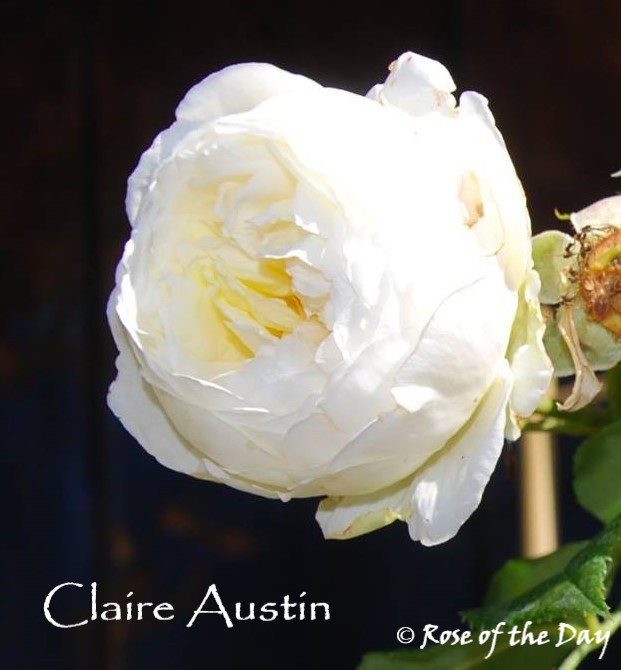
A rose today that has yet to endear herself to me as she has been rather an underperformer. ‘Claire Austin’ a David Austin climber introduced in 2007 with undisclosed parentage. I bought her at an end of season container sale in 2015 where she looked like a healthy plant. In three summers, she has reached just a miserly 1.2m and not too much wider. On a sheltered south facing wall in a bed where everything else romps away. She has another chance this summer then I will move her to see if a new neighbourhood prompts her alleged vigorous growth.
Plump creamy lemon buds with pink streaking open to the classic David Austin globular cupped blooms. These are the most delicious vanilla ice cream colouring with the signature strong myrrh fragrance. However, with me, she doesn’t produce the promised abundance of bloom, yet! Tendency to ‘ball’ in damp weather. When she does condescend to give me blooms, they last a maximum of two days before the petals decorate the flower bed at her roots. I can say though, despite the poor growth she shows excellent disease resistance which is a plus. She looks such a spindly miserable thing!
Named for David Austin’s daughter Claire who also has a garden nursery, but one specialises in hardy plants, predominantly irises, peonies and daylilies.
Do I have a dud plant or is she just in the wrong spot? If you grow her, please comment.
Friday 5th March
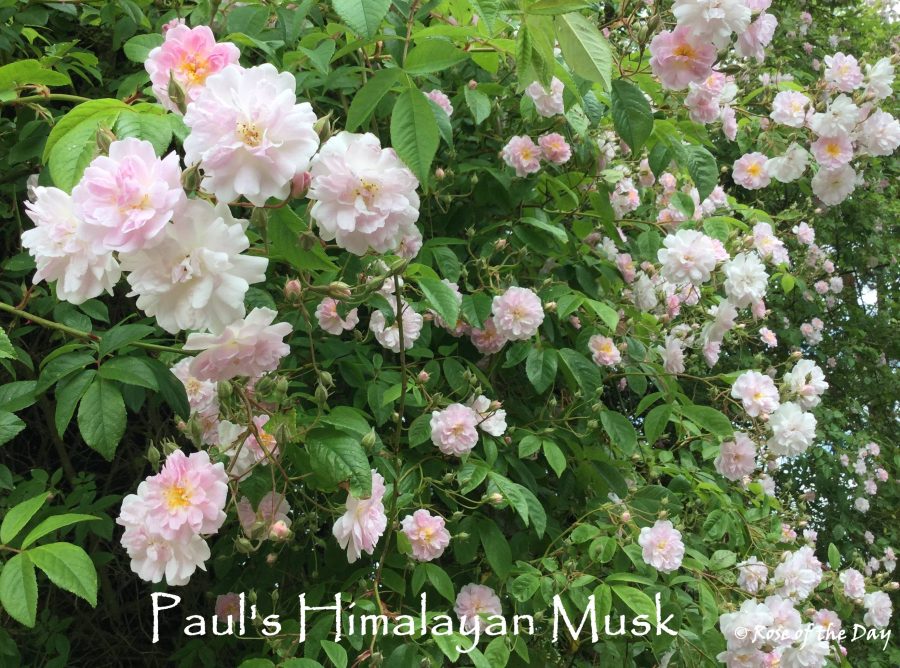
A rose today that needs to come with a health warning. She is large, enormous really so only suitable to grow through a tree in a large garden, the enigmatically named ‘Paul’s Himalayan Musk’.
Enigmatic as this is a modern rose of unknown breeding but one that doesn’t have Rosa moschata nepelensis, a true Himalayan Musk, in its parentage. The botanists consider ‘Paul’s Himalayan Musk’ to be a R. multiflora or filipes descendant. George Paul introduced three roses in 1916: Paul’s Himalayica, an R. brunonii hybrid, Paul’s Tree Climber, hybrid R. brunonii or R. himalayica, Paul’s Himalayica alba Magna. One of these is likely to be the rose rediscovered in the 1960s and now known as ‘Paul’s Himalayan Musk’.

You can see from the photographs the size of this rose. She grows at the end of my drive as it opens out in the yard in front of the house and was planted around 1984 and grows up, over and through a clump of Ash trees. Sadly, these trees are beginning to suffer from Ash Dieback caused by the fungus Hymenoscyphus fraxineus so she will lose her support. I guess when the trees are felled ditto the rose and then we will see. If she regenerates, we will have to build some enormous frame but there is a pond behind so not so much space for foundations. I can see that I will need to plant another, she grows well from cuttings. Her maximum predicted height is around 10m so needs careful placing.
Long thin flexible stems hang down producing copious clusters of small elegant pinky white buds that open to these charming blush pink loose semi double blooms. Each one hanging on a tiny thread of a stem. The petals have yellow bases giving each bloom a real glow surrounding the golden stamen corona. Always alive with bees, humming happily as they harvest the pollen and nectar. The pink blooms fade to white and then drop creating a bridal shower underneath. The fragrance is sumptuous. Her height means the fragrance is caught by the lightest of breezes and spreads across our garden into the house. A truly stunning sight for around three weeks before she gently shakes her last blooms away and retires for the year. A crop of small dark hips appears in the autumn but is not so spectacular.
The narrow pointed foliage is semi evergreen even in the teeth of icy easterly gales and thankfully very healthy. Spraying her would be impossible! Hardy USDA zone 4b-9b. Widely available.
I will miss her when the Ash trees have to go, they are slowly dying inch by inch. It’s always an exciting moment when we spot the first blooms on the top of her branches – ‘the Himalayan is off!’ and then it’s summer again.
Saturday 6th April
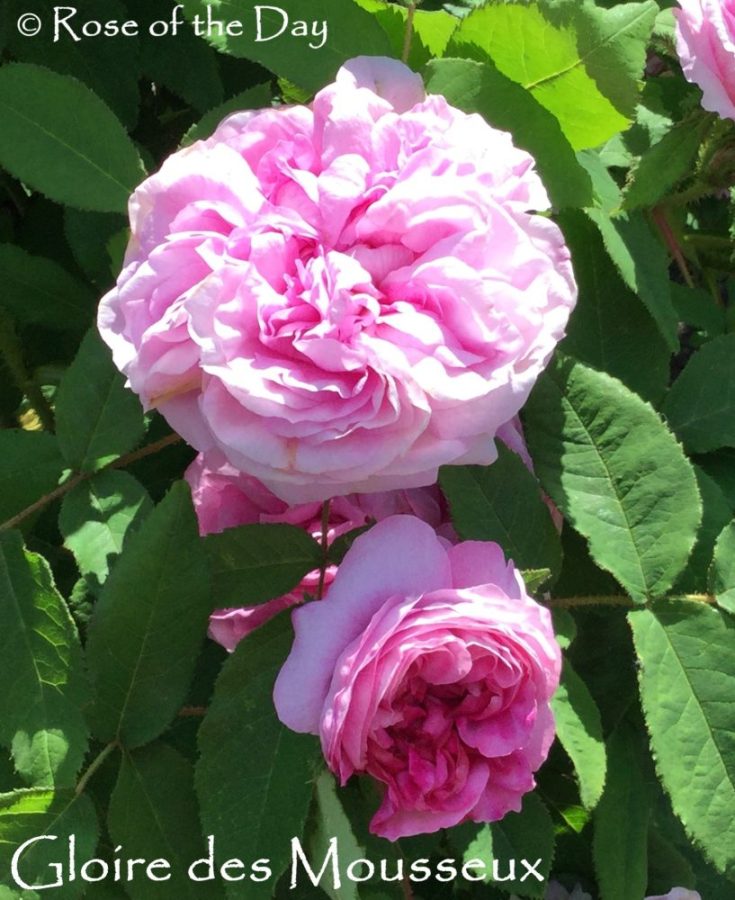
Possibly one of the most widely grown Moss roses today, the fabulous richly coloured ‘William Lobb’. Just a couple of aliases for this one ‘Duchesse d’Istrie’ and ‘Old Velvet Moss’. Originated from the French nursery of Laffay and introduced in 1855 by Portemer as ‘William Lobb’. Laffay also bred the Moss ‘Gloire de Mousseux’ featured on 31st January.
Named for William Lobb a Cornish plant hunter responsible for collecting seeds of the ‘Monkey Puzzle’ conifer. This tree had been introduced earlier in 1795 but William’s employer James Veitch wanted to exploit what he considered to be a highly commercial tree. Rather too commercial as one sees this very large tree planted in all sorts of unsuitable places such as a small suburban garden! William was a prolific plant hunter and introduced many shrubs and plants as well as the Monkey Puzzle. Too many to list here but the Passion flower and the Wellingtonia pine are two well-known finds
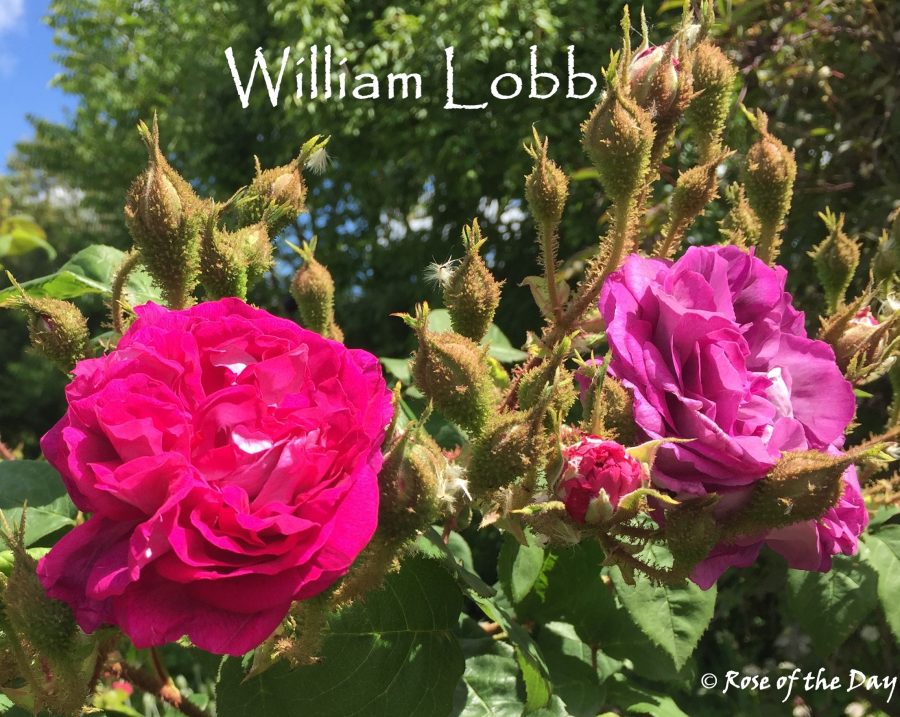
‘William Lobb’ is a rose of astonishing colour. The well mossed soft green with just a tinge of purple buds opens to a dark purple semi double bloom with an untidy but charming muddle of petals in the centre. The petals have a paler pink lilac back giving that nice contrast of colour as he unfurls his bloom to reveal golden stamens surrounded by white petal bases. Just beautiful! Fades quietly through lilac, lavender, mauve, slate grey blue. Heavy fragrance and of course if you brush the moss, you have the balsam perfume as well. A profuse blooming rose so you have all these colours every day for around three weeks and then he goes to sleep for the rest of the summer. Perks up a little in the autumn with round orange bristly little hips.
One of the tallest Moss roses, a lofty 2.5m high with a 1.5m spread so not one for the smaller garden. Vigorous growth habit with long mossy stems with a fair few thorns. He is a sprawler though and needs to be grown by a wall or in a support frame, pillar or trellis. Foliage has serrated edges and is a soft mid green. Rather susceptible to mildew so watch him in the late summer or damp conditions. Hardy USDA zone 4b and warmer. Widely available.
I planted him only three years ago, but he is already a sizeable rose. I pull the long stems down with a weight so one gets the fabulous blooms all along the stems. A rose well worth growing if you have the space. Ideally next to a repeat flowering rose to disguise him once he has completed his summer burst of bloom.
Sunday 7th April
The county of Norfolk is quite rightly proud of its son Admiral Lord Nelson. Born in 1758 a small weak baby not expected to survive he confounded expectations by hanging onto life. What a life, joining the Navy at the age of twelve he rose through the ranks. Given command of the Agamemnon in 1793, proving to have exceptional strategic battle skills he was at the forefront of Naval battles until his death at the Battle of Trafalgar in 1805. Losing an eye, an arm, but gaining a mistress Emma Hamilton on the way! Driving over the county boundaries on the major roads the signs read ‘Norfolk – Nelson’s County’.
Peter Beales was also a Norfolk man and likewise, his daughter Amanda was born and raised at his rose nursery. Today’s rose is one of Amanda’s shrub rose ‘Horatio Nelson’. Introduced in 1997 with the Delbard Floribunda ‘Centenaire de Lourdes’ as the seed parent and the lovely ‘Aloha’ providing the pollen.
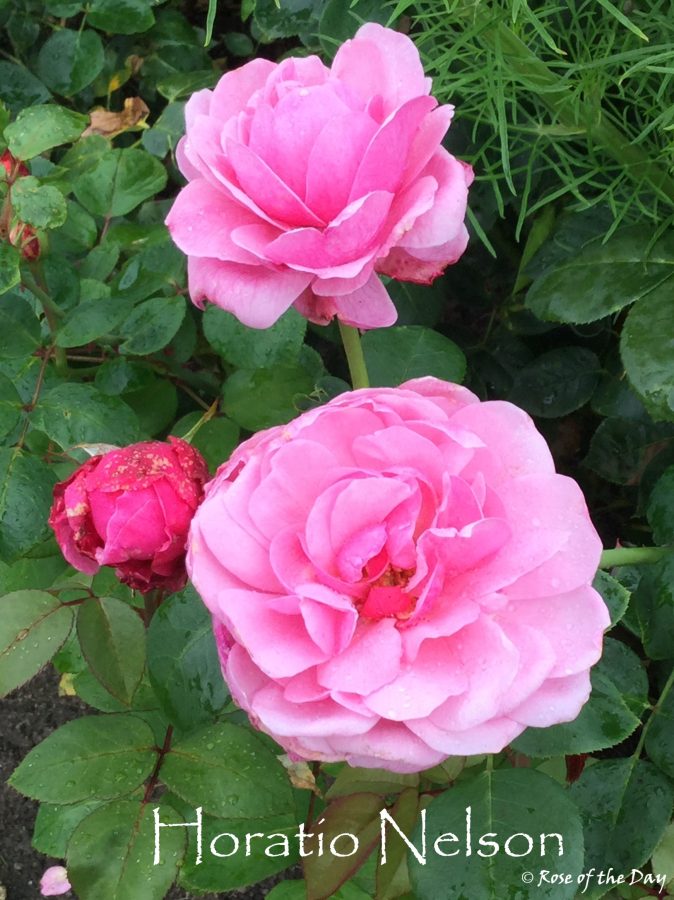
The Delbard genes give ‘Horatio Nelson’ his strong intense fragrance and the glorious colour must come from ‘Aloha’. Plump dark pink buds lighten as they unfold into a large full petalled mid pink bloom. The outer guard petals are of a lighter colour intensifying the darker centre. Described by Peter Beales as an old fashioned style with an attractive rosette petal formation. Reliably repeat blooms into late autumn.
Medium sized at 1.2m x1.2m so useful size for all gardens he is a healthy vigorous rose. Good glossy foliage and hardy USDA zone 4b-9b.
This one is available outside the UK with European, Canadian and New Zealand nurseries listed. Perhaps someone can comment on his availability?
A good rose for your garden particularly if you have an interest in Naval history and if like me you descend from good Norfolk stock.

Tuesday 9th April
One to wake you up this morning! An extremely eye catching rose – ‘Super Trouper’.
Bred by Gareth Fryer who has produced a substantial number of Floribunda roses, around 190. His lovely ‘Let’s Celebrate’ was Rose of the Day on the 21st of December last year. ‘Super Trouper’ was introduced in 2009 by Fryer’s Nurseries. The name? Well, I guess that Gareth Fryer is an Abba fan!
Winner of the Novelty Rose of the Year in 2010 and one can certainly see why. Clusters of fiery sunset orange buds open to an initially blazing bloom, but she softens her colouring as she opens. The combination of pale buffy orange petal backs, the slightly red tinged guard petals and the paler apricot centre make for a striking rose. Repeat flushes of bloom and can be almost continuous in some climates. Fragrance is eclipsed by the colouring I am afraid, just a mild perfume.
A rose on the small side, around 85cm high, would be an ideal container candidate. She will need carefully placing though not to clash with other roses. The second photograph shows her cleverly placed against a quiet background of shrubs. She doesn’t detract from the other plants but still lights up the garden.
Good glossy dark foliage which is healthy. Compact and tidy growing. I cannot find a hardiness score, but I would assume USDA zone 6b-9b. Do comment if you grow her outside of these zones.
I am not too much of an orange rose fan so she wouldn’t be a rose for me. For those of you with those sunset beds who love these hot colours, she is perfect!
Wednesday 10th April
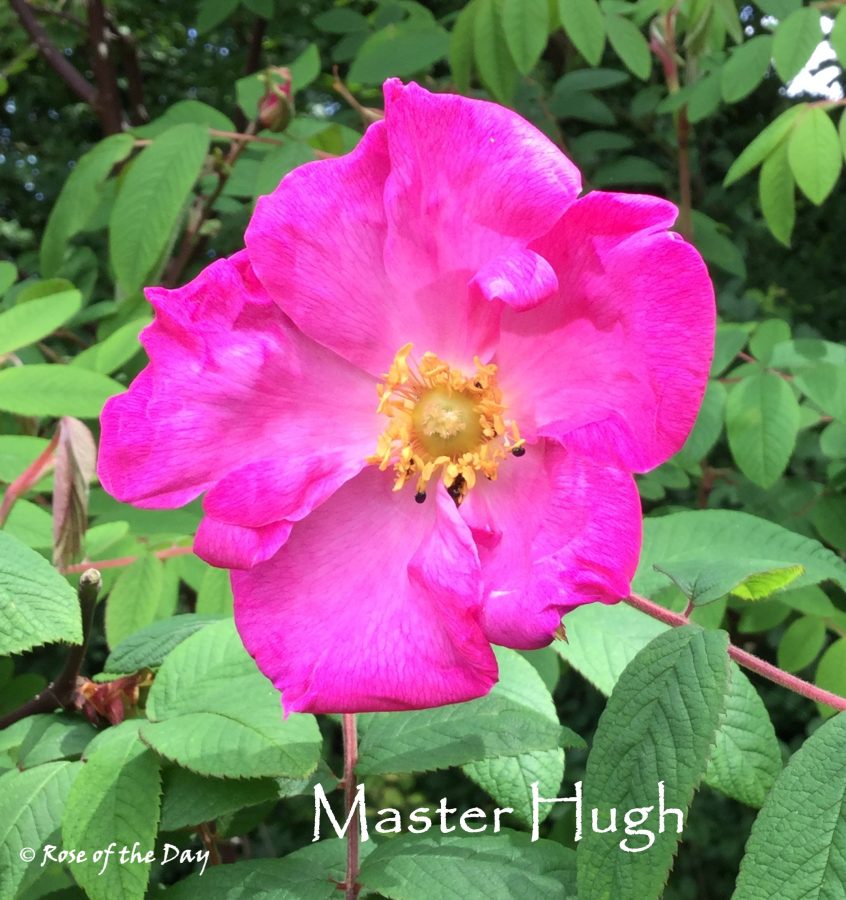
A wild Wednesday rose whose seeds travelled from the Himalayas to Norfolk, nurtured in the garden of a great twentieth century plant hunter and introduced in 1966 as ‘Master Hugh’.
The plant hunter was Maurice Mason, a west Norfolk farmer who farmed just to fund his plant hunting expeditions, and his magnificent gardens. Maurice introduced a vast number of plants, particularly the Sorbus family, was chairman of the RHS tender plants committee and was awarded the Victoria Medal of Honour (VMH). This is awarded to British horticulturists whom the Royal Horticultural Society Council considers deserving of special honour by the Society.
‘Master Hugh’, named for his son, is the only rose Maurice introduced. A Hybrid Macrophylla from seeds collected in China by a famous trio of Himalayan plant hunters Stainton, Sykes and Williams. This is not a rose for small gardens as he can be a lofty 4.5m and around 2.5m in width. Nor is he a rose for hot and dry areas, his Himalayan ancestry means he is happier in cool even cold damp climates.
In late spring small clusters of buds unfurl into large mid pink single blooms with a magnificent golden stamen corona. A hint of fragrance and nothing more. I have noticed his bloom has reduced as our spring weather is now warmer and dryer. Rather un rose like sparse foliage, looks almost like rowan leaves. Deeply veined matt leaflets, often seven or nine on the leaf stem. Completely disease resistant though. I rarely prune him as he grows up on a bank with masses of space. Hardy USDA zone 4-10 but I fear that 10 would be way too hot and dry for this rose.
Just a single flush of bloom and then in the autumn he rewards one with the most extraordinary hips. Large chestnut brown with a blueish bloom and with long reddish brown fleshy sepals. They remind me of lobsters. If you have friends into flower arranging, they love these unusual hips for their floral creations.
‘Master Hugh’ is not going to suit a small garden or a formal rose garden. He is an interesting landscape rose suitable for wilder areas of a semi natural garden where he can grow tall and wide. If you have such a garden in a cool damp climate do consider him, he won’t disappoint.
Thursday 11th April
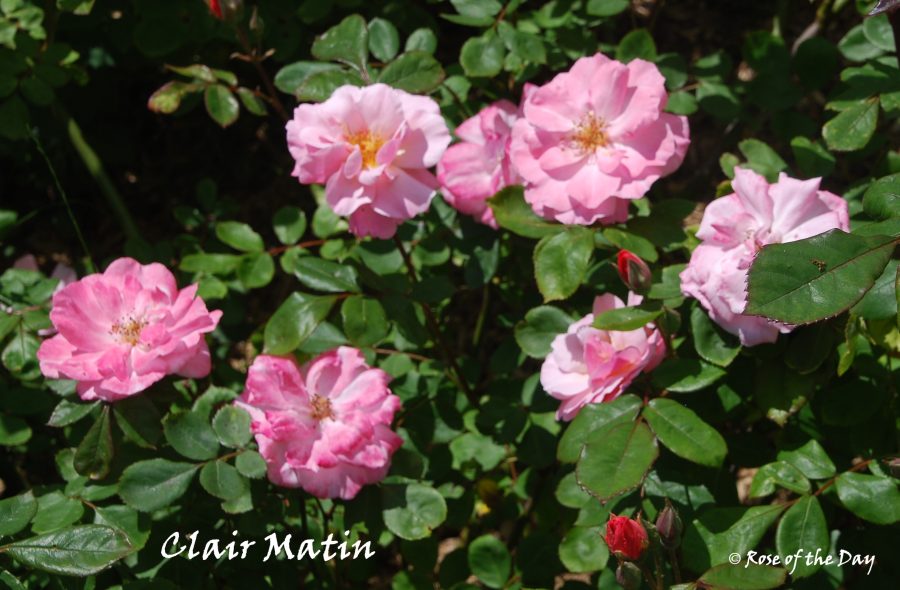
A climbing rose not yet in my garden but one that will be planted this winter, replacing a rather straggly and elderly ‘Amy Robsart’. I want an almost continuous blooming climber, poor Amy has just a single flush of bloom. A lot of consideration, shuffling notes, and looking at photographs before I settled on ‘Clair Matin’.
From the premier French rose breeders Meilland, this rose was bred by Marie Louise Meilland and introduced in 1960.
‘Clair Matin’ translates as ‘morning light’ an appropriate name for this dawn pink rose. Vast clusters, up to forty, lipstick pink pointed buds which open out into salmon pink semi double cupped blooms. Fades to a pale sunrise pink as the bloom matures, revealing the bee friendly golden stamens. Practically continuously in bloom, she starts early in the season and just keeps on going, one of the most freely flowering of all roses. Sweet light fragrance.
She can be grown as a large shrub reaching around 2m. As a climber though she extends those prickly stems up to 4m. A little bit of a diva as she prefers good soil and some care to give her very best. Dark leathery foliage but her disease resistance is also variable, she can suffer both mildew and blackspot. Whenever I write that comment I get lots of remarks from page followers that their rose is very healthy. That. of course, is good to hear but in some areas in some years, this is a rose that will need some fungicide.
Widely available. Hardy USDA zone 6b-9b. She has a rating from the American Rose Society of 8.5 placing her in the ‘very good to excellent, one recommended without hesitation’ category. These ratings are based on returns from rose growers in the States.
Friday 12th April
Today we have a rose with what I think is one of the most unappealing names given to a rose the dwarf polyantha ‘Baby Faurax’. Despite this name, she is a very interesting little rose.
Bred by Leonard Lille who had a seed company in Lyon where he sold rose seeds of the ‘Lawrenceana’ (small China roses) and ‘Polyantha’ groups. The parentage of ‘Baby Faurax’ is unknown but one could assume this rose was grown from seeds from Lille’s company. Lille bred around fifteen roses, most now extinct, and introduced ‘Baby Faurax’ in 1924.
Faurax appears to be a relatively common Belgian surname and there was a nursery with this name somewhere in Belgium in the early twentieth century. There are a handful of other roses dating from this time which include this surname, for example, Elisabeth Faurax. I would pronounce the name ‘far row’ as it is French and not Flemish. I doubt it is ‘four rax’ as I have heard. It’s not the baby food Farex either! I guess amongst you all someone knows the correct pronunciation.
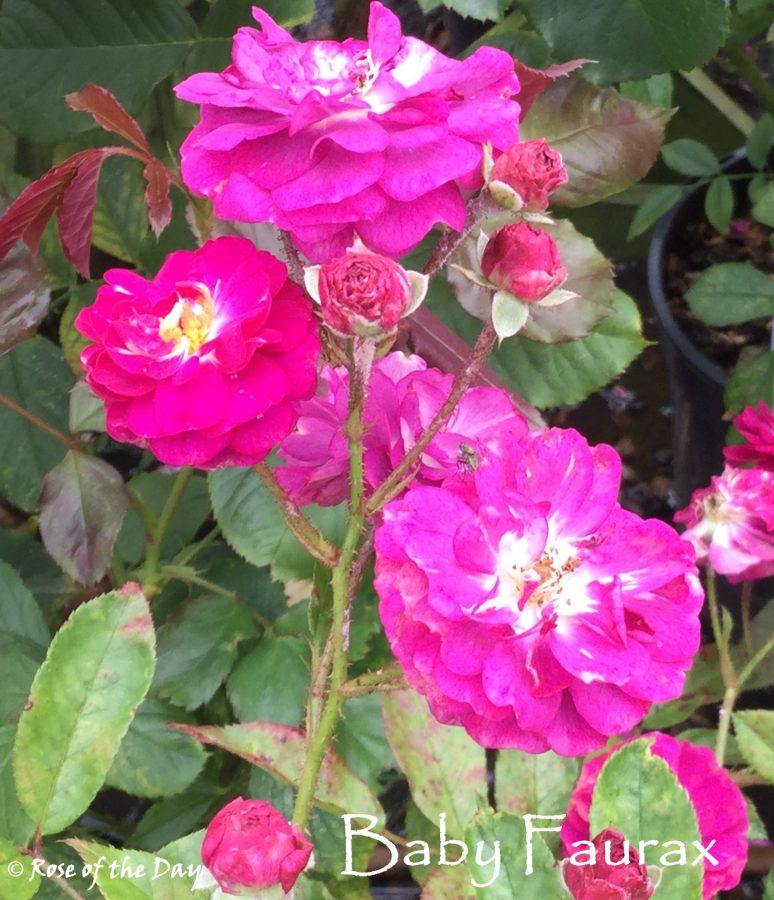
However, she will forgive you for mangling her name. She is an accommodating little rose, only around 50cm on her tiptoes, so you can pop her in her container or snuggle her in a small space. Produces fairly large, for her size, clusters of mini bright pink buds. These open to what is reputed to be the ‘bluest’ of all roses. However, she is more a purple to me than a blue, but this colour is highly variable depending on your climate and soil. She can be pinker, violet, lavender even slate blue. The petals with their white base and paler backs create an attractive little, 3cm, double bloom. Reputed to have the fragrance of grapes but I have never got a hint of perfume from her. Blooms in flushes throughout the summer. Healthy and hardy USDA zone 5b-10b. Graded 8.0 with the American Rose Society ‘a solid to very good rose. It is good features easily outweigh any problems. Well above average’.
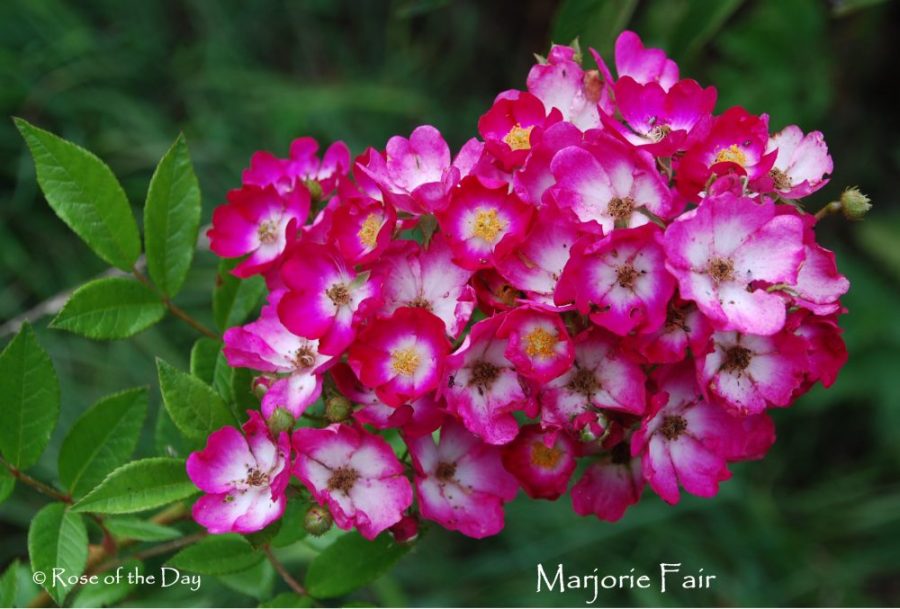
This is a rose that has been used very successfully in breeding programmes with 102 descendants. ‘Marjorie Fair’ a first generation child who featured on this page on 24th January this year.
If you want that intriguing colour and lack the space for the similar coloured rambler ‘Veilchenblau’ then this pretty little rose is for you.
Saturday 13th April
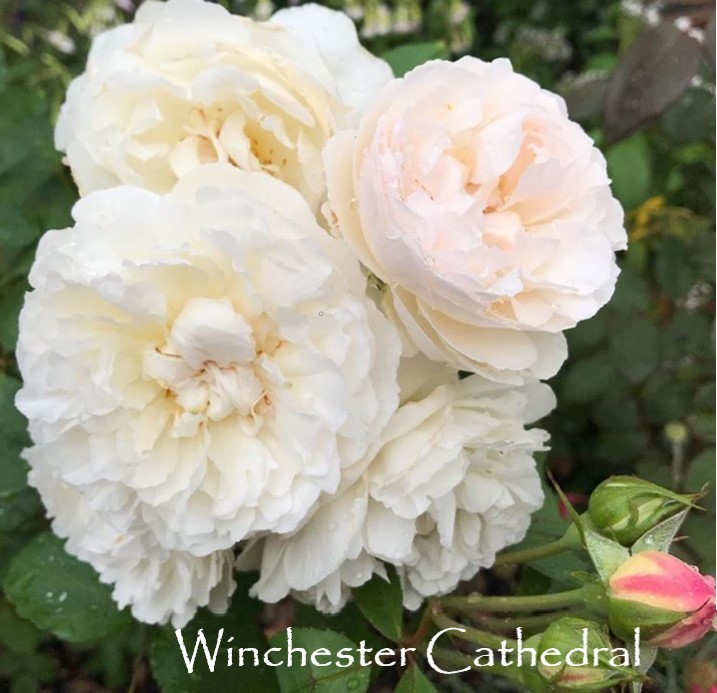
Today’s rose , the David Austin rose ‘Winchester Cathedral’.
Many of you will be familiar with the pink DA rose ‘Mary Rose’, and she produced a pure white sport, this was named ‘Winchester Cathedral’ and was introduced in 1988. She is a little bit unsure at times whether she should remain white or perhaps flirt again with being pink or even have a bit of both in a bloom. The clusters of globular pink streaked buds open initially to a soft baby pink which quickly fades to a pure white unless she is in a colour dither. Very full petalled with a charming loose rosette arrangement, although I say pure white there is a touch of green in the petal bases. David Austin remarked that this rose is one of the best white roses he bred although one could argue that this rose, being a sport, bred itself. Steadfastly repeat blooms and she has a medium fruity fragrance to complete the picture.
Around 1.2m high with somewhat twiggy growth but she makes a good shape. Good shiny foliage with good disease resistance. Hardy USDA zone 5b-10b. Scoring a 7.9 with the American Rose Society ‘a solid to very good rose. It is good features easily outweigh any problems. Well above average’.
Named for the Winchester Cathedral Trust, a registered charity that helps the cathedral with renovation and development projects. This cathedral in common with other British cathedrals has a daily running cost in the region of £10,000. Initially, a percentage of the sales went to this Trust, but she is now out of the protected breeders’ rights time frame, so I guess this no longer happens. Being out of protected breeders’ rights does mean that you will find ‘Winchester Cathedral’ propagated and sold by other nurseries although David Austin still has her in the current catalogue.
Certainly, a much better rose than last Thursday’s ‘Claire Austin’. If you want a repeat flowering white rose, then ‘Winchester Cathedral’ fits the bill.

Sunday 14th April
A rose of several names again! A Hybrid Tea from the German nursery Kordes – ‘Beverly’. Known in Britain as ‘Pink Perfection’, ‘Perfume Passion’ in Australia and South Africa and France has her as ‘Sophie Davant’. Her exhibition name is ‘Beverly’ and the ICRA appellation is KORpauvio so that last one will get you the correct rose.
Introduced in 2008 as part of Kordes Eleganza collection she has a stash of awards including a 2012 Gold Medal, Best Rose in Trials, Best Fragrance and Best Hybrid Tea in Australia. They clearly love her down there! However, in the States, she only achieves a 7.8 in the American Rose Society grower’s evaluation – ‘a solid to very good rose. It is good features easily outweigh any problems. Well above average’
A strong growing rose that produces typical HT elegant buds of a greenish white streaked pink. Opens white and touched with pink but the pink deepens as the bloom matures finishing with a deeper pink centre with paler guard petals. Very full petalled, she looks more like a classic old fashioned rose rather than an HT. Repeat blooms throughout the summer. Some reports that she is a fair weather rose tending to ‘ball’ in damp weather.
Strong zesty fragrance. I couldn’t resist adding her fragrance description from the Kordes website. One doesn’t think of the Germans as being quite so poetic – ‘The scent is intense, yet fresh. The top notes of citrus are present even when the bud is just opening. When the flower is fully open the wonderful heart notes of fresh litchi and white peach predominate with the fragrances of pear and plum also being present. The earthy base notes of patchouli and fresh myrtle are faint but complete the experience.’ Mmm OK!
Rather variable in height depending on your climate. In the UK she will be around 1m but easily 2m in warmer countries. Tall growing habit with good semi glossy foliage. Reputed to be very disease resistant. Hardy USDA zone 5b-10b.
I don’t have this rose in my garden but if you grow her perhaps you could comment on the damp weather problem with the blooms? Otherwise, she looks like a very worthy rose.
Tuesday 16th April
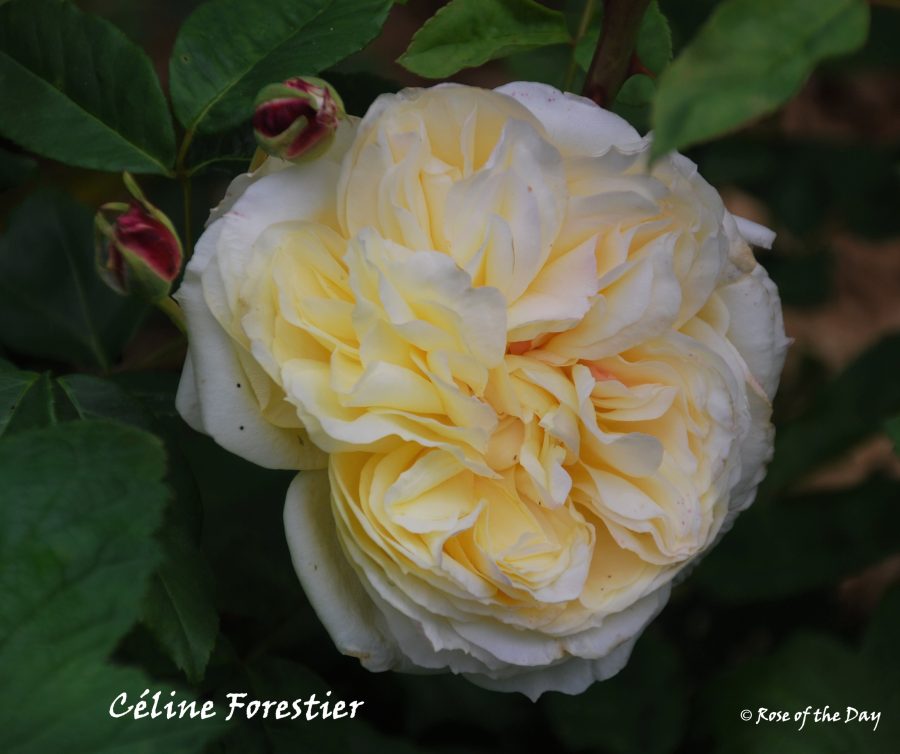
One of the most popular and prettiest of the Noisette roses this morning ‘Céline Forestier’. A lady who likes a sunny spot to give her best, but she is a tough hardy soul.
Bred by Victor Trouillard who gave us the rather special Cardinal de Richelieu, and bred in 1842 so she is one of the early Noisettes. She was not introduced onto the open market immediately, having to wait until 1860 when a fellow nurseryman André Leroy unveiled this charming rose. Parentage is not known but some guesses at ‘Champneys Pink Climber ‘and ‘Parks Yellow. Named for a close friend of Victor Trouillard and of that, I can find no more information. This is a magnificent rose, so I hope that his friend was as delightful
A rose that surprises one by producing small clusters of dark pink buds in early summer that change their colour to pale yellow as they unfurl. Exquisite full silky petalled blooms with centres of darker yellow, buff and apricot. Charming untidy petal arrangement, full of small quills in the centre surrounding a tiny green button eye. As she matures and flattens out the guard petals fade to creamy white, a truly elegant fragile beauty. Strong intense ‘tea’ fragrance. Once she starts to bloom, she will continue without a break until the first frosts.
When grown as a shrub she will reach 2m but much higher if you grow her as a climber particularly if you have a warm wall. Semi glossy almost evergreen healthy foliage, small note that she can suffer late season mildew. Hardy USDA zone 7b-11b, so not a cold climate rose at all. Holds an RHS AGM medal (Royal Horticultural Society Award of Garden Merit). Graded 8.4 with the American Rose Society (A good to excellent rose. One recommended without hesitation). She does have a slight reputation for being difficult to grow but this is related to being a slow starter, so patience is needed in her early years with you.
‘Céline Forestier’ is a rose that needs careful placing and then a little bit of cosseting. I would love to grow her, but I have run out of warm walls. That is unless I hire some roadworkers with their equipment to punch a hole through concrete beside a south facing wall in the farm yard. Now that is an idea!
Wednesday 17th April
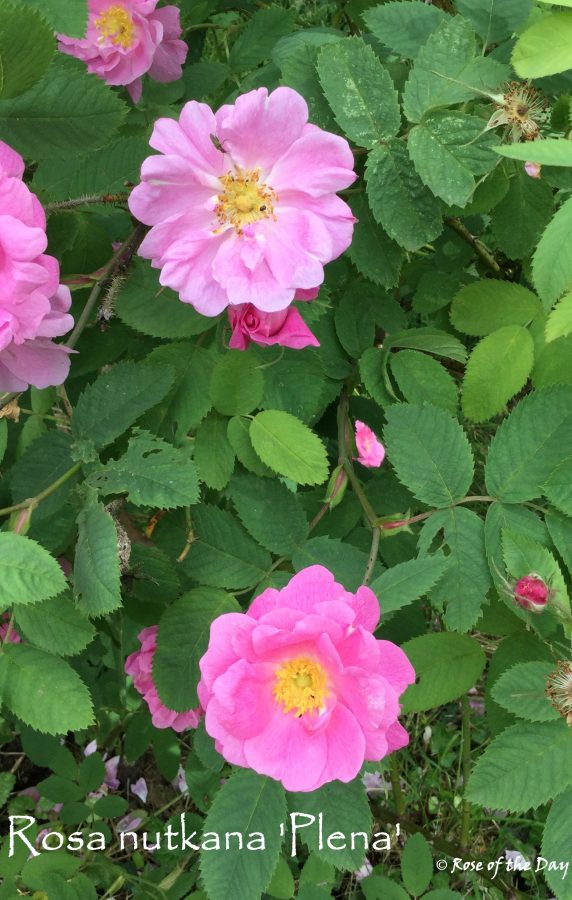
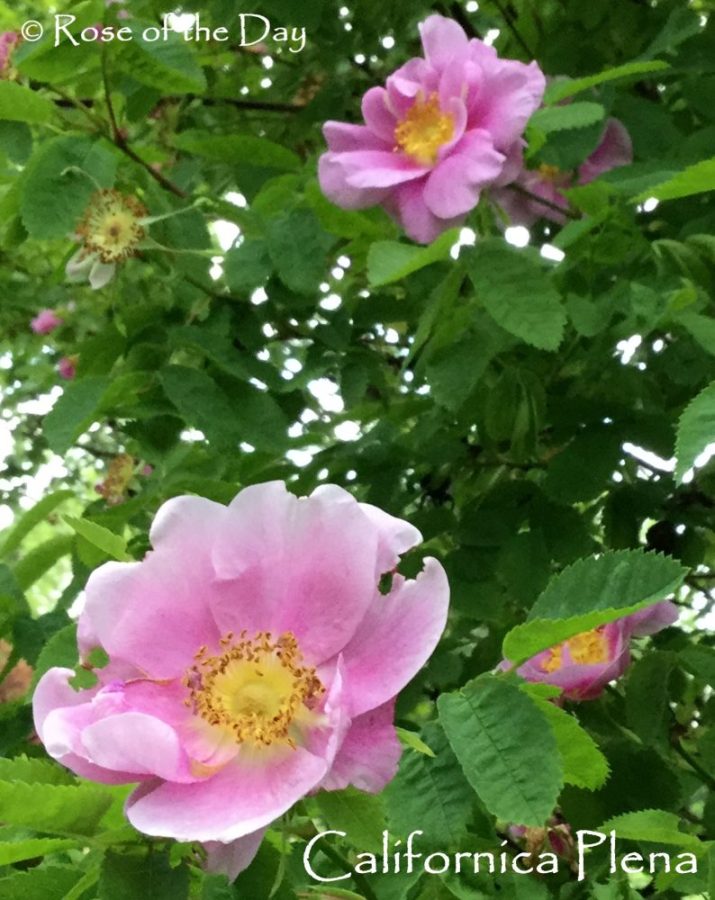
A wild Wednesday rose, well she is a found seedling of ‘Rosa nutkana’, known as ‘Rosa nutkana ‘Plena’. Her delicate blooms belie her toughness, hardiness, disease resistance and tolerance of poor soil and shade.
‘Rosa nutkana’ is a native of California, Oregon, Washington, British Columbia, and Alaska. Discovered by Archibald Menzies, one of the scientists with Vancouver’s expedition in 1793. Named for Nootka Sound on the west coast of Vancouver Island. I guess that ‘Plena’ appeared from a chance cross when Rosa nutkana was grown as a garden rose.
I don’t know how many people grow this rose, I have never seen her growing anywhere other than in the species rose collection at Peter Beales nursery. I bought her from Peter Beales back in the 1980s and planted her in a rubbish bit of soil in the front yard of the farm. The trees on the edge have now grown quite tall so she is in shade for part of the day.
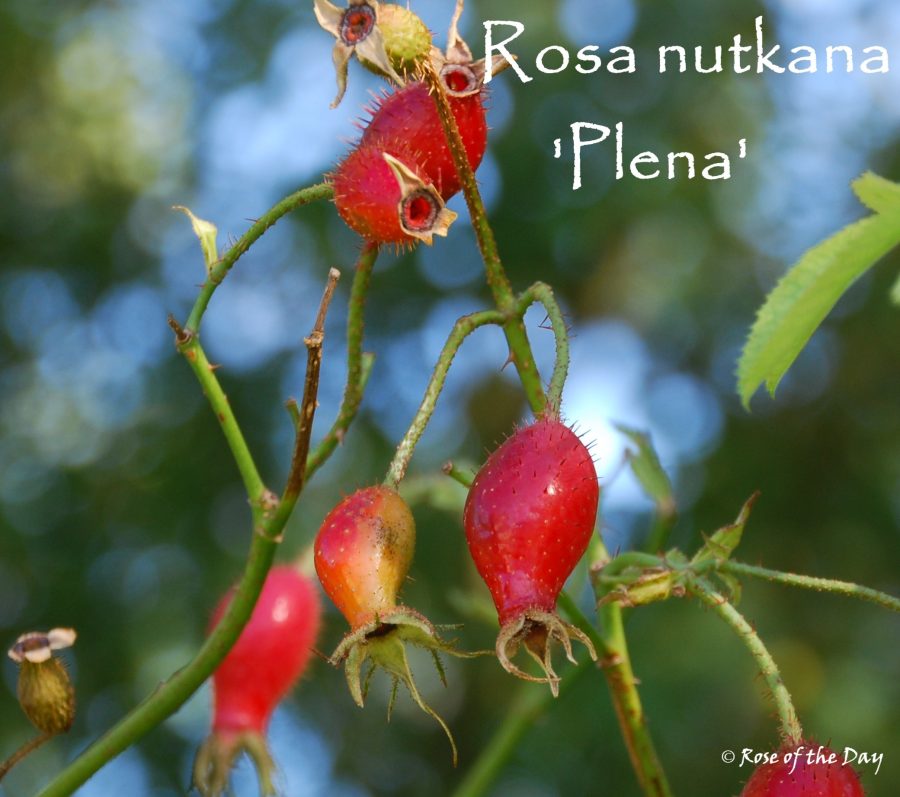
Her pink buds appear late June to early July opening to a delicate semi double lilac pink bloom with a big yellow stamen crown. Strong fragrance from such a quiet little bloom. Matt green foliage with deeply ridged leaves. Red hips follow in the autumn and hang onto the bush until the spring. They must taste unpleasant as the birds never touch them.
Grows to around 2m high and around the same width. Available in Europe but I cannot seem to find her in the US at all. Perhaps if you grow her there you can comment on this? Her parent ‘Rosa nutkana’ is hardy USDA zone 3b and warmer so ‘Plena’ may well be similar.
She isn’t a choice front of the border rose but if you have an awkward corner in a large garden, she would fill this very well. She fits my semi wild wilderness area well and surprises visitors who catch her astonishing fragrance drifting in the summer air.

Thursday 18th April
Living in the rather flat Suffolk countryside I yearn for a garden on the side of a hill so I could have terraces and banks. One always wishes for the impossible! Today’s rose is one to grow falling down a bank or over the side of a terrace. However, the photo was taken at Mottisfont Abbey where ‘Raubritter’ was spreading her charms beside a small ornamental pond.
‘Raubritter’ is a procumbent rose, wider than she is tall if you grow her as a shrub. Give her support and she will scramble up to 3m. This idiosyncratic growth habit occurs with most of the procumbent roses. Bred in Germany in 1936 by Wilhelm Kordes, the pink hybrid Macrantha ‘Daisy Hill’ provided the seed with the red hybrid Wichurana ‘Solarium’ donating the pollen.
Small pointed dark pink buds appear in large clusters in early June opening to the most astonishing bloom. The profusion of buds open to silvery pink globes each with a small opening at the top, very un rose like. The small opening gradually becomes wider and wider until a beautiful dark pink peony like bloom emerges. Just so beautiful, one could look at them all day. Fragile and delicate petals which don’t like the rain or dampness sadly as they will ‘ball’. A fresh sweet fragrance drifts from these superb blooms. Just one magnificent flush of bloom but you do get a lot of bloom for a long period
A tendency for black spot and mildew so not a rose for the non spray garden. Otherwise, she is very vigorous with slender prickly stems and narrow wrinkled foliage. Hardy USDA zone 6b-9b. Reputed to be very frost resistant. American Rose Society grading 8.1 (A solid to very good rose. Its good features easily outweigh any problems. Well above average).
This dainty rose has to me an entirely inappropriate name. A Raubritter was a feudal robber baron or knight imposing unfair taxes and demands on his subjects. I can think of several rampaging thorn ridden ramblers for whom the name Raubritter would be extremely apt but not this pretty rose.
Although she may have been overtaken by the modern healthy continuous flowering ground cover roses I still think ‘Raubritter’ is well worth growing If you have the space for her to sprawl or scramble, she will undoubtedly bring admiring glances from your friends and visitors.
Friday 19th April
I learnt the art of total immersion in a book at a very young age. This was a huge advantage growing up in a noisy and somewhat chaotic household. I opened my book and stepped into another world obvious to anything addressed to me. Eager to get to the end of any story I learnt to read very fast as well so I have read a lot of books. I don’t recall reading any of the Swiss novelist Albert Cohen’s books. Today’s rose the Delbard Hybrid Tea takes her name ‘Belle de Seigneur’ from one of his romantic novels. A satire of international relations in the 1930 and the seduction of a married French aristocrat. A film also but have not seen that either!
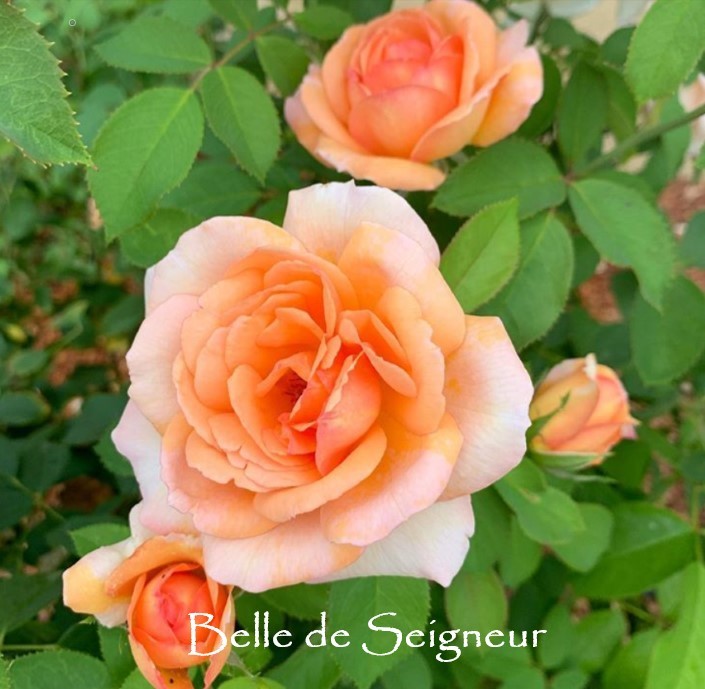
Delbard clearly had the seduction idea in mind when naming this rose. She may well seduce you if you add her to your garden with her colour and the signature Delbard fragrance. Characteristic HT buds of dark pink appear in small clusters held aloft of the red tinged dark green foliage. This foliage is the perfect foil for the large very full petalled blooms opening from those elegant buds. Delicious apricoty pink petals with darker petal edges that have peach bases giving a deep glowing centre. She is a rose influenced by growing temperature though. Grow her in cooler climes and she will be a calmer but still striking delicate pink touched with apricot and copper. Classical HT high pointed centre but they flatten out with age. I prefer HTs a little past their prime blowsy and carefree rather than the perfect tight points of early life. Long lasting blooms both on the bush and in a vase for the house. Luxurious perfume, heavy with fruit notes.
On the small side only 60-80cm high but is likely to be higher in hot climates. Good disease resistance. Hardy USDA zone 6b-9b but it looks as though she is happy 9b-10b. Widely available but you may well find her listed in South Africa as ‘The Midlands Rose’. An ordinary name for this spectacular rose! I prefer ‘Belle de Seigneur’
A real ‘Sunset’ coloured rose so you will need some thought on placing ‘Belle de Seigneur’ to avoid a sunglasses moment should you grow her next to a bright pink. I see she is recommended for informal hedging and given her small stature she would be ideal in a container.
Now that book Belle de Seigneur. Amazon calls!
Saturday 20th April
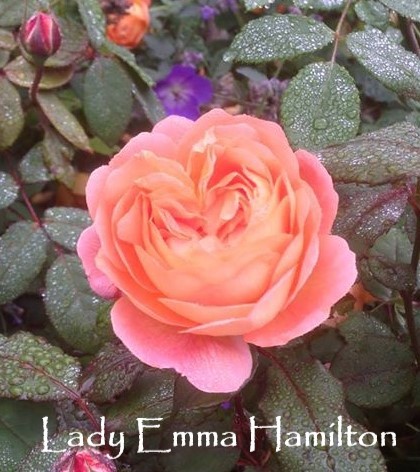
‘Horatio Nelson’ was our rose of the day on the 7th of April, so it seems appropriate to feature his mistress ‘Lady Emma Hamilton’. ‘Horatio Nelson’ bred in his birth county of Norfolk by Peter Beales whereas ‘Lady Emma Hamilton’ is a David Austin rose. Introduced in 2005 to celebrate the two hundredth anniversary of the Battle of Trafalgar. I wonder why ‘Lady Emma Hamilton’ and not ‘Trafalgar’? There is an old Hybrid Tea ‘Trafalgar’ no longer available but perhaps ‘Lady Emma Hamilton’ has a more romantic feel.
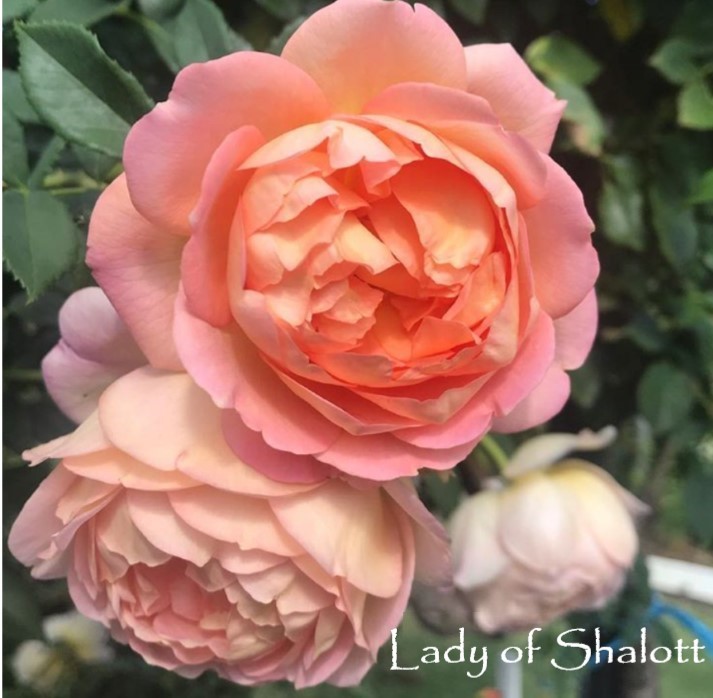
Like her namesake, this is a beautiful rose, but she can be a hot colour so needs care in placing, also like her namesake! Buds of orange streaked red open to a characteristic DA globular bloom. Initially, these blooms are a hot tangerine orange with paler guard petals and a sunglow yellow centre but fear not as the colour soon calms as the bloom ages to a loose petalled bloom. The outer guard petals fade to a lovely pale pink apricot with a beautiful peach gold centre. She does vary considerably according to growing conditions, with intense colour in the heat and dry whereas she is more mellow in the cool and damp. Strong perfume described in the David Austin catalogue as fruity with hints of pear, grape and citrus fruits. I will leave it to you to decide on this fruit cornucopia! Repeat blooms all summer.
Not over large, just 90cm high but as usual with roses, she will be taller in a warm climate. Very dark bronzed green foliage which really makes those blooms ‘pop’. Bushy growth habit. Good disease resistance. Hardy USDA zone 5b-9b. American Rose Society grading 8.0 (A solid to very good rose. Its good features easily outweigh any problems. Well above average).
Growing up in Norfolk and going to a school where I was in the Nelson House, I don’t recall hearing too much about Lady Emma. Probably considered inappropriate back then for young ears. She led an exciting if risqué life. Born into a poor family and christened Amy she made her way to London as a teenager to work in domestic service. Her beauty ‘saved’ her from a life of dreary cleaning though. Mistress to two aristocrats and bearing the child of one. The society artist George Romney became obsessed with Emma as she was now known, and she features in many of his historical paintings. The second image shows his painting of Emma as ‘Circe’. Emma was ungraciously palmed off by one of her lovers onto Sir William Hamilton the British envoy in Naples. Although thirty four years her senior he married her in 1791, and later that year she met Nelson. Her married life was as flamboyant as her youth. She entertained guests at diplomatic parties scantily dressed in classical tableaus. Her great love though was for Nelson and this liaison seems to have been condoned by Sir William as they lived in a ‘ménage à trois’. A daughter Horatia was born before Nelson was killed at the Battle of Trafalgar. Emma slid into a life of debt and alcohol and died in Paris at the age of just fifty.

I have the white semi double Peter Beales rose ‘Nelson’s Pride’ but he is snuggled up with the early single HTs ‘Ellen Willmott’ and ‘Mrs Oakley Fisher’. I wonder if those two straight laced ladies would welcome the flamboyant ‘Lady Emma Hamilton’ joining them?
Sunday 21st April
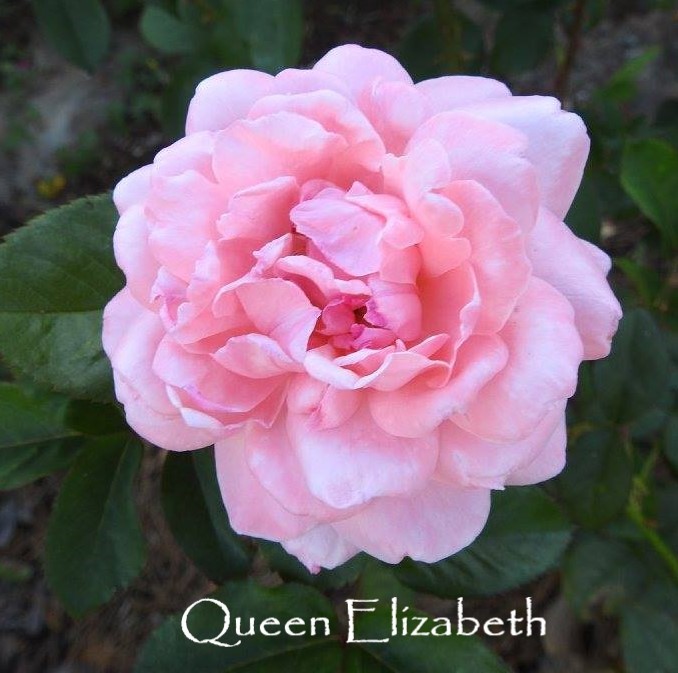
Easter Day so I send you best wishes. Today is also Her Majesty Queen Elisabeth’s birthday and today’s rose is the Grandiflora ‘Queen Elisabeth’. The 21st of April is her actual birthday, with the official one being on the second Saturday in June.
An iconic rose bred not in Great Britain but in sunny California by Dr Walter Lammerts who produced several Hybrid Tea and Grandiflora roses. The Grandiflora class was initiated by this rose ‘Queen Elizabeth’. The qualities of a Grandiflora are said to be a combination of Hybrid Teas and Floribundas and of course large blooms. The name is a bit of a clue there. The term is more widely used, I think, in the States than in Britain.
Introduced in 1954 to honour the 1952 coronation of Queen Elizabeth. I can’t see that two year gap occurring now in the days of sharp marketing! This is a very widely grown rose or should I say was. Still in catalogues but one doesn’t often see her in garden centres. I often get sent photos of an unknown pink rose found in Granny’s garden or on an old property. Usually, the unknown is this glorious pink ‘Queen Elizabeth’. She grew here at the farm when I first arrived but in a really poor position. I moved her but she fell into a decline and died. My mother, an ardent Royalist, blamed this death on me as I am not a great supporter of the Royal Family!
Large clusters of tight elegant lipstick pink buds but you can also get a single bud, on long dark stems. She is a good rose to cut for the house. Neat furled high pointed pink blooms to begin with but they open further and flatten to an attractive bloom. The outer petals are a pale seashell pink with an appealing ruffled edge surrounding the smaller mid pink centre petals. The petals reflex and ruffle as she flattens to reveal the golden stamens. Not a heavy fragrance but sweet and light. Gracious perhaps? Flushes of these gorgeous blooms all season.
Slightly inclined to late rust attacks so watch her carefully. She is narrow in growth habit but can be very tall 2.5m easily. Often grown against a wall as a climber. Vigorous and tolerant of poor soil. There is a climbing sport ‘Climbing Queen Elizabeth’, but it suffers from too much vigour so the high blooms wave to the sky and the stems are almost too stiff to bend and train. There are also two other sports, white and yellow.
‘Queen Elizabeth’ has been awarded a slew of awards since her introduction including Rose of the Year in 1979. If you have the space for her, she is a rose worth considering.
Happy Easter.

Tuesday 23rd April
One of the oldest rose growing, and breeding companies in Britain, established in 1765, is just an hour’s drive from me, I have frequently passed within a few hundred metres of their gates, but I have never visited Cants of Colchester. This is a shocking admission and I aim to correct this by visiting this summer. Cants no longer breed roses just concentrating on the sale of roses. The nursery remains in the Cant family although the current owners the Pawseys are descendants from the female line. Roger Pawsey bred the popular and beautiful ‘Just Joey’ featured on 21st March.
Originally the company was known as Benjamin R. Cant & Sons. In the child naming tradition of the Victorian era, the eldest son was usually given their father’s Christian names. We are concerned here with Benjamin R. Cant (1827-1900), (the R for Revett, his mother’s maiden name), who bred a fabulous Tea rose naming it for his wife -‘Mrs B.R. Cant’ – today’s rose of the day.
Introduced in 1901 this Tea rose has remained very popular particularly in the States and Australia as she is a bit of a hot weather lady. The picture perfect pink touched buds are carried above the bush on long stems, excellent for a cut flower. Opens to a very full petalled silver pink bloom with a quartered centre. Darker pink petal backs giving an attractive contrast as the bloom flattens and the petals reflex. Just such a faultless classic rose form you absolutely can’t beat it. Fabulous Tea fragrance and she starts blooming early in the season and just keeps on going until the frosts of winter. Her autumn blooms are often better than the early summer ones.
She needs some space should you plan to grow her as she grows as wide as she is tall. Can be 2.5m high and frequently more in hot climates. Does not appreciate being pruned too hard, leave her to her own devices. Dark healthy foliage and a bushy habit. Tolerant of poor soils. Hardy USDA zones 7b-9b. Being a Tea rose she will not appreciate cold winds so find her a sheltered spot. The American Rose Society grading is a whopper of 8.9 (An outstanding rose. One with major positives and only minor negatives. The top 1%). Praise indeed.
Whilst researching her I found a digital copy of Cant’s 1916 catalogue where I found ‘Mrs B R Cant’ at the cost of 1 shilling, 5p in decimal currency. Historic price equivalents are slightly tricky, but the real price is £3.33 in today’s money. The labour value £15.21 with an income value of £20.40. Fairly comparable with the cost of roses today in Britain.
Widely available but not however from Cants of Colchester, nor any other UK nursery. They do not stock any Tea Roses. One would think they would stock roses of their own breeding!

Wednesday 24th April
The first of the 2019 roses from my garden this morning. Usually, the harbinger of spring here although I have to say she is a little late to display her charms this year. This extraordinary spring has meant the wearing of shorts and sunburn before her sunny blooms opened. “Look the Canary Bird is out so it must be spring at last!” was not this year’s spring proclamation.
Rosa xanthina ‘Canary Bird’ is a rose of British origin, introduced in 1907 but who bred her or what her ancestry is remains mysterious. Rosa xanthina, a species rose from China, is very similar but has double blooms and prickles. ‘Canary Bird’ is generally considered to be a hybrid of either Rosa xanthina or Rosa hugonis. Graham Stuart Thomas reports she was reputedly raised at Osterley Park in west London, but I can’t find any other reference to this birthplace.
A large rose who grows wider than she is tall. Her foliage is bright green but small delicate and fern like, around 9-11 small leaflets. These are carried on long arching reddish brown stems. Along these stems appear small tufts of leaves each bearing a jewel like yellow bud which pop open to small single bright golden yellow blooms. A magical sight. Each little bloom has a golden corona of stamens, a feast for hungry pollinators. The bright yellow fades in the sun to cream before the petals drop. A light ethereal fragrance not like any other rose. In reality Canary Bird is all together an un rose like rose!

Just the one single glorious flush of bloom although after a hot summer she will produce a scatter of blooms in the autumn. Small black hips appear but these are not as glorious as her spring blooms.
Absolutely no disease problems but she does suffer from dieback. I have two bushes and one has had so much dieback that she may have to pass on to the great compost heap in the sky. Leave your secateurs in the drawer for this rose, she dislikes pruning and this can accelerate die back. She isn’t a fan of cold icy winds, USDA zones 5b and warmer. The American Rose Society grades her as 6.5, a below average rose. I feel this is a little harsh, she is a rose that I would always have in my garden. She needs space though so more suited to a landscape or wild garden than a formal town garden. Reaches around 2.5m in height and approximately 3.5m wide.
Her flush of bloom lasts around two weeks before she retires for the summer but then the other roses are waking up and summer is practically here.

Thursday 25th April
If you have the chance to visit Mottisfont Abbey Gardens in Hampshire UK, leap at it! A stupendous rose garden holding the National Collection of Pre 1900 roses in two well designed walled gardens. Those of you who have been lucky enough to visit will remember I am sure the central pathways with the attractive arches covered in climbers, the semperviren rose ‘Adélaïde D’Orléans’.
Semperviren roses were brought into being by the head gardener Antoine Jacques to the Duc D’Orléans, at the Chateau de Neuilly. Jacques used the species rose Rosa sempervirens, a strong healthy rose, in his breeding programme. To call this a breeding programme is a little ambitious. At the time it was more of a hit and miss affair compared to the highly controlled and organised programmes used today. However, from his amateur work some fine climbing roses were produced, ‘Félicité et Perpétué’ being his most widely grown rose.
‘Adélaïde D’Orléans’ produces large clusters of small bright pink buds which hang downwards in a small waterfall rather than being held erect. These little pink buds unfurl to a blush pink bloom opening further to a creamy white semi double rose with charming heart shaped petals. A small golden stamen crown in the centre pulls all the bees and pollinators towards her. Sweet light fragrance said to be reminiscent of primroses, I will leave that one for you to decide! The outer guard petals retain their pinkiness giving a slight colour contrast to the attractive cascades of bloom, a truly breath taking sight. Enjoy it while it lasts as Adélaïde blooms just the once in June.
A rose requiring space or very tall arches as she can reach a lofty 5m. The Mottisfont arches are not 5m so there will be a severe prune following her June flush. Good disease resistant small dark foliage but some report she can be hit by mildew so keep an eye for this quickly defoliating condition. Hardy USDA 6b-9b.
Adélaïde D’Orléans’, actually Louise Marie Adélaïde Eugénie was a member of the Bourbon family born in 1777 daughter of the Duc D’Orléans. She was a twin but her sister Léopoldine died aged four. Antoine Jacques named another rose for Leopoldina and it seems over time these two roses have become muddled and one has been lost to cultivation. Adélaïde may well be ‘Léopoldine D’Orléans’! Adélaïde led an interesting life in chaotic revolutionary France and the Bourbon restoration. Unmarried she lived with her brother, King Louis Phillipe and his wife running their household and caring her their children. In her youth she took painting lessons from the great rose artist Pierre-Joseph Redouté producing excellent floral portraits.

If you have space for a large rose arbour or arch Adélaïde D’Orléans’ is certainly one to consider.
Friday 26th April
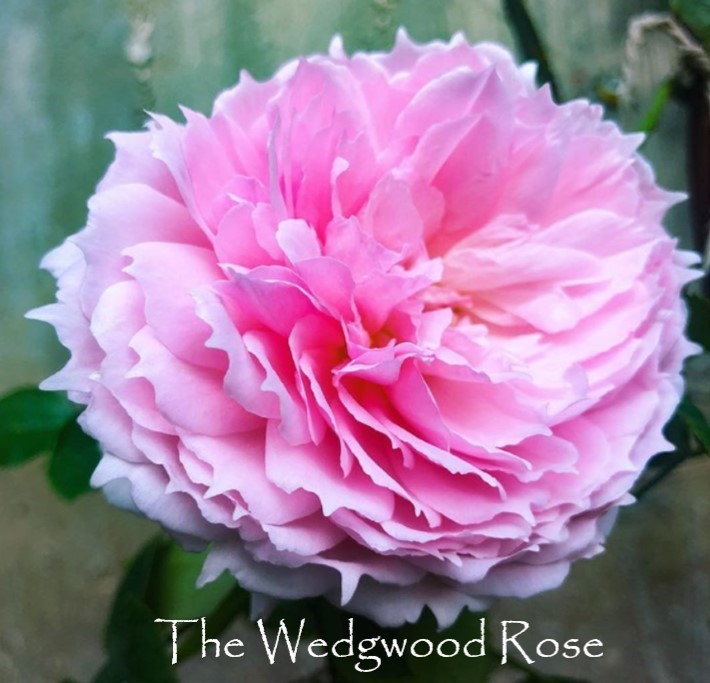
When I plan these posts, I usually try not to have two similar roses back to back, but I have failed on this as we had a climbing rose yesterday and we have another today! Today’s rose is rather more modern though, the David Austin ‘The Wedgwood Rose’.
Introduced in 2009 and named to celebrate the 250th anniversary of the founding of the Wedgwood fine china and porcelain company.
Not an overly tall climber, with a maximum, predicted height of 3m. The DA website relates that she will quickly grow into a superb climber as she sends up many shoots from the base. Seems a slightly weird claim as a climber needs a good fan shape with a few, five or seven, strong stems at the base and then you can let some side branches grow from the main stems. That however is my understanding of a good climber. A few reports that the stems are weak, but one must take these reports sometimes with a small pinch of salt. One doesn’t know the growing conditions nor the expertise of the grower.
The buds are a greenish white with a rather ruffled appearance. They open to large full petalled soft pink blooms, the petals have a charming central pointed edge. The outer guard petals are pale pink, and the DA website says these petals are a delicate gossamer. These tissue thin petals, lacking starch in their structure, mean sadly one major disadvantage, the blooms ‘ball’ badly in damp conditions. Think of those thick fleshy Hybrid Tea petals, they never ball or spoil in the rain! The fragrance is that of fruit. Repeat blooms very well through the summer.
I see from various photographs on the web that the blooms have a tendency towards a weak neck causing the blooms to hang down. Never a great feature in a rose but at least in a climber you can look up at these downward facing blooms.
Dark glossy foliage and good disease resistance reported. Hardy USDA zone 6b-9b.I find a lot of the more recent DA roses seem to either be superb or a disaster although they seem to always perform well in the hotter dryer parts of the world.
If you grow this rose do please comment as it is always of interest to hear others’ experiences.
Saturday 27th April
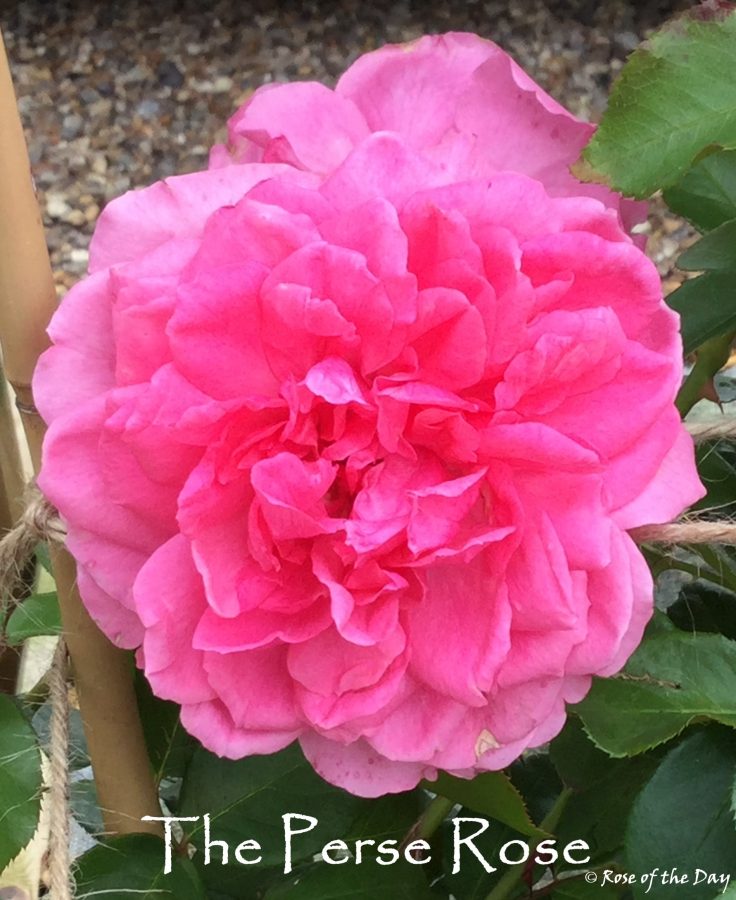
On an old village map dated 1590, our farm is marked as ‘newly built 1550’. A section of the 1550 house survives but has a later brick wall at the far end. We suspect from the remaining fractured beams that this end of the house collapsed over time and was demolished. From the humps, bumps and hollows in the garden the original footprint of the house can be guessed at. A lot of roses now cover this area but there seems to be a particularly long hollow where roses can be slow to establish. Today’s rose had the misfortune to be planted in this hollow, so she has been slow to get into her stride. A Peter Beales rose – ‘The Perse Rose’.
Rather a tall narrow rose with a predicted height of 1.5m but only a slender 1m wide. Better probably as a pillar rose than a shrub. Of course, in a small garden, these roses with a tall narrow growth habit do mean you can pack more roses into a confined space. Large clusters of fat dark buds arrive all summer, unfurling into large full petalled mid pink blooms. Attractive wavy edged petals that reflex nicely to reveal a darker quartered centre. She has a classic old fashioned feel to her coupled with a sweet light pervasive fragrance. Healthy glossy foliage which appears to have good disease resistance.
I have struggled somewhat to find the extent of nurseries that stock this charming rose. Certainly, she will be available from Peter Beales and some other UK nurseries. I see that a Moscow based grower has posted photos on the helpmefind website so she has reached Russia! I guess also to be found in some of the major European nurseries as well. I doubt whether she is available further afield, unfortunately.
Introduced in 2015 to mark the 400th anniversary of the founding of the Cambridge school The Perse School. Stephen Perse an academic, physician and philanthropist left a legacy to set up a school to change lives through education. The school, open to children from all backgrounds, is Cambridge’s oldest surviving secondary school.
I wasn’t aware of the 400th birthday commemoration connection when I planted my rose in the 1600 bumpy area of the garden, but this now seems appropriate. This spring she looks very chipper but then she didn’t have to suffer the ten days of last March’s ‘Beast from the East’. Perhaps she was just sheltering in her little hollow last summer afraid to lift her head too high.
Does anyone else grow her? Do please comment.

Sunday 28th April
A serene rose today that I grew a fair number of years ago and whilst doing the research I was left wondering why I have not replanted her. A Hybrid Musk introduced in 1939 from the German nursery of Kordes – ‘Erfurt’.
Kordes used his lovely crimson Hybrid Musk ‘Eva’ as a seed parent with the dark pink Hybrid Tea climber ‘Réveil Dijonnais’ providing the pollen. From this liaison, he created one of the most popular modern shrub roses. Named for the central German city of Erfurt which has one of Europe’s best preserved medieval city centres.
The elegant Hybrid Tea like buds are bright pink and are carried in large clusters on the long red tinged arching stems. Unfurling to a simple uncomplicated pink bloom of 4 to 10 petals that have pale creamy lemony bases encircling the long golden stamens. She can be quite a bright pink when grown in high temperatures but more usually this very understated pink as seen in the photograph. From this unsophisticated bloom, an exquisite perfume arrives. The first blooms cleanly drop and a crop of round green hips quickly appear, turning to a reddish orange. She blooms continuously so you get the unusual combination of both blooms and hips all summer. Very eye catching!
Extremely disease resistant foliage that is bronzy red when young maturing to ridged puckered leaves. Tends to be wider than she is tall, generally around 1.50m high and 2m wide. As with most roses she is likely to be taller in hotter climes. Tolerant of poor soil. Hardy USDA zones 4b-10b. An 8.4 score from the American Rose Society, that’s ‘a very good to excellent rose. One recommended without hesitation.’ Widely available. A rose for the no spray garden and for those who want an easy but attractive rose.
An excellent rose and she is in my notebook for the 2019/20 planting season. I am sure I can squeeze her in somewhere! Who grows her?
Tuesday 30th April.
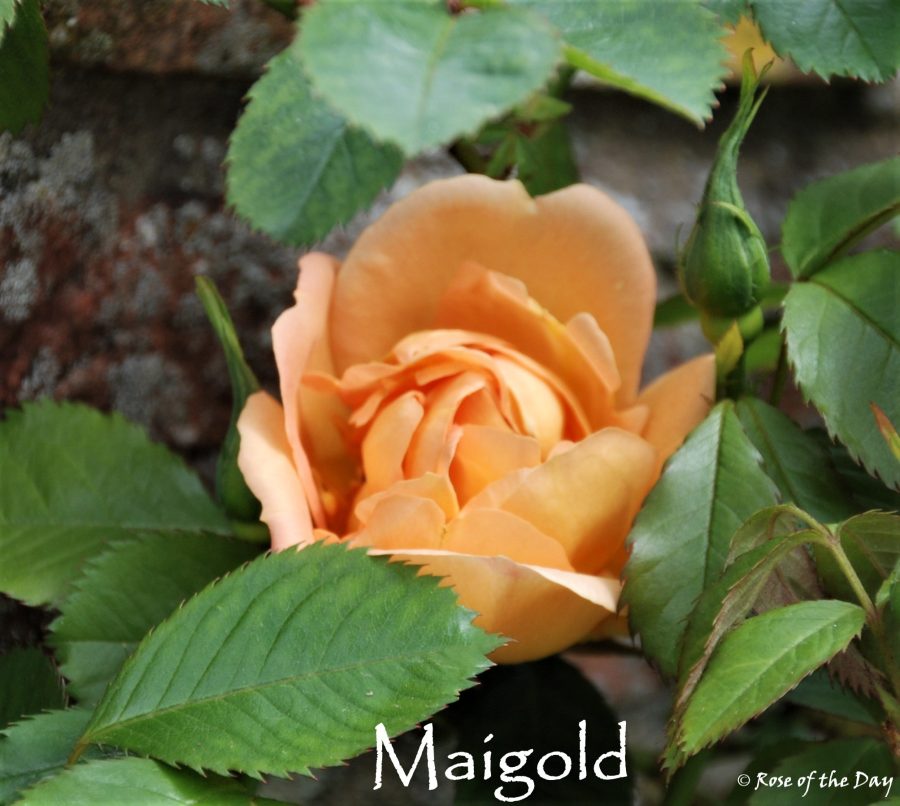
This extraordinary spring brings the roses to bloom earlier than expected. Although yet to be in her full glory today, still April, we have the modern shrub rose ‘Maigold’.
Always an early rose to bloom, a legacy from her pollen parent ‘Fruhlingstag’ literally Spring Day also an early rose. Likewise, ‘Fruhlingsgold’, Spring Gold, the pollen grandparent to ‘Maigold’. These two Hybrid Spinosissima Fruhlings were bred by Reimer Kordes, a prolific breeder of fine roses. ‘Maigold’ is another Kordes rose, introduced in 1953, her seed parent the Danish Floribunda Poulsen’s Pink. What a meeting of excellent Northern European roses.
I grow ‘Maigold’ against a south wall as a climber, but she is also happy as a shrub. Her very thorny, needle prickly stems are none too flexible and can easily snap so you will have to gently coax them into the appropriate position. I loop Flexi Tie around the stem and gradually pull it into place as the stem grows over several weeks.
Masses of dark pink buds with long feathery sepals appear in early spring. As they crack open the colour changes to a flame streaked pink orange. Beautiful coppery apricot orange blooms unfurl to greet the spring days. Opening to a large, 10cm, semi double bloom paling to creamy peach buff, the petal bases are a growing lemon encircling the crimson stamens. A delight for those hungry early foraging bees. Eventually fading further to a yellowish white. Her best show is in the spring, but she produces blooms intermittently all summer. In last year’s astonishing heat, she produced excellent flushes of bloom all summer. Fragrance is strong and fruity, but I detect a very slight edginess common in yellow roses. I have read she smells of linseed oil but not to me, I wonder if this is that sharp edge to the perfume described differently?
The foliage is glossy pale green with serrated edging to the leaves and very good disease resistance. Another rose that dislikes to be pruned. Just lightly after her first flush as she will bloom next summer on this year’s summer growth, what is known as old wood. To clarify this Hybrid Teas for example, bloom on new wood, the current year’s growth. She can reach 3m in height and breadth, given the dislike of pruning she is a rose that deserves a reasonable amount of space. Hardy USDA zone 4b-9b. The American Rose Society rating is a lowly 7.6 – ‘A good rose, a little to somewhat above average’. Widely available.
I always look forward to her spring display after the dark and cold of the winter. A rose certainly that I would always have in my garden. Do comment if you grow her.



























 Rose of the Day