
I have a long curving brick wall dividing the farmyard from the garden. On the garden side, south facing, there are a number of climbers. The bare north side is maybe not the best aspect but last winter I planted several climbers along it. They seem content enough despite the long dry spell.
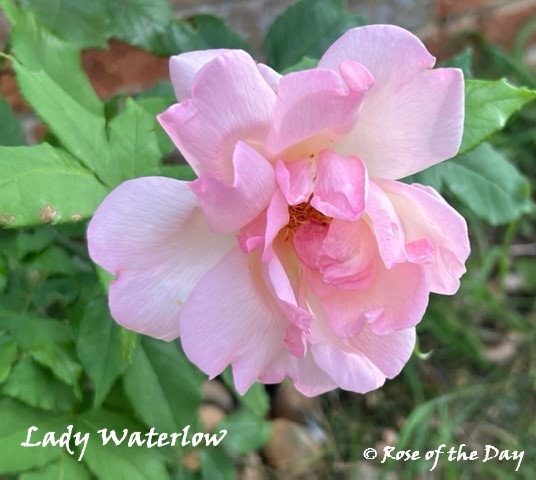
‘Lady Waterlow’, a Tea Noisette from Nabbonand, and introduced in 1902. The Nabbonand family were prolific breeders of both Tea and Tea Noisettes, many now lost to cultivation. Most were named to flatter their wealthy customers, many English aristocrats visited the nursery on their journey to the fashionable Côte d’Azur. Perhaps there may have been some monetary exchange for a rose naming. One of the last Tea Noisettes before the fashion turned to the Hybrid Multiflora and Wichuranas that dominate the climbing roses in current cultivation.
‘Lady Waterlow’, described by Charles Quest-Ritson as a ravishing rose, is considered one of the best roses produced by Nabbonand. Still very popular, and widely found in nursery catalogues. Long dark pink buds pale as they open to a large loose bloom with pale pink petals edged with a flush pink on the petal edge and a hint of yellow on the base. Quite variable in colour though, a legacy of her Tea heritage, ‘Madame Falcot’ dominates her pedigree. These elegant blooms appear either singly or in clusters, and have a delicious fragrance. Early to bloom, and then continues throughout the summer so seldom without bloom. Enjoys hot weather so this summer has made her a happy rose.
Prickly stems which are on the stiff side, not so easy to train. Large leaves which so far have not shown any disease as she is reputed to suffer from black spot. In the UK ‘Lady Waterlow’ will reach around 2m but is much larger in warmer climates. We slip towards a warmer climate so she may gain in size as global warming increases. USDA zones 6b and warmer.
Just a small note about climbers. It is tempting to plant climbers and leave them alone, much as you would do with a shrub rose. However, you need to be tweaking those stems into a good fan shape from day one. They often grow in the wrong direction, out away from the wall, but can be gently coaxed by judicious ties. If you bend or pull them too hard the stem may snap, we have all done this! I often loosely knot a length cut from a pair of old tights around the stem and tie it to the wall wire, just a gentle bend at first. As the stem grows you can shorten the tie. It is this first season that’s important for the eventual shape. You will find several stems grow outwards or that you have too many candidates. I let these grow but use them for cuttings. One must be a bit ruthless with climbers!

Edward R. Hughes
Lady Waterlow was named for an American heiress, Margaret Hamilton (1849), who married Sir Sydney Hedley Waterlow (1822-1906) after a whirlwind ten day romance. She was thirty three and Sydney, a widower with eight children, was sixty. Sydney began his career working in the family printing business Waterlow and Sons. He moved into politics and philanthropic works. Principally remembered today for giving Waterlow Park in Highgate to the public as “a garden for the gardenless” in 1889. Lady Waterlow supported her husband in his charitable work and continued to do so after his death in 1906. A gracious lady much like her rose.
Comments and questions are welcome as always.
Originally posted on the 7th August 2022 on my Facebook blog Rose of the Day



 Rose of the Day