‘Yolande d’Aragon’

Today’s rose is one that does not sit neatly into a ‘class’, described as a hybrid Gallica, Portland, or Hybrid Perpetual. A genetic study does show she is closer to the Gallicas than the Portlands. To be honest, a lot of the old garden roses are ‘mongrels’ with attributes from their parents who in turn were a bit of a mixture. Whatever her antecedent ‘Yolande d’Aragon’ is a glorious rose.

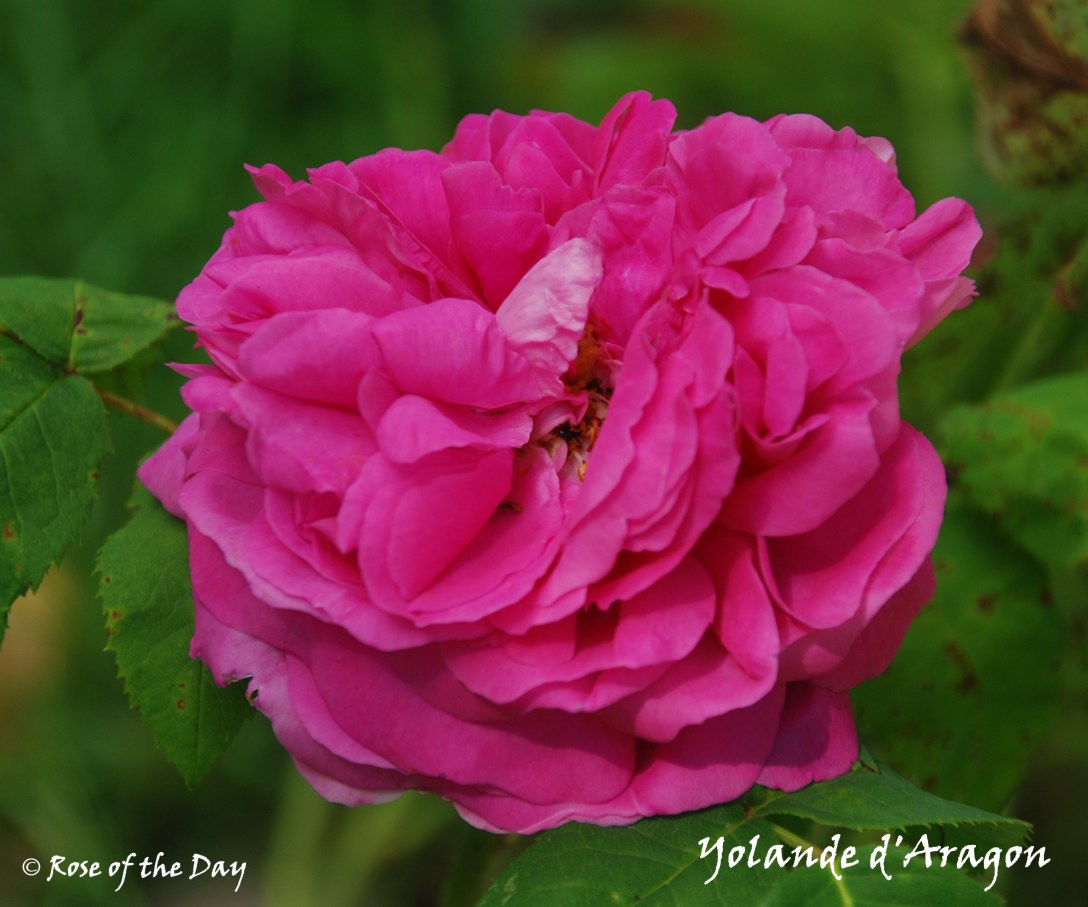
Dating from 1843, introduced by Jean-Pierre Vibert, and is reputed to be a seedling of the Damask Perpetual ‘Belle de Trianon. Yolande produces clusters of dark pink buds dressed in feathery sepals. Large, cupped blooms of deep pink with pale backs. Stuffed with petals in a rosette swirl. Breathtakingly strong old rose fragrance, you must keep returning for another deep inhale. One big summer flush followed by intermittent blooms or even a second flush. Mine is a young rose but last summer she had a lot of late bloom.

Will reach around 1.5m tall with a width of 1m. She is of the era of strongly disease resistant roses but here she had shown some black spot this summer. It has been a weird season though. A very dry mild winter and equally dry spring often with strong cold winds with the odd hot sunny day thrown into the mix. The roses did not know whether to grow or quietly sleep, producing a lot of stressed small foliage. Even the Pemberton Hybrid Musks suffered with the early foliage succumbing to fungal infection. The flush of foliage following rain was and remains healthy so perhaps Yolande’s spot is the result of the weather rather than inherent disease propensity.

A popular rose and widely available. Graded an 8.5 from the American Rose Society – a very good to excellent rose, one recommended without hesitation. Hardy USDA zones 4b-9b.

https://upload.wikimedia.org/wikipedia/commons/6/6b/Marriage_of_Yolande_of_Aragon.jpg

Depiction of the marriage of Louis II of Anjou and Yolande of Aragon from Froissart’s Chronicles 1470. (http://www.bl.uk/catalogues/illuminatedmanuscripts/ILLUMIN.ASP?Size=mid&IllID=22147)

Yolande d’Aragon (1379-1442) played a significant role in the complex ‘Game of Thrones’ in both Spain and France. Born a princess of the small Spanish state of Aragon, her parents arranged her marriage in 1400 to end a feud between the Aragon and Anjou families. Yolande initially resisted this marriage to Louis II, Dule of Anjou. However, it turned out to be a long successful marriage with five children. Yolande became a committed supporter of the French royal family in the last years of the Hundred Year War. Her involvement deepened when her daughter Marie of Anjou married Charles the youngest son of the mad Charles VI.

Charles became heir to the French throne when his eldest brother John died. Following the death of Charles VI, the infant Henry VI of England was proclaimed King of France. Yolande encouraged Charles to fight for his throne. She supported Joan of Arc’s ambition to lead the French army in the successful battle against the English, so Charles became King of France. Yolande’s great diplomatic skill continued to be employed in quelling feuds and squabbles between the French aristocratic families. Not the atypical interfering mother-in-law I think. Certainly, a lady who deserves a rose that is a little out of the ordinary.

I forgive ‘Yolande d’Aragon’ for her few spots this season as the blooms and fragrance are quite special. In her second summer here, she has grown vigorously despite being in a slightly shady position. Do you grow her? How is her disease resistance with you? Comments are welcome as always.

First posted on my Facebook blog Rose of the Day on 27th June 2023
‘Madame Knorr’

Today’s rose ‘Madame Knorr’ is one of the ‘Portland’ class. Portlands are a small class of roses with obscure origins, perhaps the best known being ‘Comte de Chambord’. The original ‘Portland’ arrived in France via England with the name ‘Rosa portlandica’ and became known as the ‘Duchess of Portland’ It was believed that a Duchess of Portland imported this rose at the time of introduction, 1809. This date places the rose in the lifetime of the third Duchess of Portland who had little interest in gardening. However, the second Duchess Margaret Cavendish Bentinck (1715-1785) was a patron of gardening and grew the rose that later bore her name, pushing the introduction date into France to 1775.

‘Duchess of Portland’ was originally believed to be a Damask x China. DNA analysis disproves ‘Slater’s Crimson China’ as one of the parents, and instead suggests a Gallica/Autumn Damask lineage. The Portland repeat blooming comes from the Autumn Damasks. However, not every Portland gives good repeat blooms

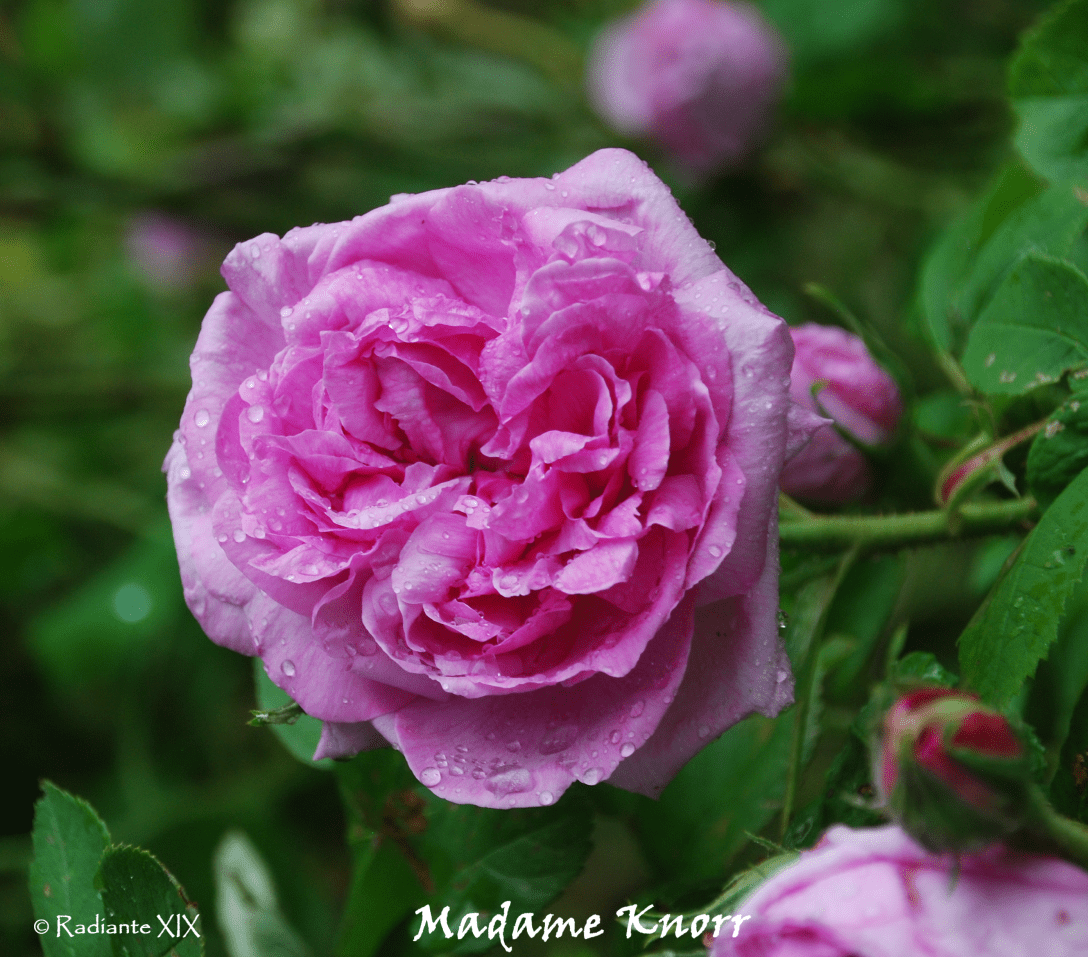
‘Madame Knorr’ was bred by Victor Verdier in Paris and was introduced in 1855 at a time when the Portland roses were sliding out of fashion as their descendants the Hybrid Perpetuals became popular.  Although photographed on a wet June day last summer she was a handsome rose. Small bright buds unfurl to a large silvery pink bloom. Short necked so the blooms nestle into the foliage. A darker centre with pale backed petals always gives such an attractive picture. Very fragrant even in cool damp conditions. She blooms once with a big flush in June with scattered blooms later.

Who was Madame Knorr? The invaluable website Helpmefind (www.helpmefind.com) has a comment that this rose is possibly named for Henriette Knorr (1828-?) née Ziegenmayer first wife of Carl Heinrich Knorr 1800 -1875, Amalie Henriette Caroline Seyffardt 1806-1867. Carl set up the food company Knorr, now part of the Unilever group.

Excellent disease resistant matt grey green foliage. Makes a small bushy 1m high shrub. The Portlands are tough roses, coping with the cold and intense heat. ‘Madame Knorr’ isn’t listed in the inestimable ‘Growing Roses in Cold Climates,’ (see below re availability). The authors recommend protection for these roses should you grow them to protect as much of the stems as possible. Most authorities give a USDA zone of 6b-9b. If any of you grow her in cooler zones please comment.

‘Madame Knorr’ appears to be widely available in Europe, also Australia, and New Zealand. She appears to be grown in the States but quite how widely I am not sure. Do comment on this point. There are references to her being identical to ‘Comte de Chambord’ aka ‘Madame Boll,’ or rather sold under the wrong name. Comments again are helpful.

An interesting rose, perhaps if I were collecting Portlands I would add her to my garden, but I am just a bit obsessed with my Teas, Chinas, and Pembertons now. Too many roses and too little time!

Initially published on 5th February 2022 on my Facebook blog Rose of the Day.

‘Indigo’, not a blue rose at all!

Visit a DIY store and you will be bemused by the names of paint. ‘Elephant’s Breath,’ hmm could that even be a colour? Dead Salmon seems unappealing even when the dead means flat as in not shiny. Pink was originally a murky yellow green only moving to describe light red in the late seventeenth century. The name of today’s rose appears to fall into these vague or confusing colour categories as we have the Portland rose – ‘Indigo.’ Not a deep midnight blue at all but mauve. Roses do not have the gene that produces the blue pigment delphinidin, (unless genetically modified) but nineteenth-century growers endlessly pursued the dream of breeding a blue rose. Perhaps naming this rose for a strong blue colour was a marketing ploy to tempt buyers?

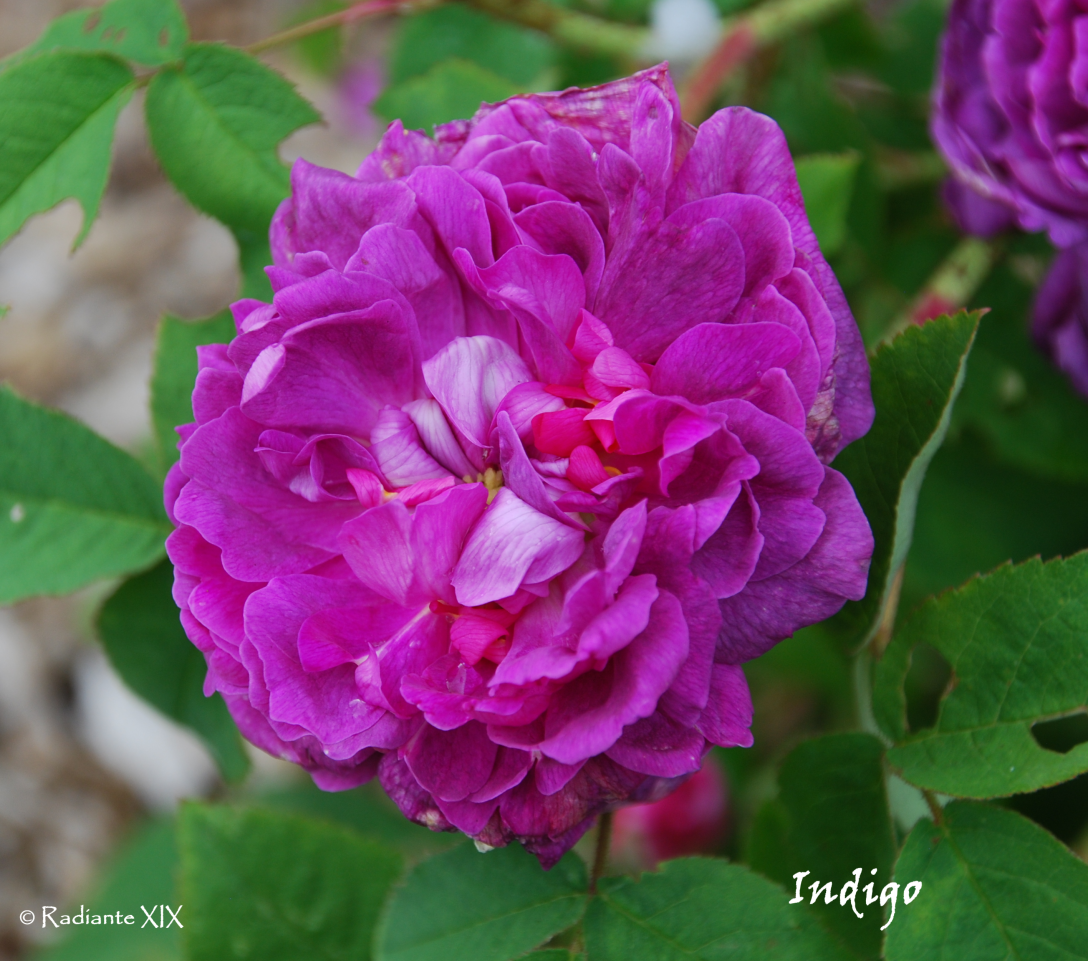
Whatever the story behind the name ‘Indigo’ is a pretty rose. She can vary in colour according to sunlight and temperature, ranging from a dark purple through to mauve, sometimes with a streak of white or crimson. The petal backs are a little paler giving an attractive appearance. She will fade slowly as the large bloom matures ending up as a slaty pinkish grey. A small yellow button peeps through the double petals. Blooms appear either singly or in small clusters from June through to autumn. Delicious fragrance.

An early rose dating from pre-1845, bred by Jean Laffay. ‘Indigo’ reaches around one metre and is quite upright, so she does not take up so much space. Dark prickly stems with matt green foliage. Disease resistant although mildew might visit in very dry summers. Said to grow well in poor soil. USDA zo