April 2019

These posts originally appeared on my Facebook blog Rose of the Day.

Tuesday 2nd April

I have a failing ‘Goldfinch’ by my front garden gate. Although he only blooms once he is semi evergreen a useful winter trait. After this summer’s golden bloom, he will undergo ‘shovel pruning’, and the bed will be prepared with a large cardboard box for today’s rose to take his place. This is the Tea Noisette  ‘Crépuscule’ who does have a slight reputation for being tender but the place for her is South facing. There are several in the Peter Beales nursery in Norfolk so they must be hardy enough to cope with the icy winds roaring across the flat countryside.

‘Crépuscule’, the name means twilight, aptly named as she has all the colours of the sunset. Small clusters of three to five shapely peach buds unfold into rather loose apricot yellow blooms. Satiny petals with darker backs with the outer ones often striped red. Fading through the sunset of butterscotch, buff, chamois and cream. She can be variable in her colours, darker in late summer and cool weather but paler in hot weather. Very repeat flowering to the point of being almost continuous. Seems fickle with her fragrance with some reports of little or nothing but others reporting intoxicating fragrance. She has always seemed very fragrant when I have seen her in the past.

Described as either a climber or a shrub requiring support, she produces long stems that arch nicely. Often grown as a ‘weeping standard’ rose which looks glorious in a formal garden. Smooth stems with few if any thorns with glossy slender dark foliage that is coppery crimson when young. Reaches around 3.75m high. Hardy USDA zone 6b-10a and widely available in most countries.

Twilight describes her colours perfectly, but it is an appropriate name in another way. Introduced in 1904, from the French nursery of Francis Dubreuil at the very end of the Tea Noisette period just before the ‘must have’ roses in your garden became the new Wichurana and Multiflora ramblers. This may be why she has always been not such a popular rose, she never got into her stride, often described as a rose deserving of more attention.

Photographed against the walls at Mottisfont Abbey Gardens in the simmering June heat last summer. Can’t wait for that heat to return although at the moment I am doing a small rain dance each morning as we have dry cold east winds here in Suffolk

I am looking forward to seeing this exotic ‘Crépuscule’ at my garden gate. My ‘Goldfinch’ will live on as cuttings from him grow in the blink of an eye, so I have several growing down on the horse fences.

Wednesday 3rd April

It must be exciting to clear an old garden full of scrub and brambles and discover a ‘lost’ rose as you do so. This happened to Vita Sackville-West and her husband Harold Nicolson when they tidied the neglected garden at Sissinghurst Castle in Kent in the late 1940s. Unsure of the correct name it was named ‘Sissinghurst Castle’ although Vita later identified the rose as ‘Rose des Maures’. Her identification is unsure, and many experts don’t support her claim so you will find this little Gallica rose as ‘Sissinghurst Castle’ in all nursery catalogues.

Not a large rose at all, around 1m, with rather upright growth. Small clusters of feathery sepalled buds, usually around three, held up above the foliage. These buds are deep claret and unfold to a rather untidy double bloom. the petals are also claret coloured but with paler edges and much paler lilac magenta backs. A joy to watch as she unfolds her jewel like blooms. There is also an attractive mottled effect on the petals with the occasional white flash. A golden stamen crown which the bloom in this photograph is just shyly hiding with a couple of petaloids. Sweet and light fragrance. Single bloom period in June.

Slender stems with few thorns, long elegant, pointed leaves. She grows easily from cuttings and suckers to a small thicket when she is on her own roots. Doesn’t mind shade, poor soil or neglect but do cosset her to get the best of those blooms. Reasonably disease resistant. She tends to get a touch of late rust with me but not the dreaded black spot. Hardy USDA zone 4b-8b. Seems to be widely available across the world.

She grows still at Sissinghurst Castle in a long bed I believe. One of the most popular National Trust properties so timed tickets on busy days. A dull rainy Wednesday morning is a suitable time to avoid the many crowds.

A charming rose for the smaller garden. I grow her close to a wooded area where she has happily started to wander on her own roots.
Thursday 4th April

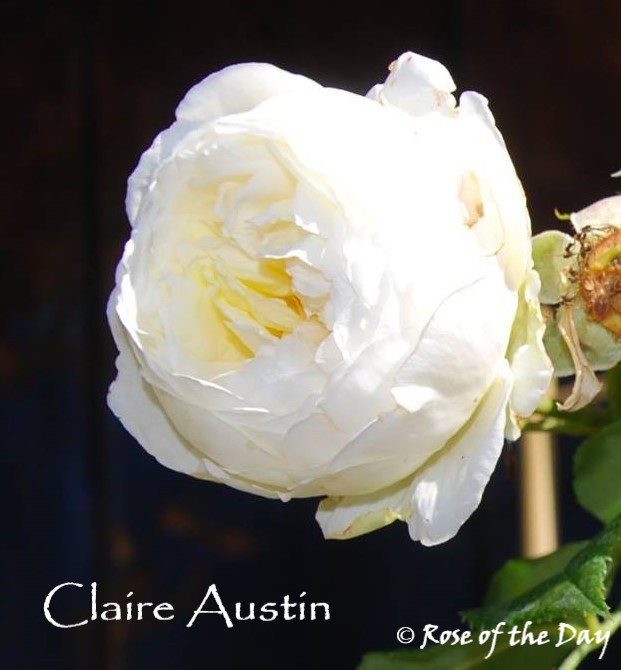
A rose today that has yet to endear herself to me as she has been rather an underperformer. ‘Claire Austin’ a David Austin climber introduced in 2007 with undisclosed parentage. I bought her at an end of season container sale in 2015 where she looked like a healthy plant. In three summers, she has reached just a miserly 1.2m and not too much wider. On a sheltered south facing wall in a bed where everything else romps away. She has another chance this summer then I will move her to see if a new neighbourhood prompts her alleged vigorous growth.

Plump creamy lemon buds with pink streaking open to the classic David Austin globular cupped blooms. These are the most delicious vanilla ice cream colouring with the signature strong myrrh fragrance. However, with me, she doesn’t produce the promised abundance of bloom, yet! Tendency to ‘ball’ in damp weather. When she does condescend to give me blooms, they last a maximum of two days before the petals decorate the flower bed at her roots. I can say though, despite the poor growth she shows excellent disease resistance which is a plus. She looks such a spindly miserable thing!

Named for David Austin’s daughter Claire who also has a garden nursery, but one specialises in hardy plants, predominantly irises, peonies and daylilies.

Do I have a dud plant or is she just in the wrong spot? If you grow her, please comment.
Friday 5th March

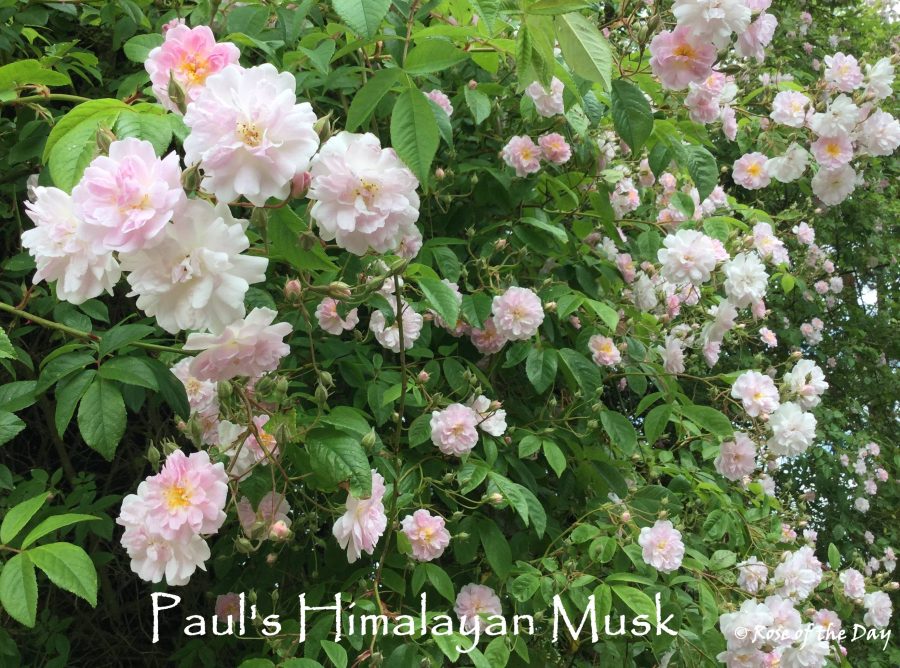
A rose today that needs to come with a health warning. She is large, enormous really so only suitable to grow through a tree in a large garden, the enigmatically named ‘Paul’s Himalayan Musk’.

Enigmatic as this is a modern rose of unknown breeding but one that doesn’t have Rosa moschata nepelensis, a true Himalayan Musk, in its parentage. The botanists consider ‘Paul’s Himalayan Musk’ to be a R. multiflora or filipes descendant. George Paul introduced three roses in 1916: Paul’s Himalayica, an R. brunonii hybrid, Paul’s Tree Climber, hybrid R. brunonii or R. himalayica, Paul’s Himalayica alba Magna. One of these is likely to be the rose rediscovered in the 1960s and now known as ‘Paul’s Himalayan Musk’.

You can see from the photographs the size of this rose. She grows at the end of my drive as it opens out in the yard in front of the house and was planted around 1984 and grows up, over and through a clump of Ash trees.  Sadly, these trees are beginning to suffer from Ash Dieback caused by the fungus Hymenoscyphus fraxineus so she will lose her support. I guess when the trees are felled ditto the rose and then we will see. If she regenerates, we will have to build some enormous frame but there is a pond behind so not so much space for foundations. I can see that I will need to plant another, she grows well from cuttings. Her maximum predicted height is around 10m so needs careful placing.

Long thin flexible stems hang down producing copious clusters of small elegant pinky white buds that open to these charming blush pink loose semi double blooms. Each one hanging on a tiny thread of a stem. The petals have yellow bases giving each bloom a real glow surrounding the golden stamen corona. Always alive with bees, humming happily as they harvest the pollen and nectar. The pink blooms fade to white and then drop creating a bridal shower underneath. The fragrance is sumptuous. Her height means the fragrance is caught by the lightest of breezes and spreads across our garden into the house. A truly stunning sight for around three weeks before she gently shakes her last blooms away and retires for the year. A crop of small dark hips appears in the autumn but is not so spectacular.

The narrow pointed foliage is semi evergreen even in the teeth of icy easterly gales and thankfully very healthy. Spraying her would be impossible! Hardy USDA zone 4b-9b. Widely available.

I will miss her when the Ash trees have to go, they are slowly dying inch by inch. It’s always an exciting moment when we spot the first blooms on the top of her branches – ‘the Himalayan is off!’ and then it’s summer again.
Saturday 6th April

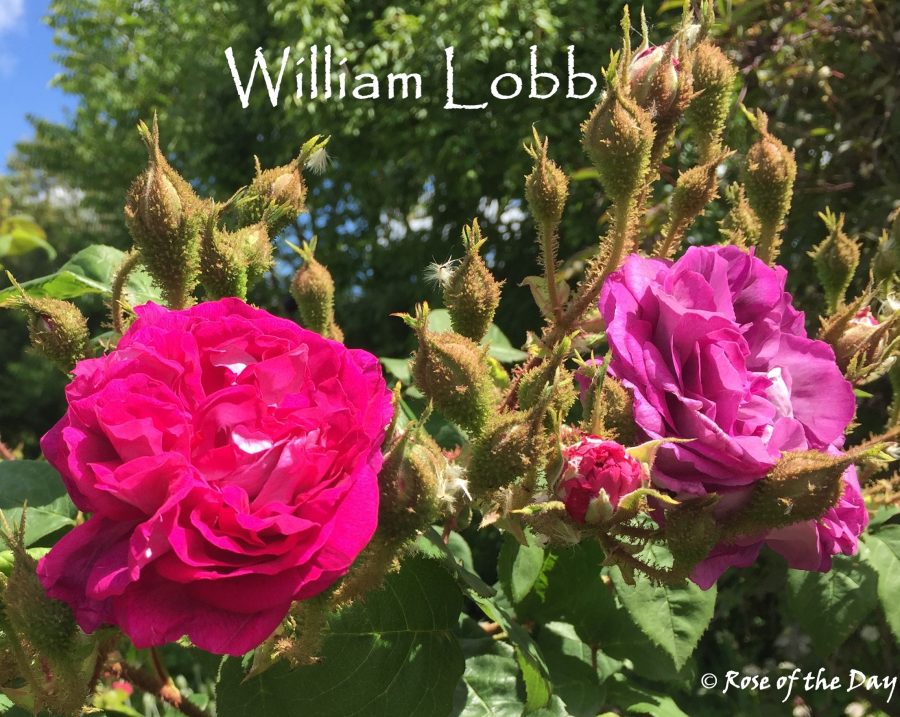
Possibly one of the most widely grown Moss roses today, the fabulous richly coloured ‘William Lobb’. Just a couple of aliases for this one ‘Duchesse d’Istrie’ and ‘Old Velvet Moss’. Originated from the French nursery of Laffay and introduced in 1855 by Portemer as ‘William Lobb’. Laffay also bred the Moss ‘Gloire de Mousseux’ featured on 31st January.

Named for William Lobb a Cornish plant hunter responsible for collecting seeds of the ‘Monkey Puzzle’ conifer. This tree had been introduced earlier in 1795 but William’s employer James Veitch wanted to exploit what he considered to be a highly commercial tree. Rather too commercial as one sees this very large tree planted in all sorts of unsuitable places such as a small suburban garden! William was a prolific plant hunter and introduced many shrubs and plants as well as the Monkey Puzzle. Too many to list here but the Passion flower and the Wellingtonia pine are two well-known finds

‘William Lobb’ is a rose of astonishing colour. The well mossed soft green with just a tinge of purple buds opens to a dark purple semi double bloom with an untidy but charming muddle of petals in the centre. The petals have a paler pink lilac back giving that nice contrast of colour as he unfurls his bloom to reveal golden stamens surrounded by white petal bases. Just beautiful! Fades quietly through lilac, lavender, mauve, slate grey blue. Heavy fragrance and of course if you brush the moss, you have the balsam perfume as well. A profuse blooming rose so you have all these colours every day for around three weeks and then he goes to sleep for the rest of the summer. Perks up a little in the autumn with round orange bristly little hips.

One of the tallest Moss roses, a lofty 2.5m high with a 1.5m spread so not one for the smaller garden. Vigorous growth habit with long mossy stems with a fair few thorns. He is a sprawler though and needs to be grown by a wall or in a support frame, pillar or trellis. Foliage has serrated edges and is a soft mid green. Rather susceptible to mildew so watch him in the late summer or damp conditions. Hardy USDA zone 4b and warmer. Widely available.

I planted him only three years ago, but he is already a sizeable rose. I pull the long stems down with a weight so one gets the fabulous blooms all along the stems. A rose well worth growing if you have the space. Ideally next to a repeat flowering rose to disguise him once he has completed his summer burst of bloom.
Sunday 7th April

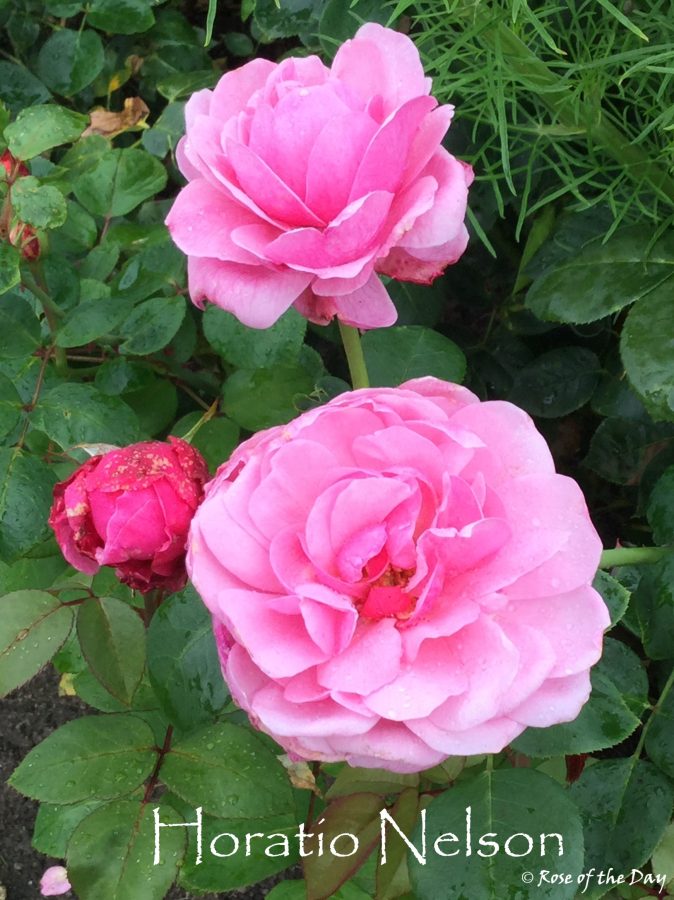
The county of Norfolk is quite rightly proud of its son Admiral Lord Nelson. Born in 1758 a small weak baby not expected to survive he confounded expectations by hanging onto life. What a life, joining the Navy at the age of twelve he rose through the ranks. Given command of the Agamemnon in 1793, proving to have exceptional strategic battle skills he was at the forefront of Naval battles until his death at the Battle of Trafalgar in 1805. Losing an eye, an arm, but gaining a mistress Emma Hamilton on the way! Driving over the county boundaries on the major roads the signs read ‘Norfolk – Nelson’s County’.

Peter Beales was also a Norfolk man and likewise, his daughter Amanda was born and raised at his rose nursery. Today’s rose is one of Amanda’s shrub rose ‘Horatio Nelson’. Introduced in 1997 with the Delbard Floribunda ‘Centenaire de Lourdes’ as the seed parent and the lovely ‘Aloha’ providing the pollen.

The Delbard genes give ‘Horatio Nelson’ his strong intense fragrance and the glorious colour must come from ‘Aloha’. Plump dark pink buds lighten as they unfold into a large full petalled mid pink bloom. The outer guard petals are of a lighter colour intensifying the darker centre. Described by Peter Beales as an old fashioned style with an attractive rosette petal formation. Reliably repeat blooms into late autumn.

Medium sized at 1.2m x1.2m so useful size for all gardens he is a healthy vigorous rose. Good glossy foliage and hardy USDA zone 4b-9b.

This one is available outside the UK with European, Canadian and New Zealand nurseries listed. Perhaps someone can comment on his availability?

A good rose for your garden particularly if you have an interest in Naval history and if like me you descend from good Norfolk stock.

Tuesday 9th April

One to wake you up this morning! An extremely eye catching rose – ‘Super Trouper’.

Bred by Gareth Fryer who has produced a substantial number of Floribunda roses, around 190. His lovely ‘Let’s Celebrate’ was Rose of the Day on the 21st of December last year. ‘Super Trouper’ was introduced in 2009 by Fryer’s Nurseries. The name? Well, I guess that Gareth Fryer is an Abba fan!

Winner of the Novelty Rose of the Year in 2010 and one can certainly see why. Clusters of fiery sunset orange buds open to an initially blazing bloom, but she softens her colouring as she opens. The combination of pale buffy orange petal backs, the slightly red tinged guard petals and the paler apricot centre make for a striking rose. Repeat flushes of bloom and can be almost continuous in some climates. Fragrance is eclipsed by the colouring I am afraid, just a mild perfume.

A rose on the small side, around 85cm high, would be an ideal container candidate. She will need carefully placing though not to clash with other roses. The second photograph shows her cleverly placed against a quiet background of shrubs. She doesn’t detract from the other plants but still lights up the garden.

Good glossy dark foliage which is healthy. Compact and tidy growing. I cannot find a hardiness score, but I would assume USDA zone 6b-9b. Do comment if you grow her outside of these zones.

I am not too much of an orange rose fan so she wouldn’t be a rose for me. For those of you with those sunset beds who love these hot colours, she is perfect!
Wednesday 10th April

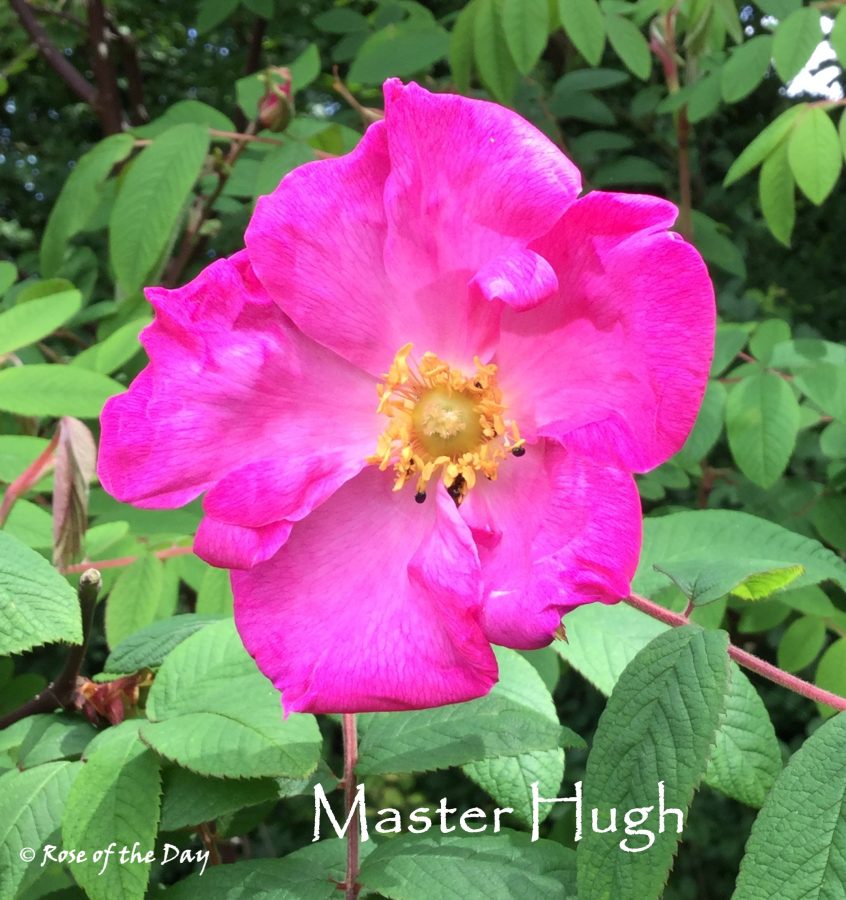
A wild Wednesday rose whose seeds travelled from the Himalayas to Norfolk, nurtured in the garden of a great twentieth century plant hunter and introduced in 1966 as ‘Master Hugh’.

The plant hunter was Maurice Mason, a west Norfolk farmer who farmed just to fund his plant hunting expeditions, and his magnificent gardens. Maurice introduced a vast number of plants, particularly the Sorbus family, was chairman of the RHS tender plants committee and was awarded the Victoria Medal of Honour (VMH).  This is awarded to British horticulturists whom the Royal Horticultural Society Council considers deserving of special honour by the Society.

‘Master Hugh’, named for his son, is the only rose Maurice introduced. A Hybrid Macrophylla from seeds collected in China by a famous trio of Himalayan plant hunters Stainton, Sykes and Williams. This is not a rose for small gardens as he can be a lofty 4.5m and around 2.5m in width. Nor is he a rose for hot and dry areas, his Himalayan ancestry means he is happier in cool even cold damp climates.

In late spring small clusters of buds unfurl into large mid pink single blooms with a magnificent golden stamen corona. A hint of fragrance and nothing more. I have noticed his bloom has reduced as our spring weather is now warmer and dryer. Rather un rose like sparse foliage, looks almost like rowan leaves. Deeply veined matt leaflets, often seven or nine on the leaf stem. Completely disease resistant though. I rarely prune him as he grows up on a bank with masses of space. Hardy USDA zone 4-10 but I fear that 10 would be way too hot and dry for this rose.

Just a single flush of bloom and then in the autumn he rewards one with the most extraordinary hips. Large chestnut brown with a blueish bloom and with long reddish brown fleshy sepals. They remind me of lobsters. If you have friends into flower arranging, they love these unusual hips for their floral creations.

‘Master Hugh’ is not going to suit a small garden or a formal rose garden. He is an interesting landscape rose suitable for wilder areas of a semi natural garden where he can grow tall and wide. If you have such a garden in a cool damp climate do consider him, he won’t disappoint.
Thursday 11th April

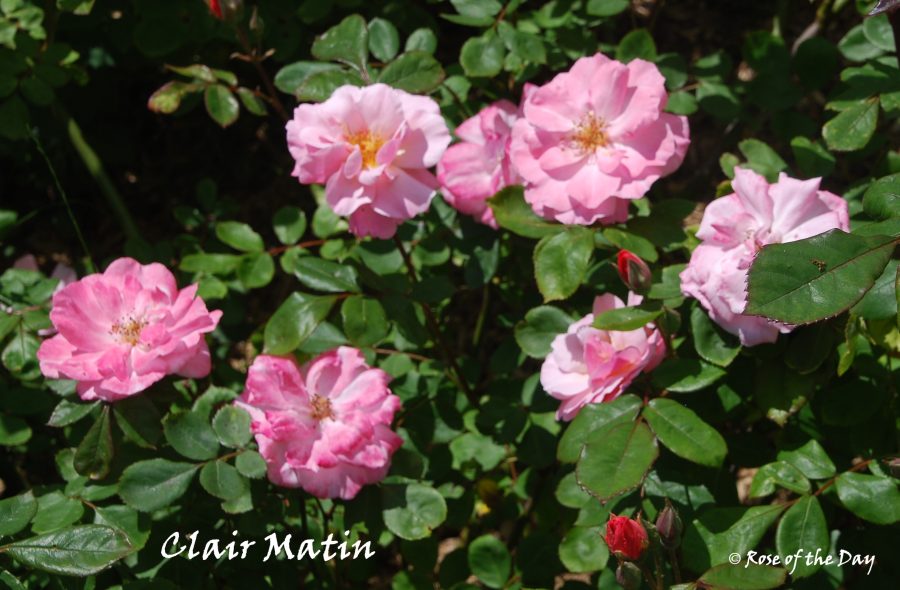
A climbing rose not yet in my garden but one that will be planted this winter, replacing a rather straggly and elderly ‘Amy Robsart’. I want an almost continuous blooming climber, poor Amy has just a single flush of bloom. A lot of consideration, shuffling notes, and looking at photographs before I settled on ‘Clair Matin’.

From the premier French rose breeders Meilland, this rose was bred by Marie Louise Meilland and introduced in 1960.

‘Clair Matin’ translates as ‘morning light’ an appropriate name for this dawn pink rose. Vast clusters, up to forty, lipstick pink pointed buds which open out into salmon pink semi double cupped blooms. Fades to a pale sunrise pink as the bloom matures, revealing the bee friendly golden stamens.  Practically continuously in bloom, she starts early in the season and just keeps on going, one of the most freely flowering of all roses. Sweet light fragrance.

She can be grown as a large shrub reaching around 2m. As a climber though she extends those prickly stems up to 4m. A little bit of a diva as she prefers good soil and some care to give her very best. Dark leathery foliage but her disease resistance is also variable, she can suffer both mildew and blackspot. Whenever I write that comment I get lots of remarks from page followers that their rose is very healthy. That. of course, is good to hear but in some areas in some years, this is a rose that will need some fungicide.

Widely available. Hardy USDA zone 6b-9b. She has a rating from the American Rose Society of 8.5 placing her in the ‘very good to excellent, one recommended without hesitation’ category. These ratings are based on returns from rose growers in the States.
Friday 12th April

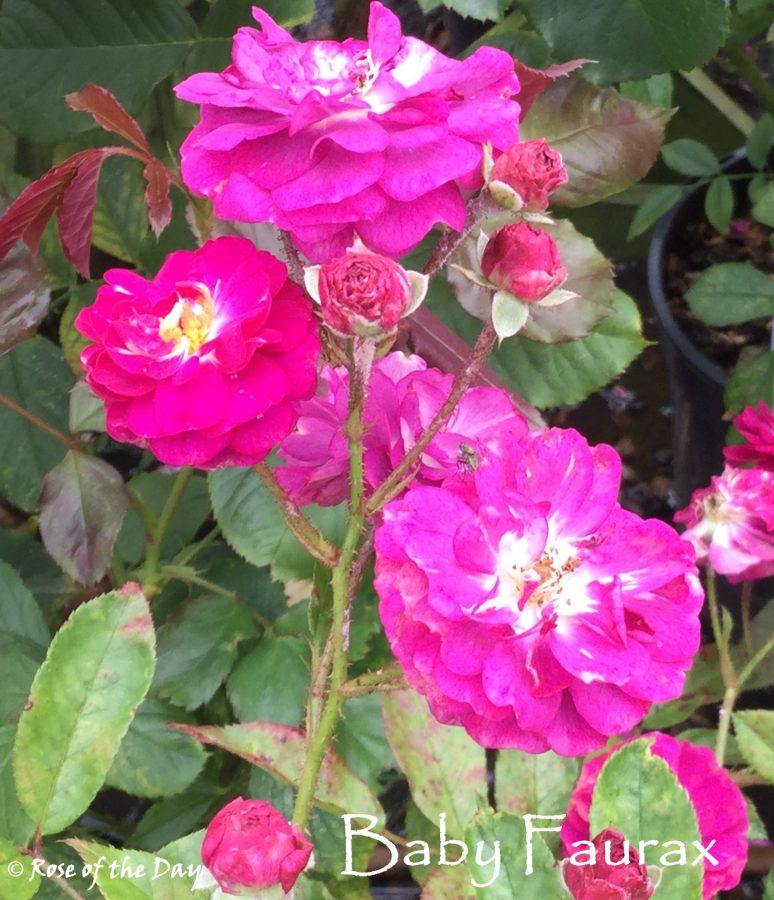
Today we have a rose with what I think is one of the most unappealing names given to a rose the dwarf polyantha ‘Baby Faurax’. Despite this name, she is a very interesting little rose.

Bred by Leonard Lille who had a seed company in Lyon where he sold rose seeds of the ‘Lawrenceana’ (small China roses) and ‘Polyantha’ groups. The parentage of ‘Baby Faurax’ is unknown but one could assume this rose was grown from seeds from Lille’s company. Lille bred around fifteen roses, most now extinct, and introduced ‘Baby Faurax’ in 1924.

Faurax appears to be a relatively common Belgian surname and there was a nursery with this name somewhere in Belgium in the early twentieth century. There are a handful of other roses dating from this time which include this surname, for example, Elisabeth Faurax. I would pronounce the name ‘far row’ as it is French and not Flemish. I doubt it is ‘four rax’ as I have heard. It’s not the baby food Farex either! I guess amongst you all someone knows the correct pronunciation.

However, she will forgive you for mangling her name. She is an accommodating little rose, only around 50cm on her tiptoes, so you can pop her in her container or snuggle her in a small space. Produces fairly large, for her size, clusters of mini bright pink buds. These open to what is reputed to be the ‘bluest’ of all roses. However, she is more a purple to me than a blue, but this colour is highly variable depending on your climate and soil. She can be pinker, violet, lavender even slate blue. The petals with their white base and paler backs create an attractive little, 3cm, double bloom. Reputed to have the fragrance of grapes but I have never got a hint of perfume from her. Blooms in flushes throughout the summer. Healthy and hardy USDA zone 5b-10b. Graded 8.0 with the American Rose Society ‘a solid to very good rose. It is good features easily outweigh any problems. Well above average’.

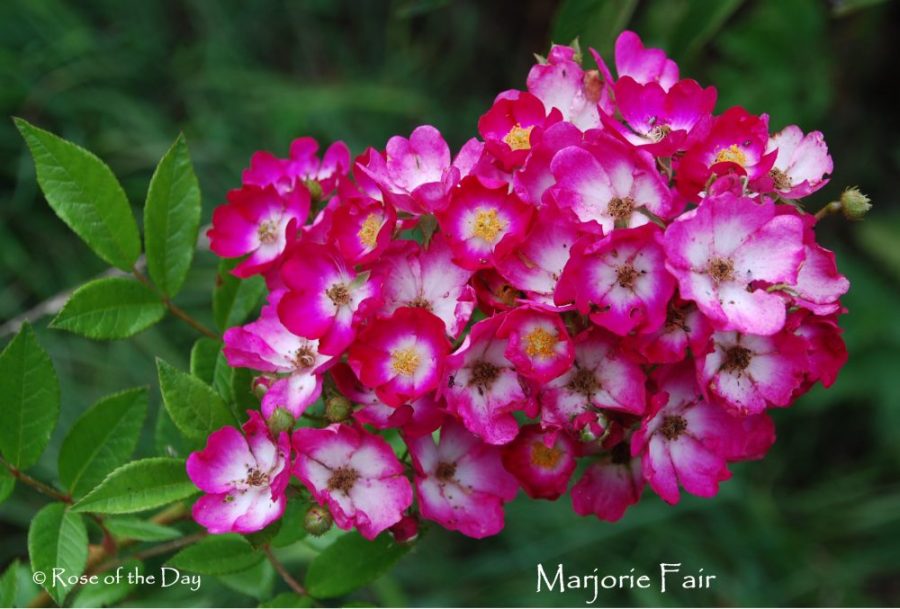
This is a rose that has been used very successfully in breeding programmes with 102 descendants. ‘Marjorie Fair’ a first generation child who featured on this page on 24th January this year.

If you want that intriguing colour and lack the space for the similar coloured rambler ‘Veilchenblau’ then this pretty little rose is for you.
Saturday 13th April

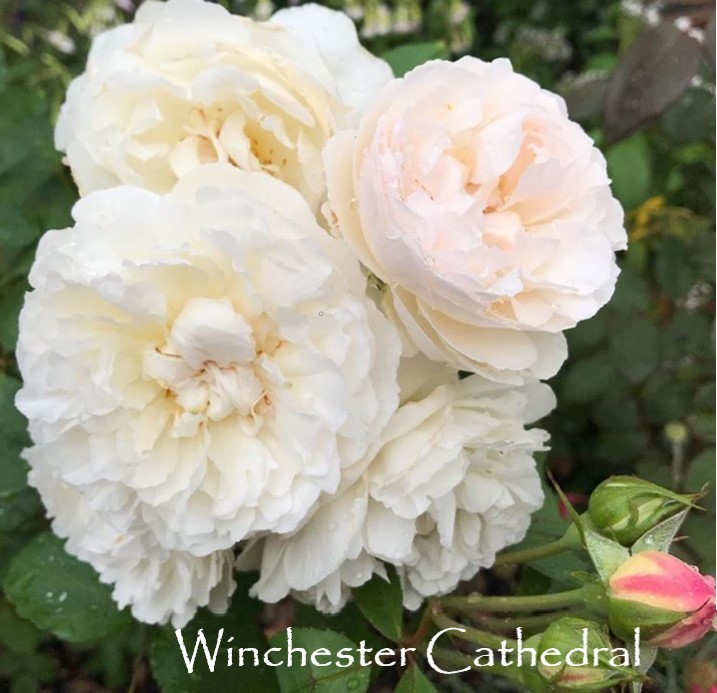
Today’s rose , the David Austin rose ‘Winchester Cathedral’.

Many of you will be familiar with the pink DA rose ‘Mary Rose’, and she produced a pure white sport, this was named ‘Winchester Cathedral’ and was introduced in 1988. She is a little bit unsure at times whether she should remain white or perhaps flirt again with being pink or even have a bit of both in a bloom. The clusters of globular pink streaked buds open initially to a soft baby pink which quickly fades to a pure white unless she is in a colour dither. Very full petalled with a charming loose rosette arrangement, although I say pure white there is a touch of green in the petal bases. David Austin remarked that this rose is one of the best white roses he bred although one could argue that this rose, being a sport, bred itself. Steadfastly repeat blooms and she has a medium fruity fragrance to complete the picture.

Around 1.2m high with somewhat twiggy growth but she makes a good shape. Good shiny foliage with good disease resistance. Hardy USDA zone 5b-10b. Scoring a 7.9 with the American Rose Society ‘a solid to very good rose. It is good features easily outweigh any problems. Well above average’.

Named for the Winchester Cathedral Trust, a registered charity that helps the cathedral with renovation and development projects. This cathedral in common with other British cathedrals has a daily running cost in the region of £10,000. Initially, a percentage of the sales went to this Trust, but she is now out of the protected breeders’ rights time frame, so I guess this no longer happens. Being out of protected breeders’ rights does mean that you will find ‘Winchester Cathedral’ propagated and sold by other nurseries although David Austin still has her in the current catalogue.

Certainly, a much better rose than last Thursday’s ‘Claire Austin’. If you want a repeat flowering white rose, then ‘Winchester Cathedral’ fits the bill.

Sunday 14th April

A rose of several names again! A Hybrid Tea from the German nursery Kordes – ‘Beverly’. Known in Britain as ‘Pink Perfection’, ‘Perfume Passion’ in Australia and South Africa and France has her as ‘Sophie Davant’. Her exhibition name is ‘Beverly’ and the ICRA appellation is KORpauvio so that last one will get you the correct rose.

Introduced in 2008 as part of Kordes Eleganza collection she has a stash of awards including a 2012 Gold Medal, Best Rose in Trials, Best Fragrance and Best Hybrid Tea in Australia. They clearly love her down there! However, in the States, she only achieves a 7.8 in the American Rose Society grower’s evaluation – ‘a solid to very good rose. It is good features easily outweigh any problems. Well above average’

A strong growing rose that produces typical HT elegant buds of a greenish white streaked pink.  Opens white and touched with pink but the pink deepens as the bloom matures finishing with a deeper pink centre with paler guard petals. Very full petalled, she looks more like a classic old fashioned rose rather than an HT. Repeat blooms throughout the summer. Some reports that she is a fair weather rose tending to ‘ball’ in damp weather.

Strong zesty fragrance. I couldn’t resist adding her fragrance description from the Kordes website. One doesn’t think of the Germans as being quite so poetic – ‘The scent is intense, yet fresh. The top notes of citrus are present even when the bud is just opening. When the flower is fully open the wonderful heart notes of fresh litchi and white peach predominate with the fragrances of pear and plum also being present. The earthy base notes of patchouli and fresh myrtle are faint but complete the experience.’ Mmm OK!

Rather variable in height depending on your climate. In the UK she will be around 1m but easily 2m in warmer countries. Tall growing habit with good semi glossy foliage. Reputed to be very disease resistant. Hardy USDA zone 5b-10b.

I don’t have this rose in my garden but if you grow her perhaps you could comment on the damp weather problem with the blooms? Otherwise, she looks like a very worthy rose.
Tuesday 16th April

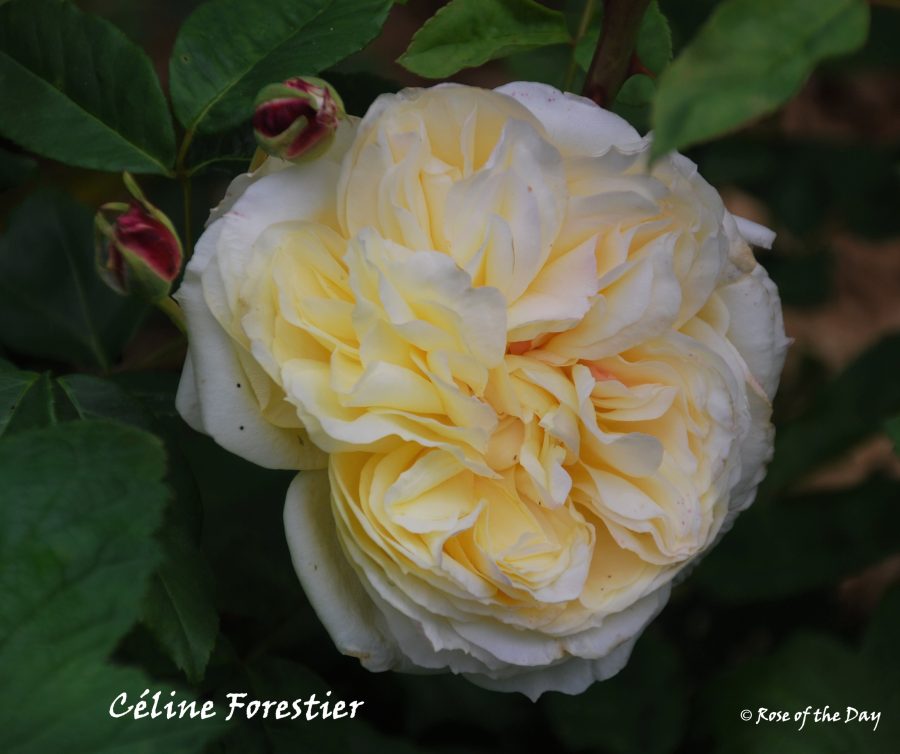
One of the most popular and prettiest of the Noisette roses this morning ‘Céline Forestier’. A lady who likes a sunny spot to give her best, but she is a tough hardy soul.

Bred by Victor Trouillard who gave us the rather special Cardinal de Richelieu, and bred in 1842 so she is one of the early Noisettes. She was not introduced onto the open market immediately, having to wait until 1860 when a fellow nurseryman André Leroy unveiled this charming rose.  Parentage is not known but some guesses at ‘Champneys Pink Climber ‘and ‘Parks Yellow. Named for a close friend of Victor Trouillard and of that, I can find no more information. This is a magnificent rose, so I hope that his friend was as delightful

A rose that surprises one by producing small clusters of dark pink buds in early summer that change their colour to pale yellow as they unfurl. Exquisite full silky petalled blooms with centres of darker yellow, buff and apricot. Charming untidy petal arrangement, full of small quills in the centre surrounding a tiny green button eye. As she matures and flattens out the guard petals fade to creamy white, a truly elegant fragile beauty. Strong intense ‘tea’ fragrance. Once she starts to bloom, she will continue without a break until the first frosts.

When grown as a shrub she will reach 2m but much higher if you grow her as a climber particularly if you have a warm wall. Semi glossy almost evergreen healthy foliage, small note that she can suffer late season mildew. Hardy USDA zone 7b-11b, so not a cold climate rose at all. Holds an RHS AGM medal (Royal Horticultural Society Award of Garden Merit). Graded 8.4 with the American Rose Society (A good to excellent rose. One recommended without hesitation). She does have a slight reputation for being difficult to grow but this is related to being a slow starter, so patience is needed in her early years with you.

‘Céline Forestier’ is a rose that needs careful placing and then a little bit of cosseting. I would love to grow her, but I have run out of warm walls. That is unless I hire some roadworkers with their equipment to punch a hole through concrete beside a south facing wall in the farm yard. Now that is an idea!
Wednesday 17th April

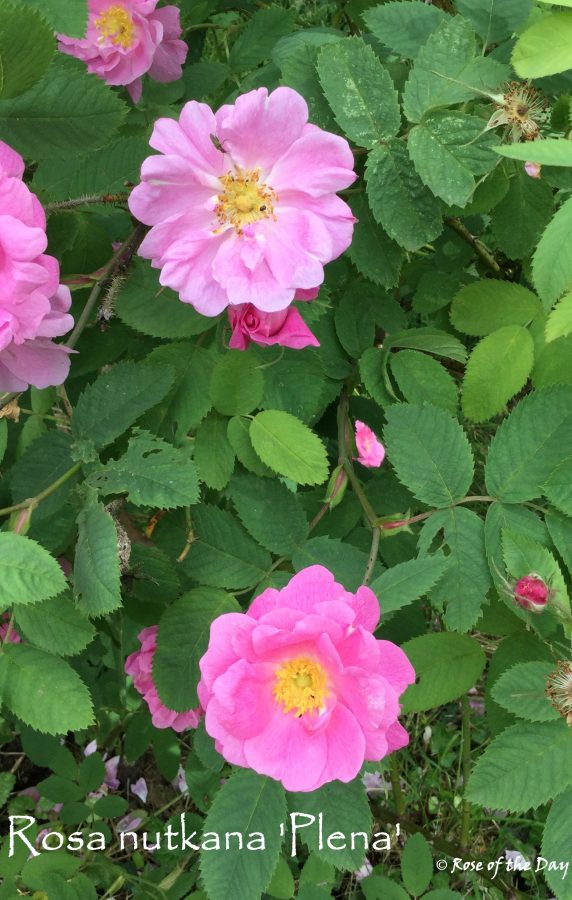
A wild Wednesday rose, well she is a found seedling of ‘Rosa nutkana’, known as ‘Rosa nutkana ‘Plena’. Her delicate blooms belie her toughness, hardiness, disease resistance and tolerance of poor soil and shade.

‘Rosa nutkana’ is a native of California, Oregon, Washington, British Columbia, and Alaska. Discovered by Archibald Menzies, one of the scientists with Vancouver’s expedition in 1793. Named for Nootka Sound on the west coast of Vancouver Island. I guess that ‘Plena’ appeared from a chance cross when Rosa nutkana was grown as a garden rose.

I don’t know how many people grow this rose, I have never seen her growing anywhere other than in the species rose collection at Peter Beales nursery. I bought her from Peter Beales back in the 1980s and planted her in a rubbish bit of soil in the front yard of the farm. The trees on the edge have now grown quite tall so she is in shade for part of the day.

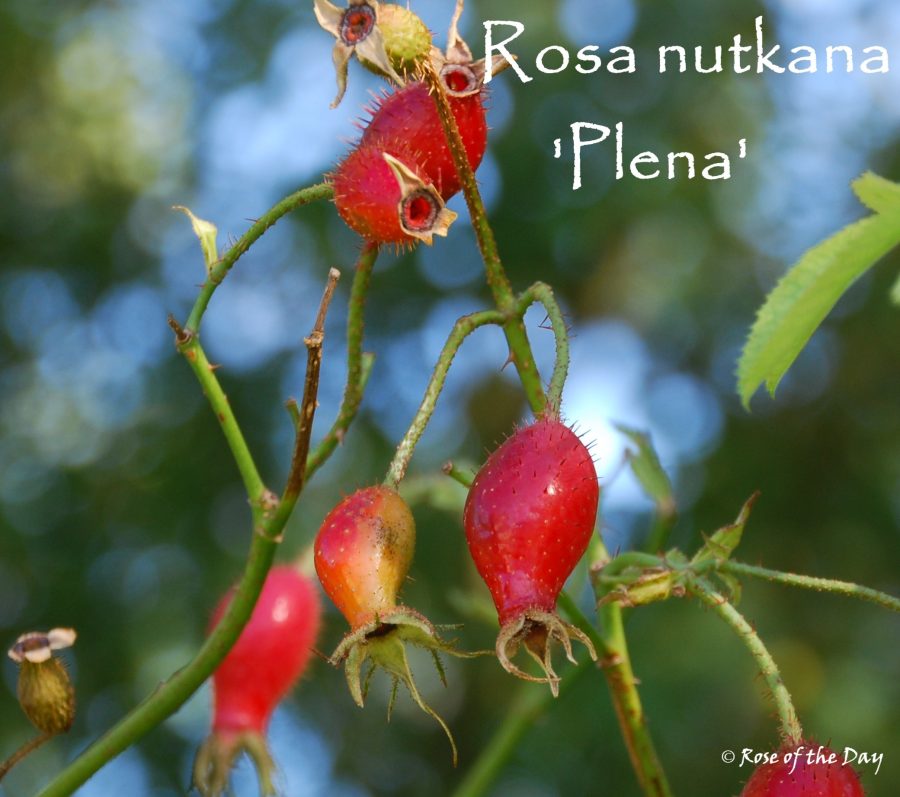
Her pink buds appear late June to early July opening to a delicate semi double lilac pink bloom with a big yellow stamen crown. Strong fragrance from such a quiet little bloom. Matt green foliage with deeply ridged leaves. Red hips follow in the autumn and hang onto the bush until the spring. They must taste unpleasant as the birds never touch them.
Grows to around 2m high and around the same width. Available in Europe but I cannot seem to find her in the US at all. Perhaps if you grow her there you can comment on this? Her parent ‘Rosa nutkana’ is hardy USDA zone 3b and warmer so ‘Plena’ may well be similar.

She isn’t a choice front of the border rose but if you have an awkward corner in a large garden, she would fill this very well. She fits my semi wild wilderness area well and surprises visitors who catch her astonishing fragrance drifting in the summer air.

Thursday 18th April

Living in the rather flat Suffolk countryside I yearn for a garden on the side of a hill so I could have terraces and banks. One always wishes for the impossible! Today’s rose is one to grow falling down a bank or over the side of a terrace. However, the photo was taken at Mottisfont Abbey where ‘Raubritter’ was spreading her charms beside a small ornamental pond.

‘Raubritter’ is a procumbent rose, wider than she is tall if you grow her as a shrub. Give her support and she will scramble up to 3m. This idiosyncratic growth habit occurs with most of the procumbent roses. Bred in Germany in 1936 by Wilhelm Kordes, the pink hybrid Macrantha ‘Daisy Hill’ provided the seed with the red hybrid Wichurana ‘Solarium’ donating the pollen.

Small pointed dark pink buds appear in large clusters in early June opening to the most astonishing bloom. The profusion of buds open to silvery pink globes each with a small opening at the top, very un rose like. The small opening gradually becomes wider and wider until a beautiful dark pink peony like bloom emerges. Just so beautiful, one could look at them all day. Fragile and delicate petals which don’t like the rain or dampness sadly as they will ‘ball’. A fresh sweet fragrance drifts from these superb blooms. Just one magnificent flush of bloom but you do get a lot of bloom for a long period

A tendency for black spot and mildew so not a rose for the non spray garden. Otherwise, she is very vigorous with slender prickly stems and narrow wrinkled foliage. Hardy USDA zone 6b-9b. Reputed to be very frost resistant. American Rose Society grading 8.1 (A solid to very good rose. Its good features easily outweigh any problems. Well above average).

This dainty rose has to me an entirely inappropriate name. A Raubritter was a feudal robber baron or knight imposing unfair taxes and demands on his subjects. I can think of several rampaging thorn ridden ramblers for whom the name Raubritter would be extremely apt but not this pretty rose.

Although she may have been overtaken by the modern healthy continuous flowering ground cover roses I still think ‘Raubritter’ is well worth growing If you have the space for her to sprawl or scramble, she will undoubtedly bring admiring glances from your friends and visitors.
Friday 19th April

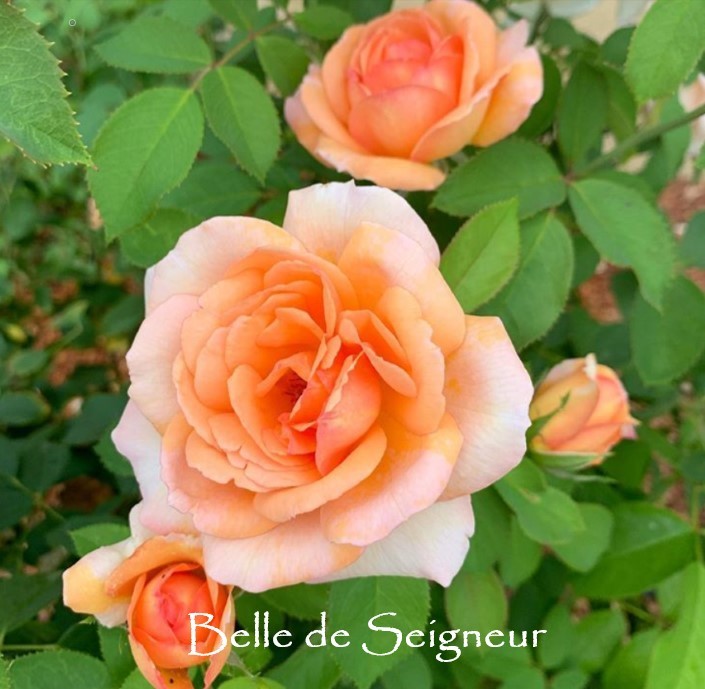
I learnt the art of total immersion in a book at a very young age. This was a huge advantage growing up in a noisy and somewhat chaotic household. I opened my book and stepped into another world obvious to anything addressed to me. Eager to get to the end of any story I learnt to read very fast as well so I have read a lot of books. I don’t recall reading any of the Swiss novelist Albert Cohen’s books. Today’s rose the Delbard Hybrid Tea takes her name ‘Belle de Seigneur’ from one of his romantic novels. A satire of international relations in the 1930 and the seduction of a married French aristocrat. A film also but have not seen that either!

Delbard clearly had the seduction idea in mind when naming this rose. She may well seduce you if you add her to your garden with her colour and the signature Delbard fragrance.  Characteristic HT buds of dark pink appear in small clusters held aloft of the red tinged dark green foliage. This foliage is the perfect foil for the large very full petalled blooms opening from those elegant buds. Delicious apricoty pink petals with darker petal edges that have peach bases giving a deep glowing centre. She is a rose influenced by growing temperature though. Grow her in cooler climes and she will be a calmer but still striking delicate pink touched with apricot and copper. Classical HT high pointed centre but they flatten out with age. I prefer HTs a little past their prime blowsy and carefree rather than the perfect tight points of early life. Long lasting blooms both on the bush and in a vase for the house. Luxurious perfume, heavy with fruit notes.

On the small side only 60-80cm high but is likely to be higher in hot climates. Good disease resistance. Hardy USDA zone 6b-9b but it looks as though she is happy 9b-10b. Widely available but you may well find her listed in South Africa as ‘The Midlands Rose’. An ordinary name for this spectacular rose! I prefer ‘Belle de Seigneur’

A real ‘Sunset’ coloured rose so you will need some thought on placing ‘Belle de Seigneur’ to avoid a sunglasses moment should you grow her next to a bright pink. I see she is recommended for informal hedging and given her small stature she would be ideal in a container.

Now that book Belle de Seigneur. Amazon calls!
Saturday 20th April

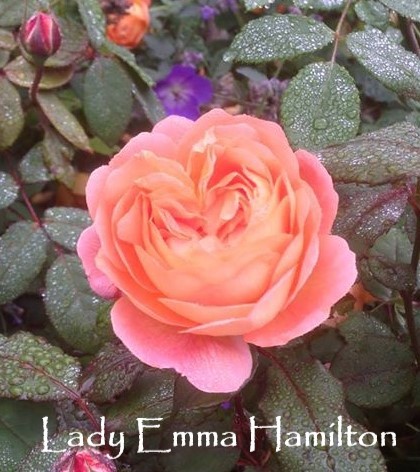
‘Horatio Nelson’ was our rose of the day on the 7th of April, so it seems appropriate to feature his mistress ‘Lady Emma Hamilton’. ‘Horatio Nelson’ bred in his birth county of Norfolk by Peter Beales whereas ‘Lady Emma Hamilton’ is a David Austin rose. Introduced in 2005 to celebrate the two hundredth anniversary of the Battle of Trafalgar. I wonder why ‘Lady Emma Hamilton’ and not ‘Trafalgar’? There is an old Hybrid Tea ‘Trafalgar’ no longer available but perhaps ‘Lady Emma Hamilton’ has a more romantic feel.

Like her namesake, this is a beautiful rose, but she can be a hot colour so needs care in placing, also like her namesake! Buds of orange streaked red open to a characteristic DA globular bloom. Initially, these blooms are a hot tangerine orange with paler guard petals and a sunglow yellow centre but fear not as the colour soon calms as the bloom ages to a loose petalled bloom. The outer guard petals fade to a lovely pale pink apricot with a beautiful peach gold centre. She does vary considerably according to growing conditions, with intense colour in the heat and dry whereas she is more mellow in the cool and damp. Strong perfume described in the David Austin catalogue as fruity with hints of pear, grape and citrus fruits. I will leave it to you to decide on this fruit cornucopia! Repeat blooms all summer.

Not over large, just 90cm high but as usual with roses, she will be taller in a warm climate. Very dark bronzed green foliage which really makes those blooms ‘pop’. Bushy growth habit. Good disease resistance. Hardy USDA zone 5b-9b. American Rose Society grading 8.0 (A solid to very good rose. Its good features easily outweigh any problems. Well above average).

Growing up in Norfolk and going to a school where I was in the Nelson House, I don’t recall hearing too much about Lady Emma. Probably considered inappropriate back then for young ears. She led an exciting if risqué life. Born into a poor family and christened Amy she made her way to London as a teenager to work in domestic service. Her beauty ‘saved’ her from a life of dreary cleaning though. Mistress to two aristocrats and bearing the child of one. The society artist George Romney became obsessed with Emma as she was now known, and she features in many of his historical paintings. The second image shows his painting of Emma as ‘Circe’.  Emma was ungraciously palmed off by one of her lovers onto Sir William Hamilton the British envoy in Naples. Although thirty four years her senior he married her in 1791, and later that year she met Nelson. Her married life was as flamboyant as her youth. She entertained guests at diplomatic parties scantily dressed in classical tableaus. Her great love though was for Nelson and this liaison seems to have been condoned by Sir William as they lived in a ‘ménage à trois’. A daughter Horatia was born before Nelson was killed at the Battle of Trafalgar. Emma slid into a life of debt and alcohol and died in Paris at the age of just fifty.

George Romney – Lady Hamilton as Circe

I have the white semi double Peter Beales rose ‘Nelson’s Pride’ but he is snuggled up with the early single HTs ‘Ellen Willmott’ and ‘Mrs Oakley Fisher’. I wonder if those two straight laced ladies would welcome the flamboyant ‘Lady Emma Hamilton’ joining them?
Sunday 21st April

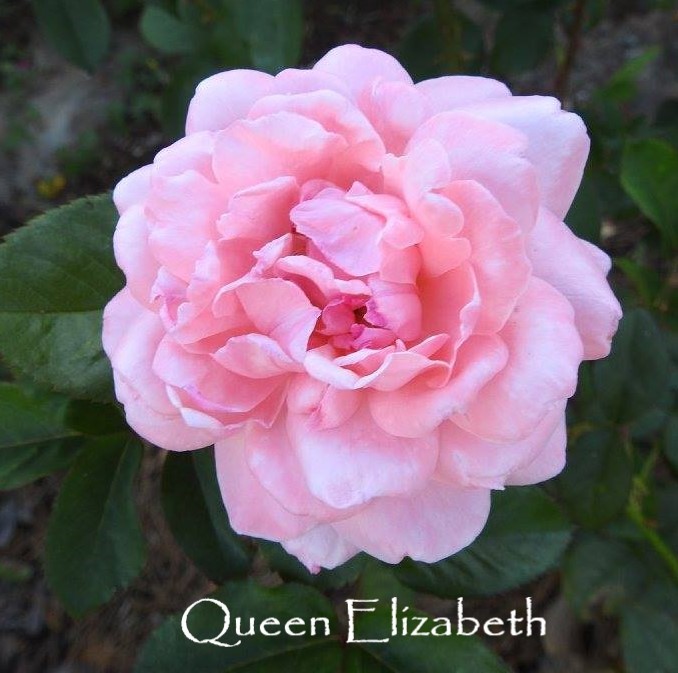
Easter Day so I send you best wishes. Today is also Her Majesty Queen Elisabeth’s birthday and today’s rose is the Grandiflora ‘Queen Elisabeth’.  The 21st of April is her actual birthday, with the official one being on the second Saturday in June.

An iconic rose bred not in Great Britain but in sunny California by Dr Walter Lammerts who produced several Hybrid Tea and Grandiflora roses. The Grandiflora class was initiated by this rose ‘Queen Elizabeth’. The qualities of a Grandiflora are said to be a combination of Hybrid Teas and Floribundas and of course large blooms. The name is a bit of a clue there. The term is more widely used, I think, in the States than in Britain.

Introduced in 1954 to honour the 1952 coronation of Queen Elizabeth. I can’t see that two year gap occurring now in the days of sharp marketing! This is a very widely grown rose or should I say was. Still in catalogues but one doesn’t often see her in garden centres. I often get sent photos of an unknown pink rose found in Granny’s garden or on an old property. Usually, the unknown is this glorious pink ‘Queen Elizabeth’. She grew here at the farm when I first arrived but in a really poor position. I moved her but she fell into a decline and died. My mother, an ardent Royalist, blamed this death on me as I am not a great supporter of the Royal Family!

Large clusters of tight elegant lipstick pink buds but you can also get a single bud, on long dark stems. She is a good rose to cut for the house. Neat furled high pointed pink blooms to begin with but they open further and flatten to an attractive bloom. The outer petals are a pale seashell pink with an appealing ruffled edge surrounding the smaller mid pink centre petals. The petals reflex and ruffle as she flattens to reveal the golden stamens. Not a heavy fragrance but sweet and light. Gracious perhaps? Flushes of these gorgeous blooms all season.

Slightly inclined to late rust attacks so watch her carefully. She is narrow in growth habit but can be very tall 2.5m easily. Often grown against a wall as a climber. Vigorous and tolerant of poor soil.  There is a climbing sport ‘Climbing Queen Elizabeth’, but it suffers from too much vigour so the high blooms wave to the sky and the stems are almost too stiff to bend and train. There are also two other sports, white and yellow.

‘Queen Elizabeth’ has been awarded a slew of awards since her introduction including Rose of the Year in 1979. If you have the space for her, she is a rose worth considering.

Happy Easter.

Tuesday 23rd April

One of the oldest rose growing, and breeding companies in Britain, established in 1765, is just an hour’s drive from me, I have frequently passed within a few hundred metres of their gates, but I have never visited Cants of Colchester. This is a shocking admission and I aim to correct this by visiting this summer. Cants no longer breed roses just concentrating on the sale of roses. The nursery remains in the Cant family although the current owners the Pawseys are descendants from the female line. Roger Pawsey bred the popular and beautiful ‘Just Joey’ featured on 21st March.

Originally the company was known as Benjamin R. Cant & Sons. In the child naming tradition of the Victorian era, the eldest son was usually given their father’s Christian names. We are concerned here with Benjamin R. Cant (1827-1900), (the R for Revett, his mother’s maiden name), who bred a fabulous Tea rose naming it for his wife -‘Mrs B.R. Cant’ – today’s rose of the day.

Introduced in 1901 this Tea rose has remained very popular particularly in the States and Australia as she is a bit of a hot weather lady. The picture perfect pink touched buds are carried above the bush on long stems, excellent for a cut flower. Opens to a very full petalled silver pink bloom with a quartered centre. Darker pink petal backs giving an attractive contrast as the bloom flattens and the petals reflex. Just such a faultless classic rose form you absolutely can’t beat it. Fabulous Tea fragrance and she starts blooming early in the season and just keeps on going until the frosts of winter. Her autumn blooms are often better than the early summer ones.

She needs some space should you plan to grow her as she grows as wide as she is tall. Can be 2.5m high and frequently more in hot climates. Does not appreciate being pruned too hard, leave her to her own devices. Dark healthy foliage and a bushy habit. Tolerant of poor soils. Hardy USDA zones 7b-9b. Being a Tea rose she will not appreciate cold winds so find her a sheltered spot. The American Rose Society grading is a whopper of 8.9 (An outstanding rose. One with major positives and only minor negatives. The top 1%). Praise indeed.

Whilst researching her I found a digital copy of Cant’s 1916 catalogue where I found ‘Mrs B R Cant’ at the cost of 1 shilling, 5p in decimal currency. Historic price equivalents are slightly tricky, but the real price is £3.33 in today’s money. The labour value £15.21 with an income value of £20.40. Fairly comparable with the cost of roses today in Britain.

Widely available but not however from Cants of Colchester, nor any other UK nursery. They do not stock any Tea Roses. One would think they would stock roses of their own breeding!

Wednesday 24th April

The first of the 2019 roses from my garden this morning. Usually, the harbinger of spring here although I have to say she is a little late to display her charms this year. This extraordinary spring has meant the wearing of shorts and sunburn before her sunny blooms opened. “Look the Canary Bird is out so it must be spring at last!” was not this year’s spring proclamation.

Rosa xanthina ‘Canary Bird’ is a rose of British origin, introduced in 1907 but who bred her or what her ancestry is remains mysterious. Rosa xanthina, a species rose from China, is very similar but has double blooms and prickles. ‘Canary Bird’ is generally considered to be a hybrid of either Rosa xanthina or Rosa hugonis. Graham Stuart Thomas reports she was reputedly raised at Osterley Park in west London, but I can’t find any other reference to this birthplace.

A large rose who grows wider than she is tall. Her foliage is bright green but small delicate and fern like, around 9-11 small leaflets. These are carried on long arching reddish brown stems. Along these stems appear small tufts of leaves each bearing a jewel like yellow bud which pop open to small single bright golden yellow blooms. A magical sight. Each little bloom has a golden corona of stamens, a feast for hungry pollinators. The bright yellow fades in the sun to cream before the petals drop. A light ethereal fragrance not like any other rose. In reality Canary Bird is all together an un rose like rose!

Just the one single glorious flush of bloom although after a hot summer she will produce a scatter of blooms in the autumn. Small black hips appear but these are not as glorious as her spring blooms.

Absolutely no disease problems but she does suffer from dieback. I have two bushes and one has had so much dieback that she may have to pass on to the great compost heap in the sky. Leave your secateurs in the drawer for this rose, she dislikes pruning and this can accelerate die back. She isn’t a fan of cold icy winds, USDA zones 5b and warmer. The American Rose Society grades her as 6.5, a below average rose. I feel this is a little harsh, she is a rose that I would always have in my garden. She needs space though so more suited to a landscape or wild garden than a formal town garden. Reaches around 2.5m in height and approximately 3.5m wide.

Her flush of bloom lasts around two weeks before she retires for the summer but then the other roses are waking up and summer is practically here.

Thursday 25th April

If you have the chance to visit Mottisfont Abbey Gardens in Hampshire UK, leap at it! A stupendous rose garden holding the National Collection of Pre 1900 roses in two well designed walled gardens. Those of you who have been lucky enough to visit will remember I am sure the central pathways with the attractive arches covered in climbers, the semperviren rose ‘Adélaïde D’Orléans’.

Semperviren roses were brought into being by the head gardener Antoine Jacques to the Duc D’Orléans, at the Chateau de Neuilly. Jacques used the species rose Rosa sempervirens, a strong healthy rose, in his breeding programme. To call this a breeding programme is a little ambitious. At the time it was more of a hit and miss affair compared to the highly controlled and organised programmes used today. However, from his amateur work some fine climbing roses were produced, ‘Félicité et Perpétué’ being his most widely grown rose.

‘Adélaïde D’Orléans’ produces large clusters of small bright pink buds which hang downwards in a small waterfall rather than being held erect. These little pink buds unfurl to a blush pink bloom opening further to a creamy white semi double rose with charming heart shaped petals. A small golden stamen crown in the centre pulls all the bees and pollinators towards her. Sweet light fragrance said to be reminiscent of primroses, I will leave that one for you to decide! The outer guard petals retain their pinkiness giving a slight colour contrast to the attractive cascades of bloom, a truly breath taking sight. Enjoy it while it lasts as Adélaïde blooms just the once in June.

A rose requiring space or very tall arches as she can reach a lofty 5m. The Mottisfont arches are not 5m so there will be a severe prune following her June flush. Good disease resistant small dark foliage but some report she can be hit by mildew so keep an eye for this quickly defoliating condition. Hardy USDA 6b-9b.

Adélaïde D’Orléans’, actually Louise Marie Adélaïde Eugénie was a member of the Bourbon family born in 1777 daughter of the Duc D’Orléans. She was a twin but her sister Léopoldine died aged four. Antoine Jacques named another rose for Leopoldina and it seems over time these two roses have become muddled and one has been lost to cultivation. Adélaïde may well be ‘Léopoldine D’Orléans’! Adélaïde led an interesting life in chaotic revolutionary France and the Bourbon restoration. Unmarried she lived with her brother, King Louis Phillipe and his wife running their household and caring her their children. In her youth she took painting lessons from the great rose artist Pierre-Joseph Redouté producing excellent floral portraits.

Louise Marie Adelaide Eugenie d’Orleans

If you have space for a large rose arbour or arch Adélaïde D’Orléans’ is certainly one to consider.
Friday 26th April

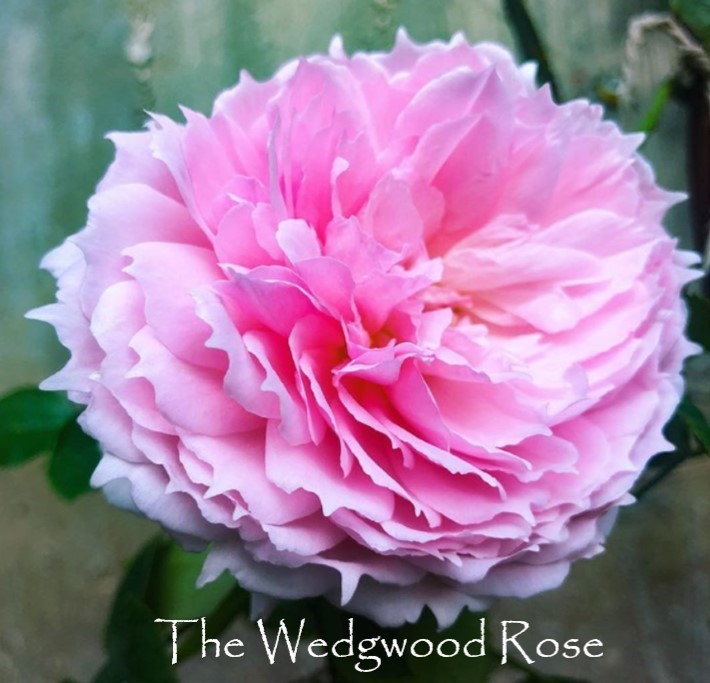
When I plan these posts, I usually try not to have two similar roses back to back, but I have failed on this as we had a climbing rose yesterday and we have another today! Today’s rose is rather more modern though, the David Austin ‘The Wedgwood Rose’.

Introduced in 2009 and named to celebrate the 250th anniversary of the founding of the Wedgwood fine china and porcelain company.

Not an overly tall climber, with a maximum, predicted height of 3m. The DA website relates that she will quickly grow into a superb climber as she sends up many shoots from the base. Seems a slightly weird claim as a climber needs a good fan shape with a few, five or seven, strong stems at the base and then you can let some side branches grow from the main stems. That however is my understanding of a good climber. A few reports that the stems are weak, but one must take these reports sometimes with a small pinch of salt. One doesn’t know the growing conditions nor the expertise of the grower.

The buds are a greenish white with a rather ruffled appearance. They open to large full petalled soft pink blooms, the petals have a charming central pointed edge. The outer guard petals are pale pink, and the DA website says these petals are a delicate gossamer. These tissue thin petals, lacking starch in their structure, mean sadly one major disadvantage, the blooms ‘ball’ badly in damp conditions. Think of those thick fleshy Hybrid Tea petals, they never ball or spoil in the rain! The fragrance is that of fruit. Repeat blooms very well through the summer.

I see from various photographs on the web that the blooms have a tendency towards a weak neck causing the blooms to hang down. Never a great feature in a rose but at least in a climber you can look up at these downward facing blooms.

Dark glossy foliage and good disease resistance reported. Hardy USDA zone 6b-9b.I find a lot of the more recent DA roses seem to either be superb or a disaster although they seem to always perform well in the hotter dryer parts of the world.

If you grow this rose do please comment as it is always of interest to hear others’ experiences.
Saturday 27th April

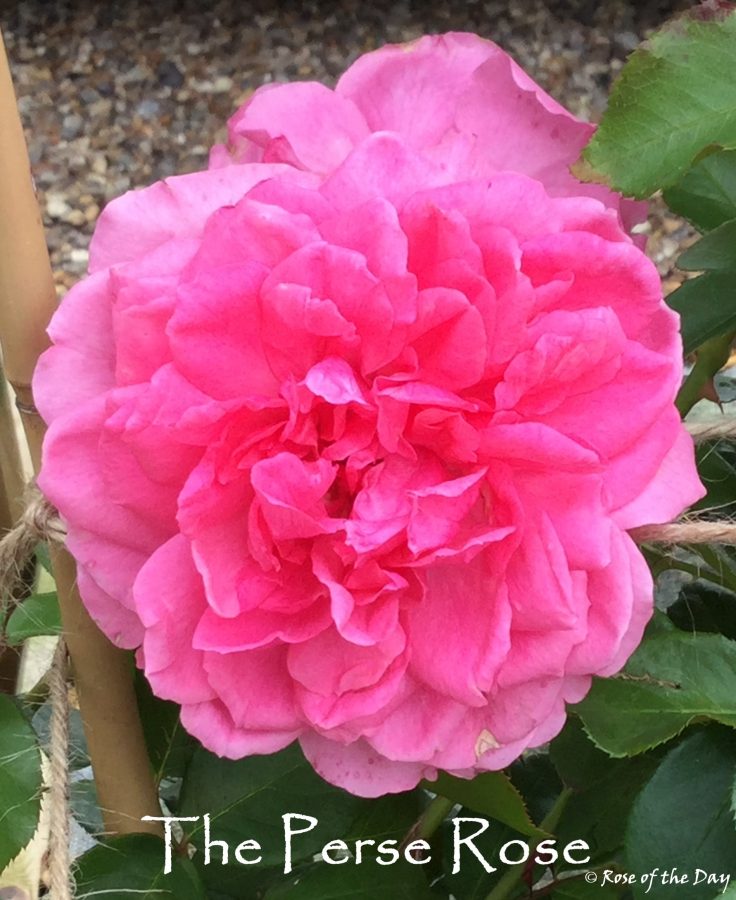
On an old village map dated 1590, our farm is marked as ‘newly built 1550’. A section of the 1550 house survives but has a later brick wall at the far end. We suspect from the remaining fractured beams that this end of the house collapsed over time and was demolished. From the humps, bumps and hollows in the garden the original footprint of the house can be guessed at. A lot of roses now cover this area but there seems to be a particularly long hollow where roses can be slow to establish. Today’s rose had the misfortune to be planted in this hollow, so she has been slow to get into her stride. A Peter Beales rose – ‘The Perse Rose’.

Rather a tall narrow rose with a predicted height of 1.5m but only a slender 1m wide. Better probably as a pillar rose than a shrub. Of course, in a small garden, these roses with a tall narrow growth habit do mean you can pack more roses into a confined space. Large clusters of fat dark buds arrive all summer, unfurling into large full petalled mid pink blooms. Attractive wavy edged petals that reflex nicely to reveal a darker quartered centre. She has a classic old fashioned feel to her coupled with a sweet light pervasive fragrance.  Healthy glossy foliage which appears to have good disease resistance.

I have struggled somewhat to find the extent of nurseries that stock this charming rose. Certainly, she will be available from Peter Beales and some other UK nurseries. I see that a Moscow based grower has posted photos on the helpmefind website so she has reached Russia! I guess also to be found in some of the major European nurseries as well. I doubt whether she is available further afield, unfortunately.

Introduced in 2015 to mark the 400th anniversary of the founding of the Cambridge school The Perse School. Stephen Perse an academic, physician and philanthropist left a legacy to set up a school to change lives through education. The school, open to children from all backgrounds, is Cambridge’s oldest surviving secondary school.

I wasn’t aware of the 400th birthday commemoration connection when I planted my rose in the 1600 bumpy area of the garden, but this now seems appropriate. This spring she looks very chipper but then she didn’t have to suffer the ten days of last March’s ‘Beast from the East’. Perhaps she was just sheltering in her little hollow last summer afraid to lift her head too high.

Does anyone else grow her? Do please comment.

Sunday 28th April

A serene rose today that I grew a fair number of years ago and whilst doing the research I was left wondering why I have not replanted her. A Hybrid Musk introduced in 1939 from the German nursery of Kordes – ‘Erfurt’.

Kordes used his lovely crimson Hybrid Musk ‘Eva’ as a seed parent with the dark pink Hybrid Tea climber ‘Réveil Dijonnais’ providing the pollen. From this liaison, he created one of the most popular modern shrub roses. Named for the central German city of Erfurt which has one of Europe’s best preserved medieval city centres.

The elegant Hybrid Tea like buds are bright pink and are carried in large clusters on the long red tinged arching stems. Unfurling to a simple uncomplicated pink bloom of 4 to 10 petals that have pale creamy lemony bases encircling the long golden stamens. She can be quite a bright pink when grown in high temperatures but more usually this very understated pink as seen in the photograph. From this unsophisticated bloom, an exquisite perfume arrives. The first blooms cleanly drop and a crop of round green hips quickly appear, turning to a reddish orange. She blooms continuously so you get the unusual combination of both blooms and hips all summer. Very eye catching!

Extremely disease resistant foliage that is bronzy red when young maturing to ridged puckered leaves. Tends to be wider than she is tall, generally around 1.50m high and 2m wide. As with most roses she is likely to be taller in hotter climes. Tolerant of poor soil. Hardy USDA zones 4b-10b. An 8.4 score from the American Rose Society, that’s ‘a very good to excellent rose. One recommended without hesitation.’ Widely available. A rose for the no spray garden and for those who want an easy but attractive rose.

An excellent rose and she is in my notebook for the 2019/20 planting season. I am sure I can squeeze her in somewhere! Who grows her?
Tuesday 30th April.

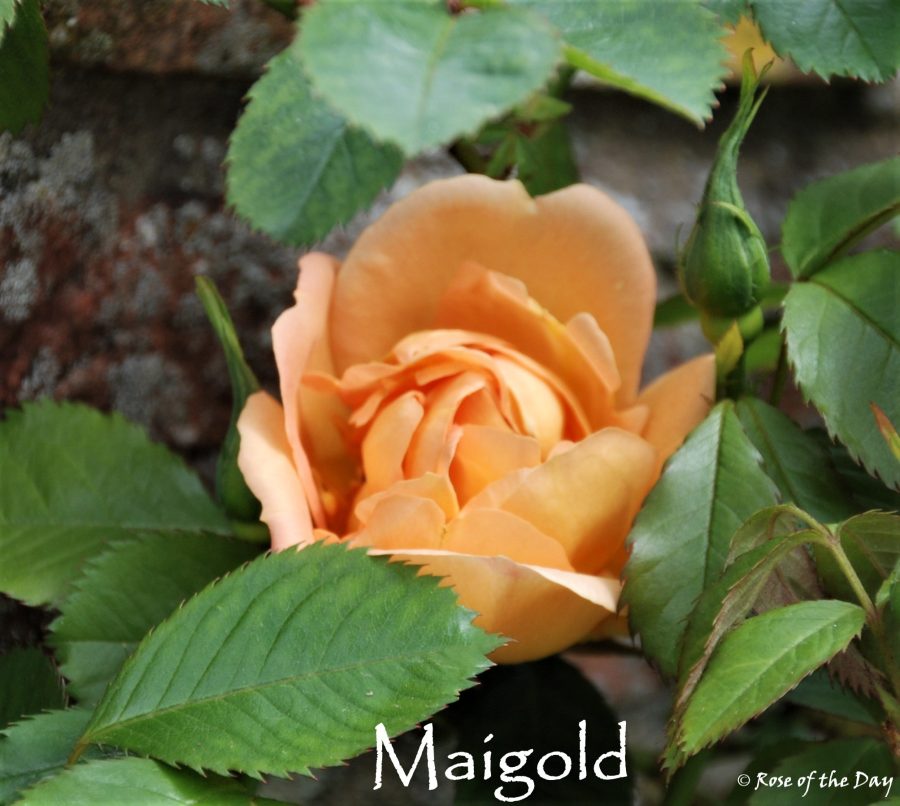
This extraordinary spring brings the roses to bloom earlier than expected. Although yet to be in her full glory today, still April, we have the modern shrub rose ‘Maigold’.

Always an early rose to bloom, a legacy from her pollen parent ‘Fruhlingstag’ literally Spring Day also an early rose. Likewise, ‘Fruhlingsgold’, Spring Gold, the pollen grandparent to ‘Maigold’. These two Hybrid Spinosissima Fruhlings were bred by Reimer Kordes, a prolific breeder of fine roses. ‘Maigold’ is another Kordes rose, introduced in 1953, her seed parent the Danish Floribunda Poulsen’s Pink. What a meeting of excellent Northern European roses.

I grow ‘Maigold’ against a south wall as a climber, but she is also happy as a shrub. Her very thorny, needle prickly stems are none too flexible and can easily snap so you will have to gently coax them into the appropriate position. I loop Flexi Tie around the stem and gradually pull it into place as the stem grows over several weeks.

Masses of dark pink buds with long feathery sepals appear in early spring. As they crack open the colour changes to a flame streaked pink orange. Beautiful coppery apricot orange blooms unfurl to greet the spring days. Opening to a large, 10cm, semi double bloom paling to creamy peach buff, the petal bases are a growing lemon encircling the crimson stamens. A delight for those hungry early foraging bees. Eventually fading further to a yellowish white. Her best show is in the spring, but she produces blooms intermittently all summer. In last year’s astonishing heat, she produced excellent flushes of bloom all summer. Fragrance is strong and fruity, but I detect a very slight edginess common in yellow roses. I have read she smells of linseed oil but not to me, I wonder if this is that sharp edge to the perfume described differently?

The foliage is glossy pale green with serrated edging to the leaves and very good disease resistance. Another rose that dislikes to be pruned. Just lightly after her first flush as she will bloom next summer on this year’s summer growth, what is known as old wood. To clarify this Hybrid Teas for example, bloom on new wood, the current year’s growth. She can reach 3m in height and breadth, given the dislike of pruning she is a rose that deserves a reasonable amount of space. Hardy USDA zone 4b-9b. The American Rose Society rating is a lowly 7.6 – ‘A good rose, a little to somewhat above average’. Widely available.

I always look forward to her spring display after the dark and cold of the winter. A rose certainly that I would always have in my garden. Do comment if you grow her.
March 2019

The following posts originally appeared on my Facebook blog ‘Rose of the Day’. Facebook doesn’t keep the older posts available, hence recreating them on this blog for you to enjoy.

Friday 1st March

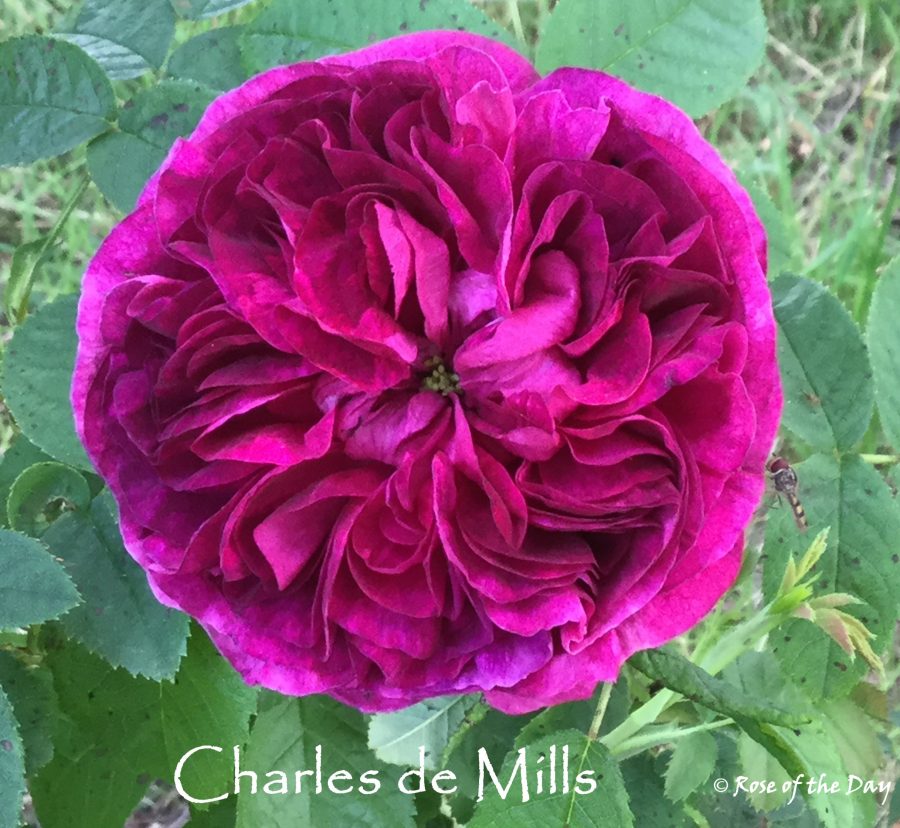
Today a rose that also I am very fond of. A Gallica rose, one with a lot of discussion on its true identity, the correct name and the namesake, – ‘Charles de Mills’. It likely dates from the late 1700s.

Several namesake choices for this rose. Could be a director of the East India Company, a Nottinghamshire nurseryman, a Mr Mills living in Rome in 1840 who had a pergola covered in roses. Perhaps this is a German rose Charles Wills whose name morphed to de Mills when the rose arrived in France. Also, a German rose named ‘Bizarre Triomphant’. Are they one and the same? Bizarre is a French corruption of Bizard, a German term for the streaks found in tulips. Given that ‘Charles de Mills’ doesn’t have streaks this identity seems tenuous. Another claim is this rose is one of fifteen Dutch bred Gallicas. Possible but the name Charles de Mills has more of a French ring about it.

Whoever Charles was, where he lived or his career choice, this is a superb rose, one of the best Gallicas I think. The cerise buds are round and plump with feathery sepals. They open to a unique flat disc like form. My husband and I call this the “mushroom” rose as the flat disc with tightly packed petals looks like an upturned purple mushroom. The petals really look as though have been neatly trimmed to shape, he is an unmistakable rose. His colour can vary from lilac pink, through wine red to dark purple crimson depending on the growing conditions and ambient temperature. As the bloom ages the petals fade a little and often show some blotchiness, maybe this is the ‘Bizard’ colouring? A distinctive little green ‘cup’, not a button eye, appears in the centre. I don’t know of another rose that has this centre. His fragrance can be elusive. Sometimes very strong and other times faint with no rhyme nor reason for his fickleness. This is a late flowering rose for a single blooming rose. Mine often starts to break his buds in late June often as some of the other Gallicas are coming to the end of their show.

Rather a floppy growing habit so he needs a bit of support. Height around 1.25m and similar width. If you grow him on his own roots, then he will cheerfully throw up a forest of suckers. All Gallicas have the same habit and you can let the suckers spread where you have space. Alternatively, you can dig them up, pot them on and surprise a friend with a new rose for their garden.

Relatively disease free. Shade tolerant. Hardy USDA zone 4b-8b. He is a very popular rose and widely available.He has such amazing blooms that you really must include him in your collection of classic roses.

Saturday 2nd March

A petite Tea rose today – ‘Anna Olivier’- dating from 1872, bred in France by Jean Claude Ducher. A bit of a caveat, she is petite in the cooler British climate but a little more robust in sunnier climes.

A classic rose of complex colour. Of a cream base but shows pink, primrose yellow, buff, parchment, salmon, coppery apricot, and pale creamy white but always with a darker pink back to the petals. Darker hues in low temperatures. These quiet sunset or dawn colour combinations add to the charm of this elegant rose with her high centred blooms and reflexed petals. Strong ‘Tea’ fragrance. She repeat flowers very well, almost continuous in hot weather. A rain hater as the blooms may ‘ball’ and spot badly.

Large dark green foliage with new shoots of attractive bronzy red. Good disease resistance. Here in Britain, she is small, around 90cm high so ideal for containers so she can retire to the conservatory in cold wet weather. Given constant high temperatures she can reach 1.5m.

A widely available and popular rose. Of unknown parentage but she does have a few offspring. Notably a climbing sport and the fickle ‘Lady Roberts’. Predominantly a coppery apricot ‘Lady Roberts’ will often revert to her parent’s colouring.

Who was the Anna Olivier for whom Jean Claude named his rose? Usually, there are a few clues or ideas but here I cannot find a hint or whisper. Was Anna a pretty young girl or a doughty matron? History remains silent sadly. Beautiful, classical and eye catching! Do comment if you grow this elegant lady.

Sunday 3rd March

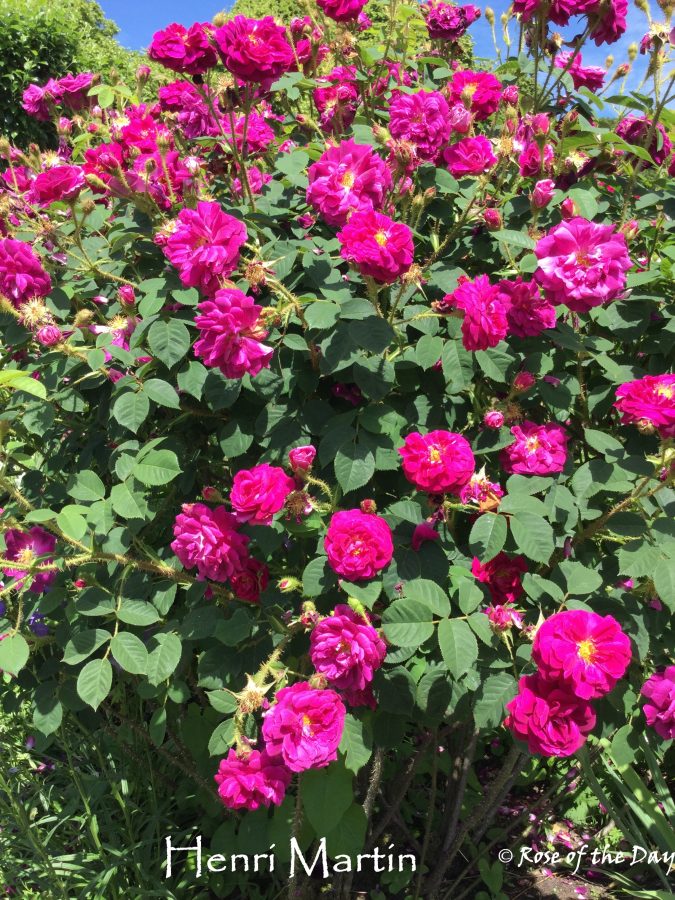
A graceful moss rose of a gorgeous colour – ‘Henri Martin’- sometimes known as ‘Red Moss’. Bred by Jean Laffay sometime before 1862 and then introduced in 1862 by the French nursery Portemer.I saw this rose on a blisteringly hot June day last year in the gardens of Mottisfont Abbey. He forms part of the National Collection of Pre-1900 roses. He was a stunning sight, a tall shrub 1.50 to 1.85m, covered in blooms. Extremely bristly stems carry clusters of well mossed mid pink buds. This softest moss, I couldn’t resist a little stroke, with an intense resinous perfume. The buds open quickly to large double blooms of rich clear crimson pink with an odd white flash. The petals reflex attractively revealing large bright yellow stamen. Variable in colour depending on temperature, he can be a crimson red ageing to a purplish hue.  A very strong fragrance, although I admit on that hot day in a sheltered walled garden the rose fragrance hung heavy in the air everywhere. Just the one single glorious flush of bloom in June but he does go on to produce little hairy orange hips in the autumn.

A vigorous rose but he is sprawly so would appreciate wall support or a frame. He tends to get a little broader than he is tall. Tolerant of poor soil and extreme heat. The foliage is a dull bright green if that doesn’t sound too much of an oxymoron! Good disease resistance as well. A popular rose so widely available. Hardy USDA zone 4b and warmer.

Named not for Henri Martin the French Impressionist painter, my first guess but for the great French historian. Henri was a good friend and colleague of Edouard Rene Lefebvre de Laboulaye and a fellow member of the French anti-slavery movement. Laboulaye commissioned the “The Statue of Liberty Enlightening the World”, gifted to the United States in 1886. A spectacular rose to catch the eye if you have a little space for him.

Tuesday 5th March

I used to only grow the older classic roses and species roses. Most of those bloomed just once so I began to add some remontant – repeat blooming- ones. A few David Austin’s were chosen, followed by some modern shrubs. Some Hybrid Teas crept in along with Floribundas and Patio roses. I have a few small low growing roses such as the Flower Carpet group in containers. These are useful on the commercial side of our property as I can move them around to brighten dull areas.

It is easy to dismiss these small ground cover roses in favour of the classic roses with their magnificent blooms and wonderful history, but these little roses are well worth considering. Inexpensive, often for sale in large DIY stores or market stalls. They are hardy, disease resistant, and bloom their hearts out all summer. As well as container roses they can be front of the border fillers or low informal hedges. When planted into weed suppressant mats you have an easy care bed that looks great all season for remarkably little effort.

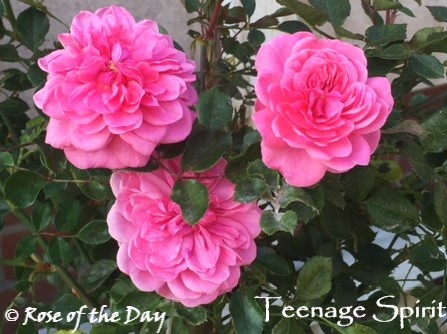
I spotted today’s rose – ‘Teenage Spirit’ in a local cheap and cheerful garden centre where I buy my dog food. It was mid October, but the bushes were covered in small clusters of mid pink blooms. Large blooms as well for the size of bush, she has a maximum predicted height of just 80cm. Pretty double petalled blooms sitting in small leaved glossy foliage made an attractive sight. Ever the one for a bargain, these were £5.99, I bought three! Lacks fragrance though which is a pity.

I don’t know who bred ‘Teenage Spirit’ (ICRA name Worcasserole which is a curious name!). Marketed by the online company World of Roses in the UK, they are canny commercial growers producing endless roses named Happy Birthday, Congratulations, etc. They also name roses for your charity or a business promotion. Being a cynic, I wonder if some of their roses are recycled under different names for different occasions!

This rose is only available in the UK online from World of Roses or in the less specialist garden centres. At least this one has a name, I have bought a few just named ‘Pink’ or ‘Peach’ patio rose. Do other countries have these types of rose growing companies? If so, have a browse through their catalogues, you may be surprised by the choice.

Wednesday 6th March

Everyone has different tastes, different sizes of garden, varying soil plus a huge range of different growing conditions and also a different budget to spend on roses. When I select candidate roses to appear on this page, I am mindful of these differences, so I try to include a wide range of different types. Included are some that I don’t particularly like and wouldn’t grow in my garden. Additionally, there are ones unavailable in Britain or only available here. Yesterday we had a cheap and cheerful little British rose. In contrast today we have a rather uncommon classic old French rose – ‘Ambroise Paré’. Bred by Jean Pierre Vibert, introduced in 1846.

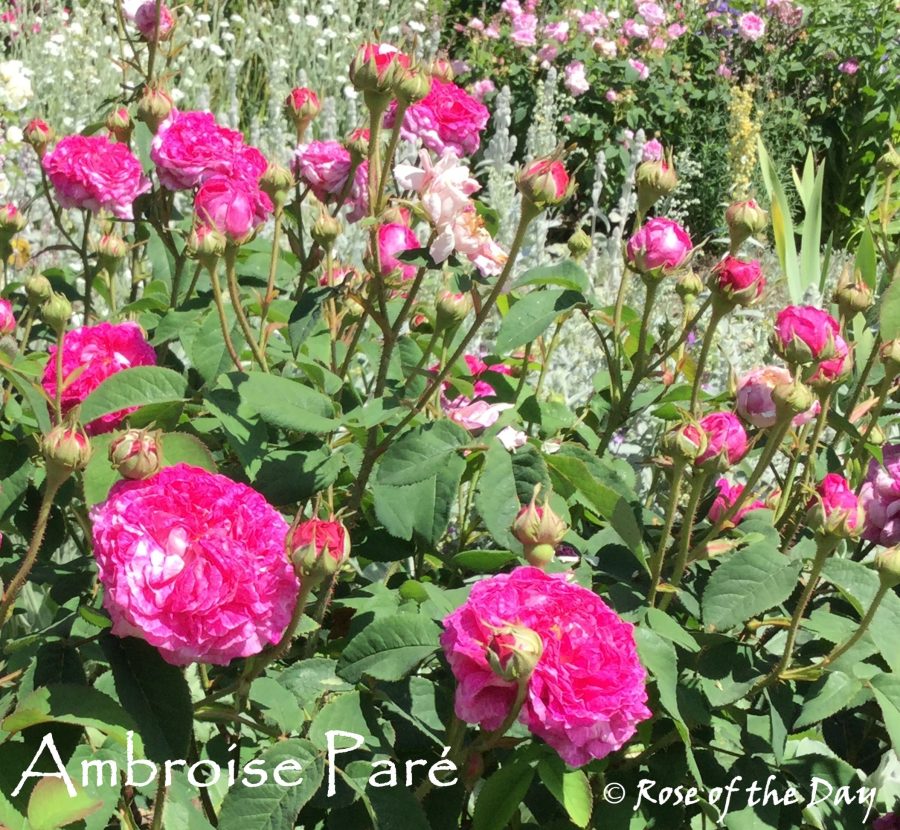
Clusters of long stemmed plump reddish pink buds open to magnificent full petalled rosette blooms. Initially deep cerise pinky purple with darker stripes. the odd white streak as well plus spots and speckles. He fades as the bloom matures with the petals reflexing to show a small green yellow button eye. We had a comment yesterday about bees’ attraction to fragrance. ‘Ambroise Paré has good light fragrance but the bees have to wait until the petals fully reflex to access their breakfast! The blooms fade through to whitish pink before dropping their petals. Blooms just once.

Soft green rather droopy Gallic foliage and the young leaves have a rather pretty red edging. Soft bristles rather than prickly. Good disease resistance. Grows as a tallish shrub to around 1.20m. Hardy USDA zone 4b-8b.

Named for an early progressive French surgeon (1510-90). Serving as a military surgeon Ambroise Paré developed a kinder more effective technique for wound dressing. Rather than cauterising with boiling oil (do not even think of the pain) he used a dressing of egg yolk, turpentine and rose oil. This was much more effective than the harsh boiling oil. I do not know whether the inclusion of rose oil later inspired Vibert to name this rose for him.

Small note of caution when buying. You guessed it, as there is a Tea rose with the same name bred by Moreau-Robert (1865).

One of the less known Gallicas, ‘Ambroise Paré doesn’t seem to be too widely available. Some British and European nurseries stock him and a few in the States and Canada. Certainly, worth including in your garden but if space is at a premium then there are better Gallica roses, to be honest.

Photographed at Mottisfont Abbey gardens last summer where he did look rather splendid.

Thursday 7 March.

Of all the David Austin roses I very much prefer the older ones dating from the 1980s and early 1990s. I have a couple of later ones, ‘Gentle Hermione’ (2005) and ‘The Alnwick Rose’ (2001). If the latter one declined to grow, I wouldn’t miss her. I find her blooms unsettling in a rather odd way. The recent ones just do not excite me. I expect to be struck down by a bolt of lightning having made that confession!

Today’s rose is one of the older DA’s, dating from 1983 – ‘Troilus’. This rose is now out of its breeder’s licence protection period so you can find it in a lot of nurseries and usually at a much lower cost than the newer varieties.  A rose of considerable charm with clusters of pointed buds, breaking open to a cupped large full petalled blooms of creamy buff apricot pink. He can be very variable in colour though depending on growing conditions. Fades to an elegant parchment pink as he matures, flattening out to reveal a mass of little petaloids in the centre. Strong ‘English Rose’ fragrance. The stems are strong on these early DAs, so he does not hang his head shyly and makes an excellent cut bloom.

Reaches around 1.5 x1.5m. Good dark foliage and reasonable disease resistance, better in warmer climes than damp Britain!

Another plus with these early DAs is the lineage can be given which I find interesting. David Austin, in common with other rose breeders, have a ‘stud’ of their home bred unnamed seedling roses. Whereas other breeders outcross to named roses DA stay in house as it were, this may account for the ‘sameness’ of their roses.  Troilus has the spectacular ‘Duchesse de Montebello’ in both the seed and pollen lines. Seed parent is a ‘Duchesse de Montebello’ x ‘Chaucer’ seedling with a pollen parent ‘Charles Austin’, himself a ‘Chaucer’ offspring. This close line breeding would raise eyebrows in the dog and horse breeding worlds but it is  common in plant breeding.

Named in the Shakespearean phase at DA, Troilus is the Trojan prince in the Greek tragedy ‘Troilus and Cressida’. I’m sure you can remember that from school, or at least if you had a traditional English Grammar school education.

I would certainly buy this rose for my garden, he is a very worthy inclusion whether you love DAs or are slightly indifferent.

Friday 8 March

Friday already so it’s a Friday Favourite Day. Today one of my favourite roses, although she has only been in my garden for three summers, the Griffith Buck rose “Earth Song”. Most American and Canadian growers will be aware of these outstanding Griffith Buck roses but only a few are available in the UK from a single nursery R V Roger Ltd in Yorkshire.

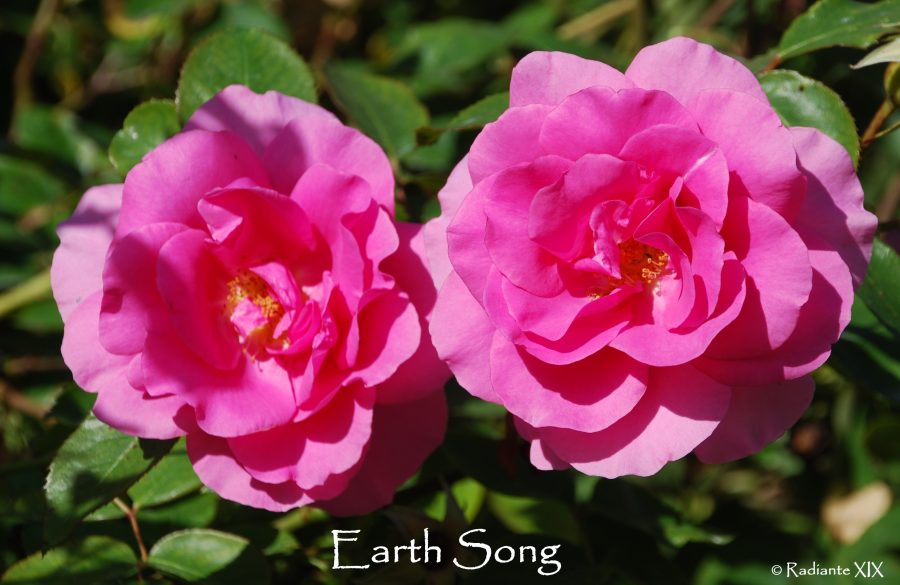
Copious clusters of long bright pink buds break open into large cupped double blooms, opening even larger so this is a rather over the top rose.  Blooms are of the most attractive clear bright pink, but I believe she can be almost red in some growing conditions. Fragrance is not heavy and intense but strong sweet and light. If you cut these blooms for the house, they last for ten days and the same in the garden with a neat clean drop. Said to be repeat blooming but here in Suffolk she blooms almost continuously. A late starter but then she just keeps on going, she has blooms until the New Year.

Rather Hybrid Tea like foliage, dark and shiny and completely disease resistant. A strong grower and cuttings take like a dream. She is so forward that my cuttings had buds within five weeks. Predicted height is 1.20m but she is easily 1.70m now. Not a lot of action in her first summer but she grew phenomenally fast in her second season.

Dr Griffith Buck was a professor of horticulture at Iowa State University and started rose breeding in the 1950s. He wanted to produce healthy roses that need no pesticide or fungicide, strong growers, great flowers with good scent. If that wasn’t enough, he wanted them to be hardy down to -20C and to cope with humid 30C summers. No mean task and by crossing modern hybrid teas and species rose he succeeded spectacularly. There are around eighty cultivars in commercial production today. Only nine are available in the UK and I now have them all as they have been so impressive. The UK nursery is mainly wholesale so they haven’t really pushed these roses. I hope some have made it into other growers’ catalogues, but I haven’t been able to find them yet. Some European stockists but it does not look as though these exceptional roses are in Australia or New Zealand. Please do comment if you grow her or her Griffith Buck sisters.

Ideal for a no spray garden and for those who want a minimal input rose with maximum output. Superb rose and deserves to be better known outside the States. Grow her, she will not disappoint.

Saturday 9 March

We haven’t had a climbing rose for a little while, so today’s rose addresses that omission. I spotted this one growing against a chain link fence at the far end of the Peter Beales nursery last year. A rose that vastly improved the boring fence was ‘Antique’, bred by the German nursery Kordes and introduced in 1988. Also sold as ‘Antike 89’, Kordes has an earlier red Floribunda ‘Antique’ so take care when buying.

A rose of unusual colouring. Described as a white or pale pink rose with pink crimson petal edges. Looking at the photograph please don’t think I have posted the wrong one! A very large full petalled rose so the effect is more crimson than pale pink. She produces large clusters of these attractive blooms in flushes throughout the summer. As the bloom matures the petals gently reflex so the pale pink bases are revealed giving a quieter colour. These blooms are both unbothered by heat or rain, so you get a long display. The mixture of the brighter crimson and paler pink blooms is very eye catching but not too jarring. Sadly, not a great deal of fragrance.

Rather stiff in growth habit so you will need to be training the inflexible stems quickly otherwise they will snap off when you gently bend them. She makes a good shrub as well, in fact, she was being grown as a shrub in front of the ugly fence. Large dark foliage which has good disease resistance. A little slow to get going but when she gets into her stride, she can reach up between 2.5 to 4m high. I think she would also make a great hedge with the inclusion of a heavily fragranced rose to compensate for her lack of perfume.

A very useful rose I think if you can don’t mind the poor fragrance. Please do comment if you grow her.
Sunday 10 March

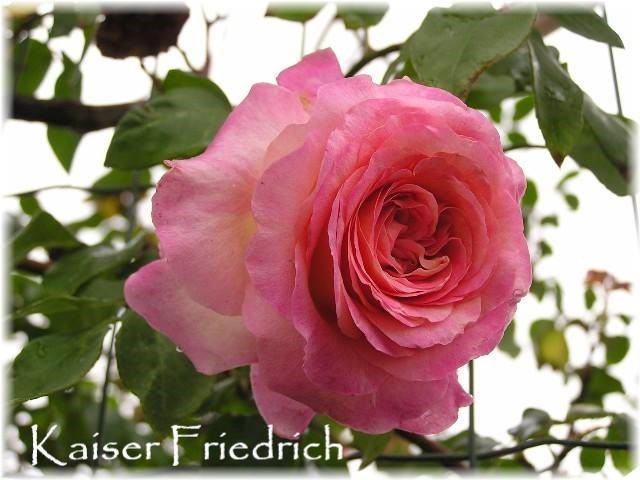
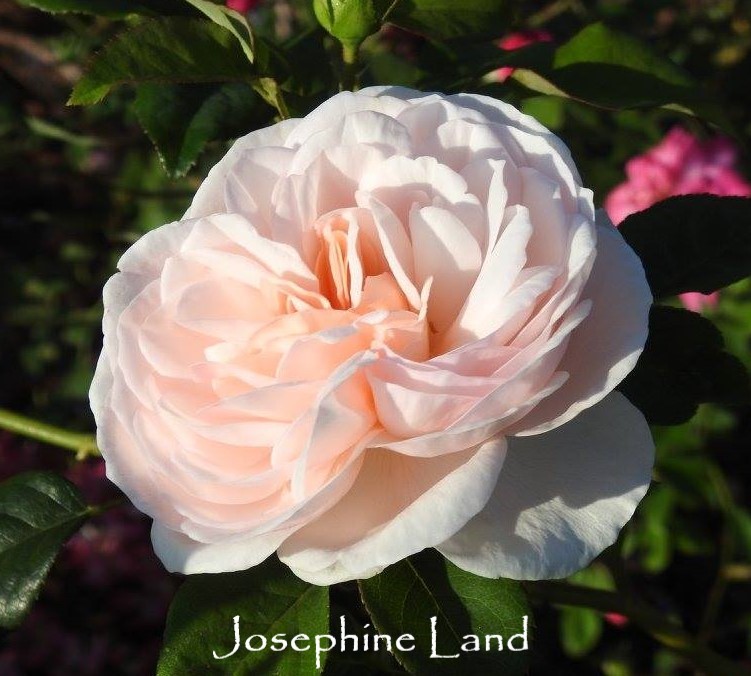
There is a very beautiful early Hybrid Tea, a seminal rose in the career of the German rose breeder Peter Lambert, named ‘Kaiserin Auguste Viktoria’, for the wife of Kaiser Wilhelm, the last Kaiser of Germany. Kaiser Wilhelm’s father Friedrich Wilhelm Nikolaus Karl – also has a rose named for him, and this is today’s rose ‘Kaiser Friedrich’.

I am always ambivalent about Queen Victoria and her dynastic matchmaking of her children. Her eldest daughter Victoria had an arranged marriage to Friedrich Wilhelm, and although the marriage was said to be a contented one, she didn’t have the happiest life in Germany. Friedrich himself was Emperor of Germany for just 99 days dying from laryngeal cancer in 1888 and was succeeded by his son Kaiser Wilhelm.

Enough of history let’s get to Friedrich’s rose. A Tea rose bred in Germany by Heinrich Drögemüller and introduced in 1890. Herr Drögemüller bred and introduced just a handful of roses, eleven in number which includes ‘Kaiserin Friedrich’, ‘Kaiser Wilhelm’, together with ‘Fürst’ and ‘Fürstin Bismarck’. A man very enamoured with the German court it seems. ‘Kaiser Friedrich’ has the seed parent ‘Gloire de Dijon’ with the pollen of ‘Countess of Oxford’. The colours of these two, creamy apricot and cerise pink have blended to produce a beautiful rose. Initially he is pure mid pink when first opening, only revealing the golden petal bases as he matures. Large double form with a superb centre swirl of petals. Not over endowed with fragrance sadly.

Of his growth habit and disease resistance I can find no information. As with all Tea roses, he will prefer the heat, and is likely to have a longish blooming season.

This classic Tea rose is a rarity. I have been unable to find a stockist for him so if you grow him or know of him, please comment.

Tuesday 12 March

When I was a child I often stayed with my grandmother, who ran a small village shop, visited by everyone for groceries and the latest gossip. One customer though, never came as my grandmother delivered her groceries daily. I was allowed to accompany her but only to the garden gate. Peering through a crack in the fence I often saw a small woman sitting in the garden. ‘Who’s that lady?’ I asked. ‘Oh, that’s the lady of the lake’ replied my grandmother ‘and no more questions about the poor lady.’ Later when Sir Walter Scott’s poem ‘The Lady of the Lake’ was read to our class at school I was ridiculed after telling everyone the lady lived near my grandmother. 

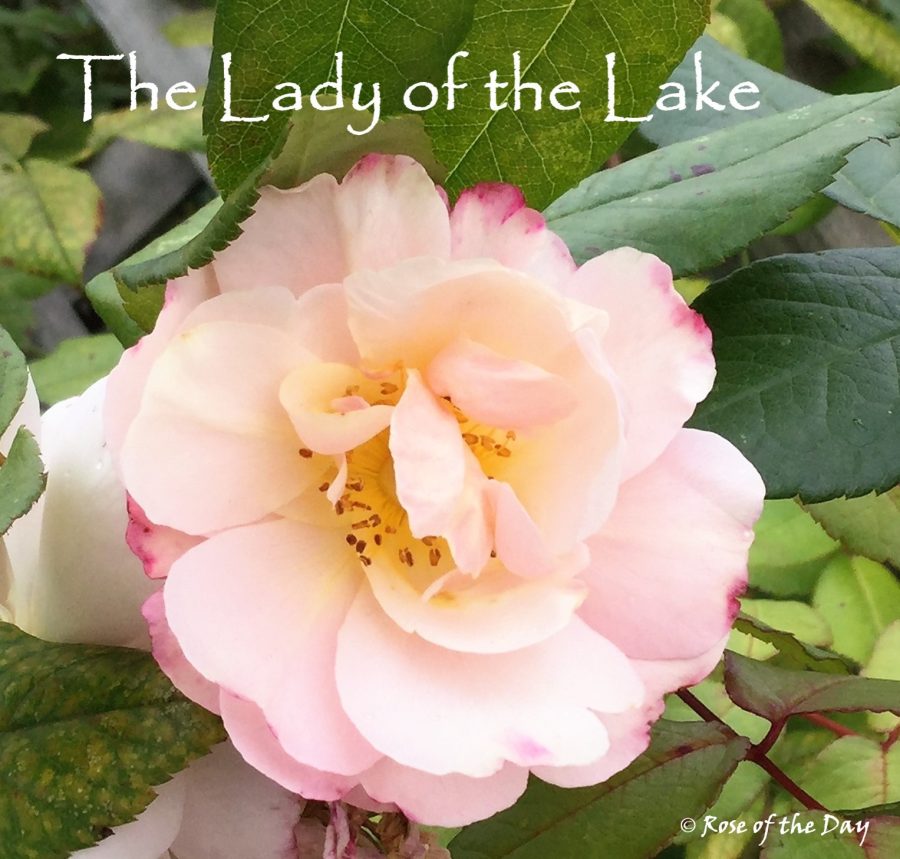
Last week I revealed I am not so keen on the later David Austin roses, but today’s rose could easily find a place in my garden and not just in memory of my imaginative grandmother. That rose is the rambler rose introduced in 2014.

Large sprays of pink tipped creamy buds unfold to pale pink apricot semi double blooms. These are not so large, only around 5cm (2 inches) in diameter, but are produced in great numbers. Fading to a shell pink and then to white as the petals reflex nicely to show the golden stamens. This one is good for all bees and pollinating insects as they can easily access pollen and nectar. Zesty fruit like fragrance. Flushes of bloom through the summer and well in autumn.

The long narrow leaves are bronze touched green when young, becoming an attractive dark green later. No reports of poor disease susceptibility so I assume she is a healthy rose. For a rambler she is not too rampant, maximum height of 3.75m (12ft 6ins).

I have a pensioner of an apple tree wreathed in a ‘Wedding Day’ rambler who flowers just once, so the tree is then rather dull. I am tempted to plant ‘The Lady of the Lake’ next to this tree and train her into the ‘Wedding Day’ to make an all summer long spectacle. 

‘The Lady of the Lake’ was also the ruler of Avalon in the Arthurian legends. Today the British Parliament has a decisive and fateful vote, perhaps we may need a ruler in the Arthurian style afterwards!

Wednesday 13 March

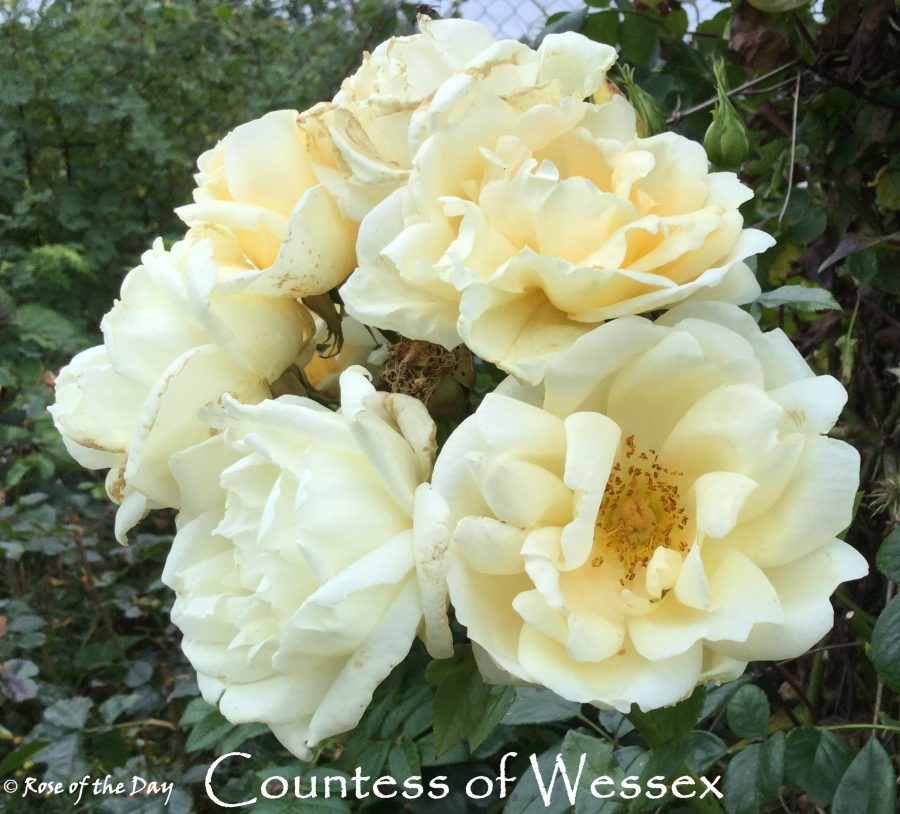
I am charmed by today’s rose ‘Countess of Wessex’, not least because her namesake is not at the forefront of the rather ‘celeb’ younger royals. The Duchesses of Cambridge and Sussex do not yet have their namesake roses but the quiet hardworking Sophie, Countess of Wessex has this beautiful one.

Bred by the late Amanda Beales, the rose was named at the request of the Bishop of Norwich who took the marriage ceremony between Prince Edward and the then Sophie Rhys-Jones in 1999, now entitled the Earl and Countess of Wessex. Introduced in 2004 in the UK and in Australia in 2008, one of the rare Peter Beales roses available outside of Britain. I found a listing of this rose on the ‘Dave’s Garden’ website, I don’t know whether that means she is available in the States though.

Clusters of long buds with feathery sepals, these swell revealing creamy petals with a touch or two of pink. Opening to large double blooms of a creamy lemony apricot, with an egg yolk yellow centre. The outer petals reflex and fade to whitish cream as the golden stamen corona is displayed. Another good pollinating insect friendly rose. Reliably repeat blooms all summer, the photo taken in mid September on a rainy day, so some spotting has occurred. A mass of new buds was waiting to burst open so I think she would have had a good autumn show.

Not so large at 1.2m high and 90cm wide, good for a small garden or perhaps a large container. Good dark shiny foliage, vigorous growth and excellent disease resistance. Hardy USDA zone 6b -9b.

Not the flashiest of roses but a good performer if you are looking for a small shrub of this colour.

Thursday 14 March

One of the best white roses although she blooms but once in the summer – the Damask ‘Madame Hardy.’ She doesn’t fit too neatly into the Damask classification. The foliage isn’t particularly Damask like and the blooms have a Gallica appearance. I guess those who decide these things had their reasons.

I love her clusters of distinctive long feathery buds, these look like some exotic bloom in themselves. Opening to a cupped quartered form stuffed with petals of white with just a touch of shell pink. As the bloom matures it flattens becoming pure glistening white and revealing a unique green ‘pip’ in the centre. Superb fragrance, really superb! Very free flowering for the three to four weeks of her glorious flush of bloom. Graham Stuart Thomas described her as ‘This variety is unsurpassed by any rose’. Praise indeed.

She can reach up to two metres in hot climates but is generally around 1.5m in the UK. Foliage is soft light green on red brown prickly stems. The weight of the blooms will cause these stems to arch attractively. Very disease resistant, in 1998 the Montreal Botanical Garden (Le Jardin Botanique de Montreal) surveyed its established roses’ resistance to black spot, powdery mildew and rust. ‘Mme Hardy’ showed a 0% to 5% infection rate – classified as outstanding. Hardy USDA zone 4b-9b, she is a tough vigorous rose and one that is easy to grow. Roots easily from cuttings as well.

Introduced in 1831 and bred by Julien-Alexandre Hardy, head gardener of the Luxembourg Palace gardens, Paris from 1817 to 1859. A prolific breeder of roses, he introduced two hundred and twenty five varieties, most of which are still in cultivation today. ‘Albertine’ is one of his most famous roses.  He named this beautiful rose after his wife Félicité and you may find her listed as Félicité Hardy. Did Félicité have the ethereal splendour of her rose? I do hope so.

Any collection of classic old fashioned roses should include this rose. Grow her, you won’t regret it!

Friday 15 March

Today this is one of my favourite roses ‘Admired Miranda’. Planted way back in 1984 in memory of my lovely horse Miranda who died very suddenly with no warning when she was still a young horse with her life in front of her.

‘Admired Miranda’ is a discontinued David Austin rose as it was believed to be inferior and isn’t recommended to be grown unless you are a collector! I find this inexplicable as she is such a lovely rose. Introduced in 1982, during DAs Shakespeare naming theme. Admired Miranda’ is named for Prospero’s daughter in The Tempest.

Fat buds open slowly to a cupped mid pink full petalled bloom which is not so large. Flattening as she opens a little further revealing a beautiful quartered swirl of petals and I regularly find she has blooms of 12cm diameter (4.5inches). The outer guard petals fade to pale pink, but the inner petals hold their colour and show their rather apricot bases. A truly superb fragrance. Repeat blooms again and again and again into the winter. To my mind, she is a very superior rose.

Said not to be vigorous but mine is at least 1.8m high. I have a cutting from her, planted in a pergola and this is equally vigorous She grows on an east wall so she catches the east wind and boy she caught the Beast from the East in March last year! She probably has dry feet as she grows against the wall of the house as generally, the rain comes from the south west.

Attractive dark green foliage with puckered leaves. Reputed to be very unhealthy but I find no more so than the recent DA roses. I do spray her with fungicide but for several years I left her alone and she then suffered rust later in the season. Hardy USDA zone 6b-9b.

She is still available from small nurseries, but you will need to search around a bit. She grows well from cuttings so you could always beg for a cutting if you know someone who still grows her. I would be interested to hear from anyone else that grows this special rose.

Saturday 16 March

Some time ago I found a rather tired copy of ‘In Search of Lost Roses’ by Thomas Christopher in a charity shop. Until reading this book I had no idea about the American hobby or obsession of ‘rose rustling’ where one forages around old homesteads, settlements and cemeteries searching for roses. Settlers often took cuttings of a rose from home with them on their long journeys across the world to the States. Carefully planting them in their new homes, or by a loved ones grave these roses hopped across the States losing their names but not their beauty. These found roses are carefully harvested for cuttings, grown on sometimes being identified, other times renamed and perhaps re introduced into cultivation.

Organised rose rustling seems to be confined to the States where there are responsible groups who have an etiquette around collecting rather than thoughtlessly plundering roses on private property. The Texas Rose Rustlers website (http://www.texasroserustlers.com/) is a great source of information.

Does rose rustling happen elsewhere? I am sure it does quietly. I confess to taking some cuttings from a derelict house as the rose was spilling over the crumbing fence into the road. Two months later when I passed the house again, the garden had been bulldozed as the property had been sold and the rose was gone.

After this rather long preamble we finally arrive at today’s rose ‘Josephine Land’. Discovered by Mark Nelson of Nelsons’ Florida Roses, a mainly wholesale nursery who do have some retail stock. Mark named his found rose after his maternal grandmother. A lady who raised nine children, so he says this rose is just as tough as she was.

Other than Josephine Land is pink and very fragrant I can find little further information. The small pink buds quietly open to small full petalled blooms. These flatten into very large quartered blooms that fade to white. Either single or small clusters and blooms in flushes. Dark green slightly glossy foliage and thorny stems. Hardy USDA zones 7 to 10 although this is a bit of guesswork. Seems to be a small rose from various photos on the internet.

I would be interested to hear from anyone who grows her. Or perhaps someone who grows her under her original name? Or anyone who has indulged in rose rustling and has found roses growing in their gardens? Do comment and share any photos.

Sunday 17 March

Roses are introduced today in a huge flurry of advertising and fanfare. Everyone rushes to buy them particularly if they have an appealing name or a novelty colour feature, so they gain quick and instant popularity. Some stay in cultivation for years, and others fade to obscurity even though they had good attributes. Today’s rose was not popular when she was first introduced, great blooms but poor growth, she is the early Hybrid Tea ‘Lady Mary Fitzwilliam’. Named for a daughter of 6th Earl Fitzwilliam and one of the train bearers at the marriage of Queen Victoria’s daughter Princess Helena in 1866.

Bred by Henry Bennett, one of the foremost developers of the modern Hybrid Tea and introduced in 1882. Perfect long typical HT buds of a mid pink unfurl into very large full petalled blooms. The petal backs are a darker pink so as the petals reflex and scroll you have the attractive combination of mid and light pink. It is the archetypal classic HT blooms that made her an instant success. When introduced rose showing was very popular and ‘Lady Mary Fitzwilliam’ was a superb candidate for the show bench, and a prolific winner for all who exhibited her. These perfect show stopping blooms come at some cost. The secretary of the National Rose Society is reputed to have said ‘it would be difficult to find a weaker and more unsatisfactory grower than ‘Lady Mary Fitzwilliam’.

Certainly, she is an under height rose, only around 80cm on her tiptoes, so the large blooms look out of place on such a tiny shrub. A prolific crop of her classic lovely fragranced blooms appears at regular intervals throughout the summer. She almost staggers under the burden of her loveliness.

 The first HT ‘La France’ is beautiful but sterile. ‘Lady Mary’ on the other hand is an extremely significant, prepotent parent rose. Her bloodlines run through most of today’s modern roses, with 17,628 unique descendants. This is the reason why she remains such a popular rose today and is on most, if not every, nursery list. Or is she??

Fashions in rose growing change, Lady Mary quietly drifted off and was considered to be extinct. In the 1970s she was re-discovered to great acclaim and reappeared in cultivation. Popular again because of the historical interest in her prolific influence on our modern roses. However, a fair number of rose experts consider the reintroduced rose to be ‘Mrs Wakefield Christie-Miller’, an HT bred by McGredy and introduced in 1909. That’s a discussion point that will run and run I guess!

If you are into flower arranging and love the classical beauty of the Hybrid Teas and can cope with the poor growth, then grow her. She will certainly delight and amaze all garden visitors despite her confused identity.

Tuesday 19th March

Usually when one sees a Hybrid Musk one immediately assumes it was bred by Reverend Joseph Pemberton. Today’s rose though ‘Bishop Darlington’ dating from 1926, comes from the American breeder Captain George C Thomas. He also bred all the roses with the Broomfield prefix such as ‘Bloomfield Abundance’ and the valuable rootstock rose ‘Dr Huey’.

‘Bishop Darlington’ is not such a popular rose as he tends to be tall and lacking elegance with a distinct lack of foliage. If you grow him, he will need to be at the back of the border with smaller roses or other plants hiding his nakedness. Has been described as looking better from a distance which is perhaps a little harsh.

Small clusters of long pink buds unfurl to double and semi double creamy apricot blooms. The petals have darker backs and warm peach bases giving a fine contrast. Long golden stamens are usually shyly covered by a small petal or two. He fades to whitish pink as in the photograph. Strong typical Hybrid Musk fragrance that floats on the air even on cool dull days. Flushes of bloom all summer followed by a good crop of small orangey red hips.

The scanty foliage is dark green and very healthy, he just needs more leaves to make him a garden star. Easy to grow from cuttings. Tolerant of poor soils, shade, and cold weather but as with all roses he prefers a bit of warmth when he can reach 2.5m. In the UK he is more likely to be around one metre.

Named for James Henry Darlington (1856 – 1930) was the first Episcopal bishop of Harrisburg, now the central diocese of Pennsylvania.

Parentage reputed to be seed parent ‘Aviateur Blériot’ with the Pemberton Hybrid Musk ‘Moonlight’ (featured on this page on 1st August last year). Therefore, he is classed as a hybrid Musk although he lacks the worthy garden attributes of the lovely Pembertons.

He wouldn’t be one of my choices, but Peter Beales has him firmly on their list. They are a nursery that removes poor selling roses rather smartly, so he has fans in the UK. Available worldwide where I guess in warmer climes, he performs better than the damper cooler England.

Who grows him? Do comment with your experiences.

Wednesday 20th March

I have always been intrigued by the name of today’s rose, the Noisette ‘Alister Stella Gray.’ Who was the female Stella in this man’s name or was it Stellar and someone dropped the ‘r’? After some research, I am none the wiser.

Bred by an amateur rose breeder, Alexander Hill Gray who has just this one rose attributed to him. Alexander Hill Gray was a traveller, writer, diamond hunter, and photographer. His wife Marcella Kerr died just four days after the birth of their son Alister Stella. Bizarrely Alister Stella himself married a lady also called Marcella Kerr. I will leave you to imagine the Freudian thoughts there!

Introduced by George Paul in 1894 this rambler rose remains a firm favourite today. ‘Alister Stella Gray’ produces clusters of bloom of changing sizes, small numbers in the early summer increasing to huge numbers in the autumn. His long pointed egg yolk yellow buds open to small lemony buff full petalled silky blooms showing a range of petal formations. Sometimes cupped, quartered or a charming untidy mass of petaloids but always with a button eye. The centre petals retain their colour as the outer guard petals fade to creamy white. As the season progresses the petal colour darkens to a rich apricoty gold. Repeat blooms but Graham Stuart Thomas reports his father picked a bud for his buttonhole most days from July to October, so this rose is practically continuously in bloom all summer. Buttonholes? Please someone bring them back into fashion!

A vigorous rose, he can reach 4m in height and width, so you need some space to accommodate him. He will make a large shrub as well. Small tidy fresh green glossy foliage sets off the blooms very well. Smooth stems with few thorns. Hardy USDA zone 5b-10b and he prefers dry weather, and hates damp cool days. Available worldwide

He holds an RHS award of garden merit here in the UK, but he does have a slight propensity to mildew and blackspot later in the summer so watch those leaves carefully. Slightly holds his old dying petals for longer than he needs to so deadhead if these annoy you. Well at least deadhead those you can reach.

A magnificent rose but you must have space for him. In the UK we have endless boring roundabout junctions that the councils must mow. The lack of public money though means the large space is a weedy scrub filled mess. I feel these spaces could be graced with these large ‘landscape’ roses. That’s an idea, adopt a local roundabout but do ask your council first.

(NB this post appeared in 2019. In 2022 I revisited this rose and undertook further research. The article appears as ‘Father and Son’ under the ‘Name of the rose-more of a biography’ tab on this blog.)

Thursday 21st March

Today another rose that I planted in memory of my horse Joseph who suddenly became mysteriously lame until we discovered he had a spinal malformation. Nothing could be done and as he was increasingly in pain, we had to make a tough decision.   I planted the Hybrid Tea ‘Just Joey’ to remember him but to be honest, I need to be hard hearted and replace it as the bush is on its last legs!

Bred by Roger Pawsey of Cants of Colchester and introduced in 1972. Voted into the select company of the World’s Favourite Roses in 1994. This is an outstanding rose in every way.

Characteristic long HT buds of a creamy apricot which unfurl into huge 12cm full petalled blooms. The colour? Astonishing is the word. Mainly orangey buff with apricot petal backs but as she opens her enormous blooms the petals begin to fade one by one. Beginning with the outside guard petals fading to cream so one gets the entire colour range in a single bloom, orange and copper, apricot and buff, parchment and cream, to a final white. The petals have a rather frivolous ruffled edge enhancing her charm. She does show considerable variation according to the climate, she is darker and more intense in cooler areas. Superb fragrance as well. She has it all!

Not so large at a maximum height of 1m although she can creep higher in warm areas. Good large glossy disease resistant foliage. She does not like poor soils so she will need feeding should you grow her on such soil. Not a shade lover either. Hardy USDA zone 7b-10b.

The origin of her name matches the charm of her blooms. Roger wished to name the rose after his wife Josephine known as Joey. ‘Joey Pawsey’ is not a name that trips off the tongue easily, so Roger’s father said, ‘well call the rose just Joey’. I assume he meant ‘Joey’ only but the Just was included to make a fantastic alliterative title.

After beginning this piece yesterday, I found one of my favourite nurseries has an end of season 35% off bareroot roses sale. You guessed it ‘Just Joey’ is one of the roses on the list. Took the plunge and placed an order (plus a couple of others!). I return home from the Netherlands this weekend so I will have a busy week without rose planting, but you have to grab opportunities when you can. My elderly ‘Just Joey’ will go to the compost heap and a new one will keep my horse Joseph’s memories alive.

Friday 22nd March

When starting to research this rose, I typed in ‘Regensburg’ and got a white Floribunda so take care with your spelling! ‘Regensberg’ is a product of the great Northern Irish rose breeding family McGredy after they moved their entire rose business across the world to New Zealand. Sam McGredy IV has concentrated on breeding striped and ‘hand painted’ roses, and ‘Regensberg’ is considered to be one of the best hand painted. A self explanatory term, the bi-coloured petals look as though someone has been out with their paintbrush.

Introduced in 1979 this rose is a ‘Patio’, she rarely gets her head above 30cm unless you are in a warmer climate than the UK when she may be a touch taller. The fat green buds open to a pale pinky white. Unfurling to show a lipstick pink centre, patches of this pink appear on the outer petals looking for all the world as though someone sprayed an aerosol of paint on them. The pink slowly spreads through the petal surface, the backs remain white, becoming much brighter as the bloom opens but retaining the white edges and bases. Finally flattening out the bloom is astonishing. Hot pink petals trimmed with white lacy lines and often with a white streak, surround a white centre in which a golden stamen corona nestles. For a small rose the blooms, which arrive in clusters, are large at 10cm. Rarely without a bloom for the entire summer and she has a light sweet fragrance as well.

Small dark foliage with bronze red tinged new shoots, very disease resistant. Hardy USDA zones 4-9 but she can get nipped by late spring frosts so needs a little protection.

Often grown as a ‘bedding’ rose, this is how I have seen her growing here in the UK. I think she would be better as a single specimen, less is more I believe with her. I don’t have her in my garden, but she will be there soon in a container outside my stables!
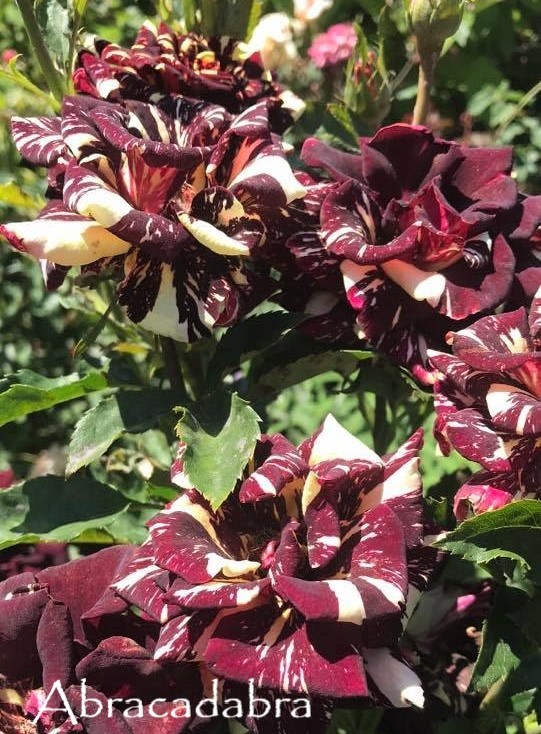
Named after the German city of Regensberg but she may just be sold under some alias names. Her ICRA appellation is MACyoumis, this was originally MACyou but this was withdrawn. Also sold as ‘Young Mistress’, this name too has been withdrawn. These two are a little un PC? She might appear as ‘Buffalo Bill’ in the States and I have also found her as ‘Twins of Regensberg’. Tiresome these multiple names!

A real wow rose and so useful. Front of the border, container, small informal hedge perhaps. I love the colouring, but I can see that she could be a bit startling for some people. Who grows her? Do comment.

Saturday 23rd March

I saw this rose last summer for the first time, how could I have missed her! This is the American bred Floribunda ‘Ebb Tide’, from the nursery of Tom Carruth a prolific breeder of fine roses, introduced in 2001.

A rose that has an old fashioned feel about her, if I had read she was introduced in 1880 I would have believed it. It is her colour that gives this feel I think together with the rather untidy petal formation. A deep moody violet purple, full petalled blooms that appear in small clusters. Often with a midline white streak or a small white fleck on the petal edge. Cupped shaped to begin with before flattening and revealing her golden stamens. The petals have a white base which accentuates this stamen corona, rather like yesterday’s little rose ‘Regensberg’. Fades to a rather smoky lilac grey as the bloom ages. Sharp spicy fragrance

‘Ebb Tide’ is a rose that varies considerably in colour depending on the intensity of the sun. Cooler damper weather gives a deep dark colour, but brighter warmer weather produces a paler version. Reputed to scorch in full sun, a lot of these dark crimson or purple roses have the same problem. You need to carefully place them, so they get the sun but not the hot scorching noon and afternoon sun otherwise you end up with blooms looking like a milk chocolate rose.

Typically, a short grower here in the UK, only 38-56cm high but I guess taller in warmer countries.

Variable reports on her health and growing habits. Some growers comment on just average or poor growth with a propensity towards blackspot and mildew. Others report good health so maybe she is picky about her locality. If you grow her do comment on these aspects, good or bad, it’s all helpful.

 I can’t make my mind up on whether I like her or not. Falls into my mmmm category. Am I being too hard on her?

Sunday 24th March

An appropriate rose for today, ‘Smarty’ bred in the Netherlands, posted on the day I leave the country to return to the UK. Dating from 1977 and introduced by Dickson Nurseries Ltd. Her seed parent is the equally cheerful shrub, the pinky purple ‘Yesterday’.

A charming quiet rose and often described as the perfect shrub. Small clusters of buds spring up early in the season, then she is off into bloom and she continues until late autumn. The small buds open to small single delicate pale pink blooms with a large yellow stamen crown, reminiscent of our wild hedgerow roses. All bees and pollinators love this rose as they can easily harvest the pollen and nectar. The blooms fade to pearly pink and then through to white before neatly dropping. Quickly replaced by another bud cluster springing to bloom. Sweet light fragrance completes the picture!

Described as a ground cover or procumbent rose as she has a spreading growth habit and is reputed to not get too high. I have seen her at a height of around 90cm and a lot taller. The photograph of the bush, taken at the Peter Beales garden last September, shows she can easily be around 1.20m. Tidy neat bright foliage with excellent disease resistance. A prickly lady though, even the bloom stalks are spiky!

An easy simple rose to grow but probably not one for a choice spot in your garden. Tolerant of a little neglect and some shade. Her spready habit makes her a good candidate for informal hedges. I often see her lining Dutch streets on the outskirts of towns. I wish that UK town streets were as decorative!

Tuesday 26th March Jeanne de Montfort

A moss rose today, I love these roses for the double hit of rose fragrance and the balsam spice of the ‘moss’. Reputed to be one of the tallest with the most moss – ‘Jeanne de Montfort’. As I typed that I thought ‘the most moss is a claim that I seem to have written before’ so perhaps that can be taken lightly.

A tall rose for sure as you can see from the photograph taken at Mottisfont Abbey Gardens last June, but I failed to get a close up of the moss. Vigorous growth habit more so than the commonly grown ‘William Lobb’. ‘Jeanne de Montfort’ can stretch to over 3m high but usually is content at 1.85m. You will need space, not a small garden rose at all.

Clusters of red buds heavily covered in bronzy moss open to pretty pink flat full petalled blooms. The petals often have darker flecks and an odd white streak adding to their appeal. Opening out to reveal a golden yellow stamen corona, another rose for the bees. Fades quietly to pale pink and then to white. Heavy strong fragrance but she is a one trick pony, just the single flush of June bloom with a scatter of late blooms in a good summer. Glorious sight when in full bloom.

Bred by the French nurseryman Robert and introduced in 1851. Named for the Duchess of Brittany (1295-1374), known as ‘La Flamme’, she was a fiery lady who defended both her husband’s and her son’s rights to the title during the Breton Wars of Succession. After lobbying Edward III for military assistance, she ended up a political pawn imprisoned in Tickhill Castle, Yorkshire where she died.

Reasonable disease resistance, the moss roses can get mildew on their moss late in the season, particularly in damp humid weather. Hardy USDA zone 6b-9b.
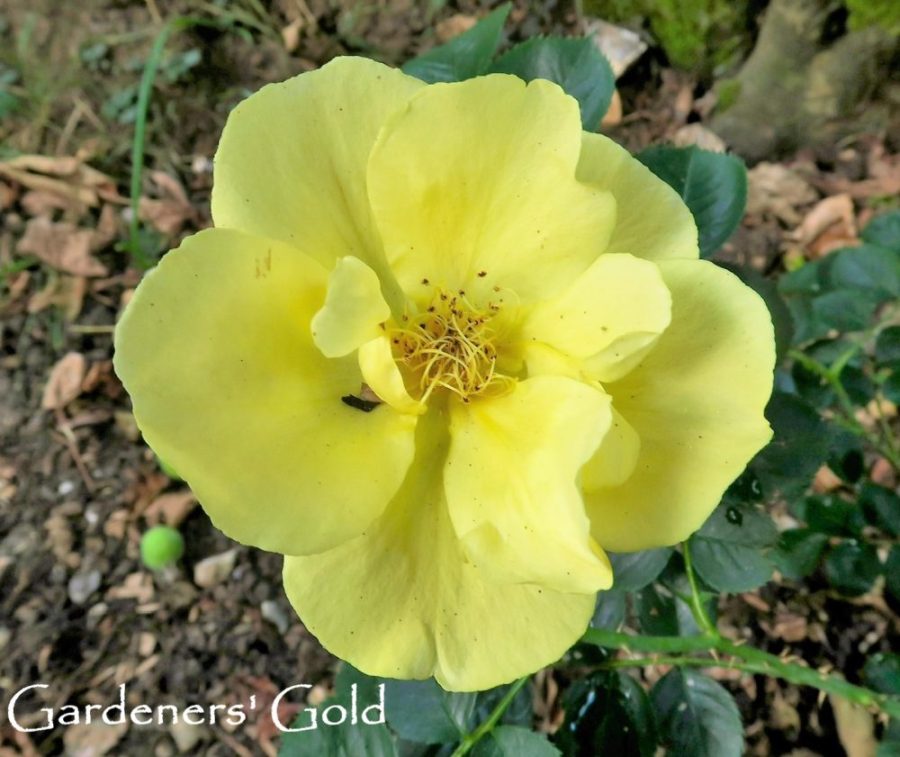
This large landscape rose will not be for everyone but if you have space and love the moss roses then you might consider her.
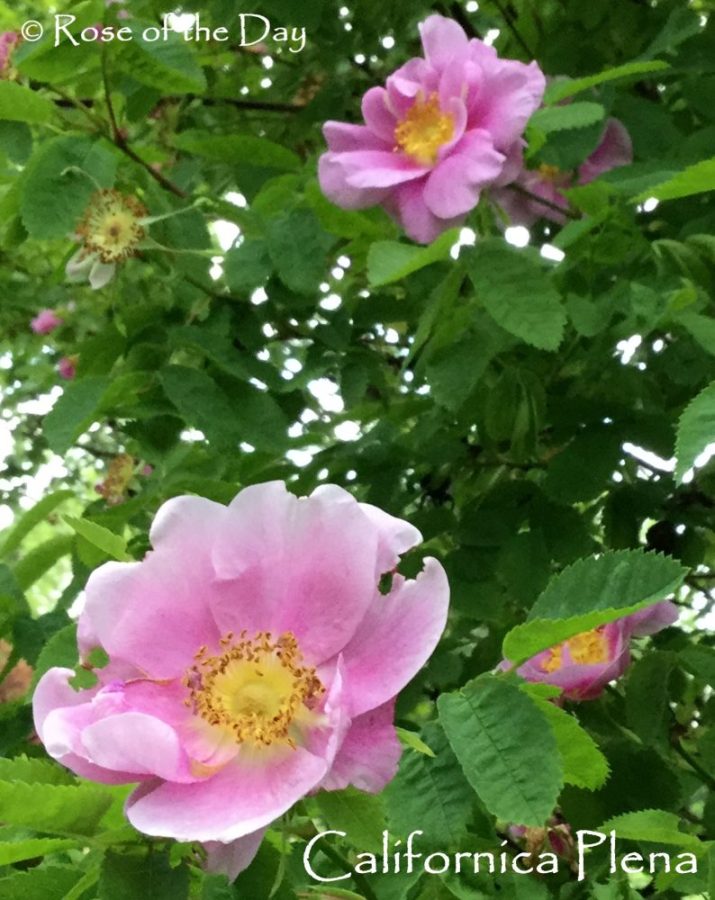
Wednesday 27th March

When selecting roses for the daily post I always try to get a good range of different rose classes each week. Today the beautiful Hybrid Musk ‘Penelope’.

Dating from 1924 and bred by the Revd. Joseph Pemberton.  For this rose he probably didn’t use his favourite ‘Trier’ parent rose but Ophelia, an HT for the seed parent and an unnamed seedling as the pollen parent. However, I see that ‘Botanica’s Roses’ suggests the pollen parent could be ‘Trier’ or ‘William Allen Richardson’ so some uncertainty over parentage here.

‘Penelope’ produces large clusters of small orangey pink buds which unfurl to the loveliest pearl pink semi double blooms. Ruffled petals with a slightly darker peach pink back. As the blooms open you get the delicious combination of peach, pearl pink to white accentuated by a golden stamen crown. Reputed to be a rose where the spectacle of the bush in full bloom looks better than an individual bloom. I think that’s a little hard as these small to medium size blooms are full of charm.  Strong musk fragrance that lifts in the warmth of the day to scent the garden around the bush. Flushes of bloom through the summer into late autumn, she is almost better in the autumn than the summer. That golden crown of stamens is a magnet for pollinators which means you will get an exceptional crop of hips. Uniquely the young hips look dusty with a fine bloom on them like a grape, maturing to a coral pink and contrasting nicely with the late blooms
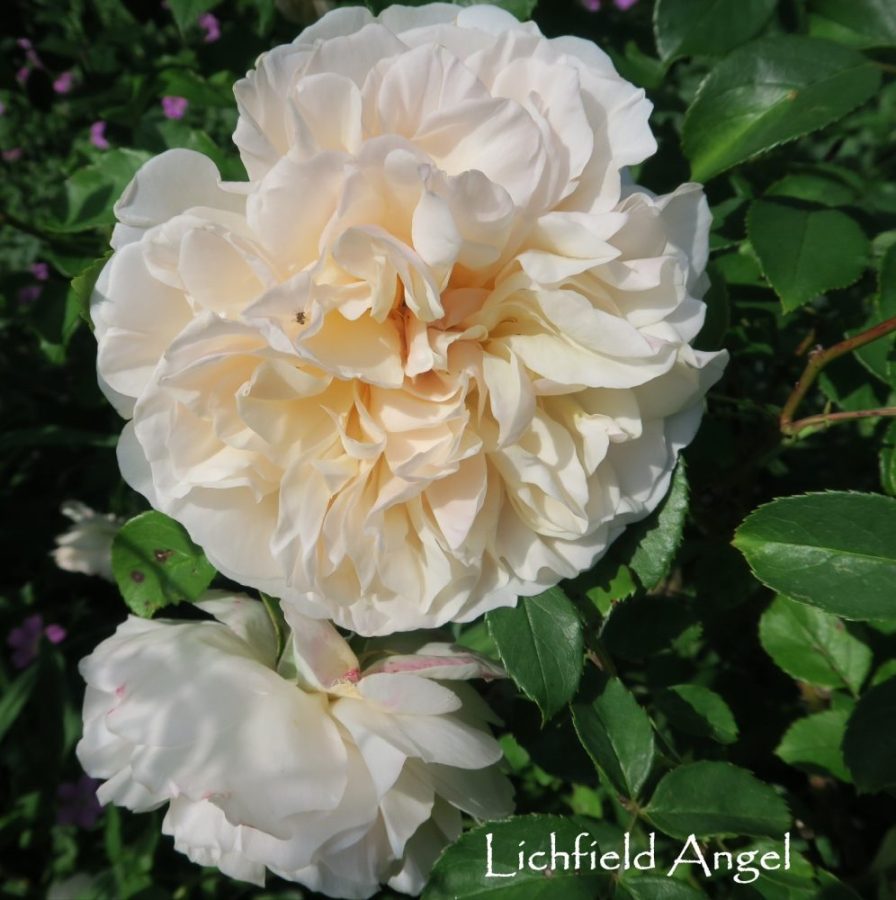
Happy healthy foliage that is dark red when young, moving to a dark shiny green later. Very disease resistant as are all the Pemberton Hybrid Musks. She can reach 3m in hot climates but generally is around 1.5m in both height and breadth. Reputed to hate pruning so she will need space to spread her lovely stems. Hardy USDA zones 5b-10b. Widely available, and she is a good candidate for cuttings.

Joseph Pemberton was well versed in the classics naming most of his roses after characters in these mythological tales. Penelope appears in Homer’s Odyssey as the wife of Odysseus. She was a very chaste lady despite many suitors when Odysseus was off fighting another war, so her name is associated with marital fidelity. The actual Greek meaning of Penelope could be some kind of bird or a cunning weaver depending on the translation and the etymologist!

Graham Stuart Thomas considered ‘Penelope’ to be one of the finest garden roses. His planting suggestion includes grey foliaged plants with pale blue flowers to frame this exquisite rose. Those who grow her will not be disappointed I promise.

Thursday 28th March

An early David Austin rose today dating back from 1969 so long gone from the David Austin catalogue but still a great favourite in Australia, ‘The Yeoman’. David Austin started his nursery in 1970 so this rose was one of the first ‘English’ roses along with ‘The Knight’, ‘The Prioress’, ‘Wife of Bath’, ‘Canterbury’ and ‘Dame Prudence’.

We are accustomed to the DA roses having either good repeat flowering or almost continuously in bloom. The early ones, however, lacked this attribute and bloomed once with occasional blooms later in the summer. ‘The Yeoman’ also blooms once although I read from growers, he is an excellent repeat blooming rose. Perhaps he prefers the sun and warmth of the southern hemisphere?

Clusters of attractive coral buds open out to full petalled flattish blooms of exquisite colour. The outer guard petals are pale pink, but the inner petals are a glorious peachy pink with glowing yellow bases. It is said that when this rose is in bloom he looks as though a lightbulb is shining in the centre, a delightful description. A truly beautiful rose with a strong myrrh fragrance.

Reputed to have poor disease resistance here in the UK hence his removal from the catalogue. Now we have warmer and dryer summers this rose would probably thrive very well. Good dark foliage sets off the blooms very well. Not overly tall at around 1m. Hardy USDA 5b-10b. Cannot find him available in the UK but still sold in Germany. Available in the States and Australia.

David Austin used ‘The Yeoman’ in the English Rose breeding programme, so his genes run down through a lot of the DAs. Interestingly Griffith Busk also used ‘The Yeoman’ when developing his extremely tough hardy roses. ‘Distant Drums’ and ‘Country Song’ are both first generation children of ‘The Yeoman.’

A wonderful rose and although no longer available here at least he grows in other countries to delight gardeners. Please comment if you grow him.

Friday 29th March

Today the happy little patio rose ‘Honey Bunch.’ Bred by Anne Cocker of Cocker Roses in Aberdeen Scotland and introduced in 1989.

This looks to be a very attractive rose, so I was slightly surprised to read the description in Botanica’s Roses that the colour is overpowering and this rose is best placed by itself in a single variety planting. I have seen roses of much more startling colours, ‘Masquerade’ for example which makes me shudder.

‘Honey Bunch’ produces clusters of small peachy orange buds opening to semi double honey and pink blooms. The wavy edged petals have a lemon yellow base giving the centre of the bloom a real glow. This little rose is similar colour wise to yesterday’s ‘The Yeoman’. Good fragrance as well and she obligingly blooms in flushes all summer.

Take a little care when buying as there is an orange patio rose named ‘Honey Bun.’ The ICRA appellation for ‘Honey Bunch’ is COCglen so that will ensure you get the right rose.

Maximum height of 50cm so very suitable for the smaller garden or front of the border. Ideal container rose. Good glossy foliage and good disease resistance. Hardy USDA 6a-10b.

I love the intense blue of the geranium Rosanne thoughtfully planted beside this rose, a great colour combination. This is such a charming little rose, so she is on my list for my container collection.

Saturday 30th March

A number of you may be familiar with the white Damask rose ‘Léda’ with her crimson pink edged pink smudged petals, also known as the ‘Painted Damask’. Today we have her sport ‘Pink Léda’

Is ‘Pink Léda’ a sport though? There is an ongoing discussion about whether she is the sport or is it the other way around. Did the pink form spring from the white or the white from the pink? An answer lost somewhere in the nineteenth century. The white rose is said to have originated in England and has always been popular in the UK. However, ‘Pink Léda’ comes from somewhere on the continent and was the preferred choice in France. From that information, I would hazard a guess that some bushes of ‘Pink Léda’ were imported to England and the white ‘Léda’ was the sport. Both are identical in every way apart from the bloom colour.

Long feathery sepalled dark pink buds appear in clusters.  Extraordinary buds really, they have a ‘mutant’ appearance. These open to double flat blooms of the clearest pink which reflex to show little yellow button eyes. An untidy petal arrangement but I so much prefer this to the modern neatly petalled roses. A sumptuous heavy intense fragrance, you cannot get a better one! A single wave of glorious bloom in June and she shuts up shop although she may offer a few late blooms. This is a rose that you will need to prune after she has finished blooming in June, she blooms on the previous summer’s growth. Prune her in the winter with the rest of your repeat and continuous roses and you will not get her spectacular show of bloom.

Height around 1.20m and a little narrower. Soft green foliage that has fairly good disease resistance. Prickles, boy is she a prickly lady! Hardy USDA zone 4b-9b. Widely available.

Named for the Greek mythological ‘Léda’ daughter of the king of Aetolia, Thestius. Wife of King Tyndareus of Sparta she caught the eye of Zeus who transformed himself into a swan and seduced her. This seduction scene of ‘Léda’ and the Swan became a popular subject for Renaissance painters.

A superb classic rose that would grace any garden although she blooms just once. I often advise followers with smaller gardens to include just one of the Pre-1900s roses in their garden. Would ‘Pink Léda’ be the one for you?

Saturday 31st March

I am not a ‘hot’ holiday fan, I do not do beaches, or cruises. However, I think I would like to visit Bermuda to see today’s rose which has naturalised across the island, the China rose ‘Cramoisi Supérieur’.

Let’s safely say this is a rose of unknown breeding but a lot of claims for the breeder. Reputed to be a seedling from ‘Slater’s Crimson China but she could be an unknown bred before 1818. Perhaps unknown Belgian breeding before 1823 or maybe French from Cocquereau 1832. Possibly Cocqurel 1832 or the Italian Villaresi 1832. We know she was introduced by the French nursery of Jean-Baptiste Paillet in 1834 as the superior crimson ‘Cramoisi Supérieur’. As well as the multiple claims for breeding her she has gathered an impressive number of aliases: Agrippina, Bengale à petals striées, Bengale Cramoisi Supérieur, Bengale éblouissant, Bengale Oeillet, Bermuda Wingood China, La Gaufrée, Lady Brisbane, L’Eblouissant, Mableton Crimson China, Old Bermuda Red Rose, Queen of Scarlet, Queen’s Scarlet, Rosa Indica Caryophyllea.

 China roses like sunny sheltered positions but this one can cope with poor conditions. In the UK she is a small wiry little shrub around 1m high suitable for containers, border front and smaller gardens. Put her in a warmer dry climate and she can reach 2m happily. Sparse long pointed foliage, characteristic of Chinas, but very healthy. Drought resistant as well. All useful attributes for the busy or lazy gardener! Widely available across the world.

Clusters of small buds on airy stems unfolding to medium sized double cupped blooms of clear crimson often with a flick of white. These delicious cupped blooms reflex and flatten attractively revealing their golden stamens. Fragrance reports vary from ‘not very fragrant’ to ‘delicious strong raspberry.’ She is more perfumed in hot climates or when grown here in the UK in a sheltered warm spot. Blooms in flushes but can be continuous in favourable weather.

A useful rose but certainly not a boring one. I think a lot of potential growers are deterred by the fragile look of China roses. She copes with oppressive heat in Bermudan summers and gales with tremendous rain. Grown in central Europe she bends but not bows under snow and frost. Consider her if you have a space for her crimson beauty.

.

.


January 2019

The posts below originally appeared on my Facebook blog ‘Rose of the Day’

Tuesday 1st January 2019

I admit to saving this rose for today with her most appropriate name for New Year’s Day. ‘Champagne Moment’ a German bred floribunda introduced in 2005 and had her champagne moment in 2006 when she was ‘Rose of the Year’.

Neat little buds of a rather bright orange appear in the dark glossy foliage. As these swell, the colour becomes less vibrant moving to a peachy pink. The clusters of full petalled blooms open to a pale cream pink with a warm peach lemon centre. Reliably repeat blooms all summer. I photographed this one in early September and she was full of buds. A light sweet fragrance, some reports of no fragrance

Not a large rose, only 90cm x 60cm. A good candidate for the front of the border, or a large container. I have seen her as a low hedge where she did look stunning.

She has a couple of alternative names. In Canada she is sold as ‘Lion’s Fairy Tale’ and in the US and it appears in the rest of the world she is known as ‘Lions-Rose’. This last name is her registered exhibition name, and the ICRA name is ‘KORvanaber’. ‘Champagne Moment’ seems to be reserved for the UK market.

Vigorous and with excellent disease resistance. Hardy USDA zone 6b-9b.

Wednesday 2 January 2019

A simple soul this morning, and one that is easily overlooked. The Revd Joseph Pemberton and his sister bred superb roses creating the Hybrid Musk group in the early 1900s. Sadly some are now no longer in commercial cultivation but the better known ones such as ‘Penelope’, ‘Felicia’ and ‘Moonlight’ are still popular. Rightly so with their delicious fragrance, attractive blooms and their extremely long blooming season. ‘Moonlight’ has a scattering of her small white blooms today. I digress; however, today’s rose is one of the lesser known Hybrid Musks, the cerise pink ‘Vanity’.

I wonder why she is not more widely grown? She is large around 2m high and a little narrower at 1.5m. An open growth habit, Graham Stuart Thomas recommends growing three together, so they can support each other. That’s fine if you have a lot of space but problematic in a smaller garden. Perhaps just one grown next to white or pale pink companions of a bushy habit would help. She is a vibrant cerise in early summer so not good next to yellows, or reds unless you like a wake-up call when you visit her. She mellows as the season progresses becoming a little softer, this photo was taken in mid September.

Large sprays of bloom are produced in flushes through the summer. Single petalled and these petals have a nice wavy shape adding to her charm. Good for the bees and other pollinators. She starts off blooming a bit late and then continues into autumn and early winter which is a useful attribute. As the blooms mature the vibrant cerise fades to bright pink, mauve and then a lilac grey so always something of interest there. Copious small orange hips follow so you will get a mixture of late bloom and early hips in the autumn. She isn’t as intensely fragranced as her sisters but still has that ‘musk’ fragrance which is detectable at some distance.

Hardy USDA zone 6b – 10b. Vigorous with good disease resistance.

If you have space, she is well worth considering. You could grow her as a bushy climber or at least against a wall or perhaps a small tree. ‘Vanity’ would be a better name I think for a very full petalled classic old rose rather than this simple quiet elegant rose.

Does ‘Vanity’ grow in your garden? Do you love her understated elegance?

Thursday 3rd January

This photograph reminds me of very over the top wallpaper, a real riot of colour to brighten your January morning. A Bourbon rose from the French breeder Laffay, introduced in 1852 ‘Sir Joseph Paxton’. Named in honour of the great English gardener, architect, MP, creator of the conservatory at Chatsworth House and the Crystal Palace, and instigator of the commercial cultivation of the world’s most widely grown banana the ‘Cavendish’ banana. I wonder what he did in his spare time. This rather extravagant rose seems to be appropriately named.

The large full petalled blooms are of a bright crimson with paler petal edges in a quartered structure. Sir Joseph looks a little like ‘Mme Isaac Pereire’ but he is somewhat paler in colour, and not quite as intensely scented. This is a great pity as from all other aspects he is a rose well worth including in your garden. Repeat blooms very well, almost continuous really. However, I happened to be looking at the David Austin website this afternoon and looked at their description. They say no repeat blooming. I wonder if this is an error as all the other authorities have him as a reliable repeat bloomer.

Medium height, around 1.2m but some reports that he can be taller in a hotter climate. A very soft grey green foliage, the perfect foil for the bright colour of the blooms. A slight tendency to black spot later in the season. Fairly thorny and prickly. Hardy USDA zone 5b-10b.

I don’t grow him, the photo was taken in mid June at Mottisfont Abbey. Does anyone have him in their garden, or know him? Would be interesting to hear others experience of growing this spectacular rose.

Friday 4th January

Today’s Friday Favourite is the Multiflora rambler ‘Ghislaine de Féligonde’. One of Angela Bokor’s five favourites, thank you Angela. The second photo was taken at Mottisfont Abbey this summer.

She is a rose once seen in full bloom never forgotten and deserving to be considered the best of the Multiflora ramblers. Not as vigorous as some in this class, she won’t take over your entire garden or house. Maximum predicted height of 3-4m or you can grow her as a bushy shrub where she will reach around 2m.

The buds are a creamy orange, however, this is a rose that does show considerable variation in petal colour so you may find the buds are more vibrant. The large semi double blooms open to a soft apricot and fade quickly through lemon and cream to white. Later in the season when the weather is cool she will have a distinctly pinker tone which lasts much longer. She produces clusters of bloom which get progressively larger towards autumn which is a pleasing feature. The flushes of bloom are long lasting as well. I will point out that some authorities don’t consider her as a reliable repeat flowering rose. Perhaps if you grow her you would like to comment on your experience of this? A delicious musk fragrance which carries across the garden.

Bright glossy foliage identical to her seed parent, the rambler ‘Goldfinch’. Thornless but the new growth has small bristles. I like thornless climbers from the pruning and training point of view!

A French rose bred by Turbat and introduced in 1916. The naming story is very appealing. Turbat had heard a story from the WWI trenches. A young officer, the Comte de Féligonde, had been left to die of his wounds in No Man’s land. His wife Ghislaine was a Red Cross nurse and she ventured into the dangerous area. On finding her husband she dragged him back behind the lines and nurse him to health. Turbat was impressed by this heroic tale hence the name of the rose. A lovely story except it is not true. A French researcher looking at the de Féligonde family history discovered that Ghislaine was the daughter of the Comte Charles de Féligonde and his wife Odette and born in 1914! It is more likely that a friend of both the de Féligondes  and Turbat suggested the rose should be named after the young daughter.

Widely available. Hardy USDA zone 5b

5th January 2019

I think every time a David Austin rose appears on this page we will remember his huge influence on modern rose breeding. Today we have the most attractive ‘Wisley 2008’ not to be confused with the earlier mid pink ‘Wisley’. ‘Wisley 2008’ supplanted the 2004 ‘Wisley’ when the disease problems became apparent. Named of course for the famous Royal Horticultural Society gardens in Surrey.

An elegant rose with the signature full petalled shallow bowl shape found in many DA roses. A very soft classic pink with paler outer petals, they are a bit pink spotted with rain here as this photo was taken in early September. The website description reports the bloom resembles ‘Konigin van Dänemark’, I don’t see the similarity as Konigin has a tight quartered rosette shape of darker pink.

Almost continually in bloom. Healthy and vigorous. Hardy as well. Widely available.

The fragrance? Well, all DA roses have good fragrance. This one is described as fruity with hints of raspberry and tea. Mmmm I will leave that one for you to decide.

6th January 2019

It’s all in the name as the cliché says and today, we have a rose for whom this is true. The glistening pure white ‘Frau Karl Druschki’. Classified as a Hybrid Perpetual some authorities consider her to be a Hybrid Tea, not least because her pollen parent is the famous HT ‘Caroline Testout’.

Bred in Germany by Peter Lambert, introduced in 1901 and named for the wife of Karl Druschki the president of the Germany Society of Rose Friends. The Druschki family lived in Görlitz on now what is the German – Poland border. The name is problematic for non German or Polish speakers, I speak some German and would say Drus-she but that might not be quite correct. It is believed that this pronunciation difficulty combined with the hatred of all things German in WWI lead to her alternative names. ‘Schneekonigin’ – ‘Snow Queen’ but still German so not so much of a change but she is sold under both aliases. The French ‘Reine des Neiges’ also translates to Snow Queen. ‘White American Beauty’ is the English version however, in the UK and Europe she is usually found as ‘Frau Karl Druschki’.

One, if not the purest white rose to be found. ‘Iceberg’ has a greenish tinge, but the Frau is really icy white although there is a slight lemon hue in the centre. Long stems with a perfect typical HT scrolled bloom which unfurls from a bright pink bud. The mature buds reveal golden stamens. She has always been a popular exhibition rose and invaluable to flower arrangers. Not a single scintilla of fragrance so you need to place her next to a fragrant neighbour. She will ‘ball’ in wet weather and will suffer pink ‘spotting’ when raindrops hit the open blooms.

Tall at 1.8m with large pale foliage and vicious scimitar like prickles, not to be planted where you brush past her. Vigorous and one for the secateurs every winter. Hardy USDA zone 4b but susceptible to mildew. Widely available.

One rarely finds named roses in paintings or literature, but this rose appears in Radclyffe Hall’s The Well of Loneliness.

I am not so keen on these very white modern roses, but I can see they have their place but not with me. Does she brighten your garden, or do you curse her spotting and ‘balling?

Tuesday 8th January

I have a horse who sees Pokémons. These invisible visions cause him to rapidly perform a 180° degree turn and attempt to remove himself at some speed from the spooky apparition. I have some sympathies with him when looking at today’s rose. I love striped roses but this one, the Floribunda ‘Abracadabra’, is just a little over the top for me.

The unusual colour combination of a rich reddish brown and creamy lemon is an eye opener. Initially, the red is brighter with a vibrant lemon, both colours darkening as the bloom matures. The petals have a velvet like appearance looking all the world like an exotic creation from an exclusive chocolatier. Imagine snapping off a chocolate petal! The colouration is variable with some blooms of full red brown, a few with half full red brown and the remainder of the splashed flecked stripes. Some very splashed and freckled and others with a few faint streaks. A rose that would make you visit her daily to see her ever changing show.

Attractively shaped blooms, not so large and double petalled. A weak elusive fragrance with some reports of no fragrance at all. Repeat blooms in flushes. The rather matte foliage gives a pleasing contrast. Fairly small, around 80cm but she may be larger in hotter climes. A very heat tolerant rose as well.

Her name? She is a sport of ‘Hocus Pocus’ so what else could she be named? ‘Hocus Pocus’ is identical to her daughter but a miniature. ‘Hocus Pocus’ was bred by the German nursery Kordes and ‘Abracadabra’ was introduced by them in 2002. Her ICRA name is KORhocsel and the reason for giving you this information is a later, 2004, introduction by Kordes of another ‘Abracadabra’. This later one, also a striped, is a gentler carmine pink and cream with the ICRA name KORamsaro. One wonders why they couldn’t have been more imaginative as there must have been some confused buyers. A further warning that there is also a 1991 HT ‘Abracadabra’ that is pink but seems to be only available in the US.

A fascinating rose but I don’t think I have a place for her in my garden. Like my horse, I think I would shy away from her. Love her or loathe her? Do comment.

Wednesday 9th January

A quieter rose for you this morning but a rather lovely one. ‘Gardeners’ Gold’ named for the fiftieth anniversary of the BBC gardening programme Gardeners World.  Gosh, fifty years must be a record for the BBC who frequently axe well loved programmes.

Bred by the Hertfordshire nursery of Harkness and introduced in 2017. In common with most other rose breeders Harkness are now breeding roses that are both easy to grow and with excellent disease resistance. During the trial period of seven years, this rose was never treated with any fungicide. Being a picky scientist, I could read that thinking it may have had some fungal infection which was never treated as the rose is a very strong vigorous one that could shrug off a spot of black spot. That is just me being cynical!

Charming clusters of semi double blooms of bright yellow, this photo was taken late in the season, so he is a bit more lemon in hue. Very free flowering according to the Harkness website and with a light fruity fragrance.

Not a large climber which is very useful, maximum predicted height and width of 2m. Many modern houses don’t have too much wall space and are easily swamped by the older climbers with their 3-4m height and similar breadth. This is a rose that will be happily gracing the rather bland frontages of new homes owned by busy people out at work all day. He could grow in a large container. I mean a really large container. I see endless photos on FB of roses in tiny containers with requests ‘What is wrong with my rose?’. The simple answer is ‘Its shoes are too tight!’. Roughly the size above the ground is repeated below the ground. Of course, that would be such a large container but get the largest one you can. I use old water troughs or large plastic horse water containers as large containers in garden centres are rather pricy.

I digress from this lovely climber though. He looks to tick a lot of boxes so if you have been looking for a small yellow climber, he will fit the bill.

Thursday 10th January

A species hybrid rose that suits my rather wild garden ‘Californica Plena’. She is a very tall shrub as you can see from the photo around 2m and she produces a small number of suckers. I usually dig these up and replant them in other wild areas or donate them to friends. You will end up with a small thicket if you leave her to do her thing.

She blooms just once fairly early in the season, starting in May but continuing for around a month. A mass of small pink buds appears which open into semi double blooms. The petals are deep lilac pink in the centre, paler on the edges and often with white streaks. Her coronet of yellow stamens attracts bees and other pollinators. Sweet light fragrance. These attractive medium size blooms sit in pleasing grey green foliage with reddish stems. Produces a large crop of large red hips in the autumn, much appreciated by the garden birds.

Slightly mysterious past with some confusion about being the original ‘Californica Plena’ introduced in 1894 by the Hungarian grower Geschwind or another one of his species hybrids ‘Theano’. Doubts also about her parent being Rosa Californica with some authorities considering her to be a Rosa nutkana hybrid. I will leave that argument for the taxonomists to decide. Sold widely as Californica Plena but you may also find her listed as Rosa californica ‘Plena’.

Very hardy, vigorous and disease free. Tolerant of shade, poor soil and drought conditions, she is a tough lady. She won’t suit a small garden but if you have a woodland or landscape garden, she is absolutely ideal. She manages to look attractive even when she has finished blooming which is rather rare for a rose.

Friday 11th January

 A David Austin rose today ‘Lichfield Angel’. Perhaps I should have kept this one back to post next Tuesday as the UK seems to need an angel at the moment but let’s think of roses rather than politics!

I haven’t planted any DA roses for some time, but I saw this rose last summer and admit to being a little tempted. Introduced in 2006, this is a pearl of a rose. Clusters of plump creamy apricot buds unfurl to large full petalled blooms. Beginning a soft subtle apricot before fading to a creamy white with warm honey petal bases giving a lovely glow to the bloom. I much prefer these creamy white roses to the rather hard glistening whites, a calmer more natural appearance that fits into any garden colour scheme.

Practically thornless she forms a nice rounded shaped bush with a maximum height of 1.5m. Good glossy foliage and excellent disease resistance was reported. Reliable repeat blooming throughout the summer and into early autumn. Fragrance? Well, this is a bit of a disappointment, to be honest. Just a light musk fragrance but rather elusive.

Her name comes from a remarkable medieval stone panel now known as the Lichfield Angel, discovered in 2003 when archaeological work was undertaken in the nave of Lichfield Cathedral. Believed to have formed part of the shrine of St Chad this panel retains traces of pigment, the body is red with white wings with red tips.

The Lichfield Angel panel

My husband and I spend a lot of time remodelling our garden and we recently demolished a sad shed on the outskirts of the garden. This has given us a large area in a neglected area. As my gardener (sounds grand but only four hours a week) said “I guess that will mean more roses then!”. ‘Lichfield Angel’ is a definite possibility.

Saturday 12 January

An interesting rose today bred by an amateur breeder the American Roy Shepherd, from unusual parents, the fabulous ‘Golden Wings’.

‘Soeur Thérèse’ a yellow Hybrid Tea is the seed parent, the pollen parent being an unnamed Rosa spinosissima var. altaica x ‘Ormiston Roy’ a Hybrid Spinosissima seedling. Unnamed seedlings are frequently used in rose breeders, these have good qualities but the second generation cross will be better. When Roy Shepherd wasn’t breeding roses he was writing, the classic 1954 ‘History of the Rose’ was an exceptional book in its time. This book has been surpassed by the increase in knowledge from recent research on the rose genome. Consequently, this book is relegated to dusty shelves and book collectors.

His rose ‘Golden Wings’ remains however a popular rose. Often the first rose in bloom and the last one before the winter frosts. She has a fragile beauty, but the species attributes have ensured she is a tough, vigorous and disease resistant rose. Tolerant of drought and poor soil, and very weatherproof as well. Thrives in heat and doesn’t mind shade. Long pointed buds open as lemon yellow cupped semi double blooms which flatten whilst fading to ivory white with lemon petal bases. A glowing corona of stamens in the centre. These are large blooms at least 12cm with a rich fruit like fragrance.

Not a small garden rose as she can easily reach 2m in height forming a tidy shrub. Rather Hybrid Tea like foliage but it is matt rather than shiny, this shows off the blooms very well. Hardy USDA zone 4b and warmer.

There is a similar American bred rose ‘White Wings’ but unrelated to ‘Golden Wings’. ‘White Wings’ is a pure white single rose with reddish brown stamens.

‘Golden Wings’ is a back of the border, landscape or woodland garden rose rather than a choice rose for the small garden. I can think of many untidy public areas that this rose would grace. Our local town tries hard with herbaceous plants on the roundabout islands, but I feel roses would be an easier solution. Imagine a traffic island filled with this rose or would she distract the passing drivers?

Sunday 13 January

A cold windy morning in Suffolk so I revisited the photographs taken in mid June at Mottisfont Abbey. Difficult to think it was so hot we were driven out of the rose garden to lie in the shade of the trees outside. Roses are sun and heat lovers but some, particularly, the older varieties, flag quickly with the blooms fading and falling before your eyes. This rose is an example so not easy to photograph. A pity as this is one of the loveliest of the Gallicas ‘Gloire de France’.

Rather renowned for fading quickly in bright sunshine she is a classic clear mid pink. The petal edges fade quickly to a lilac mauve leaving a brighter pink bloom centre. Huge globular blooms that flatten on opening. Muddled quartered swirl of petals gives charm to this rose. Exquisite heavy fragrance. Everything an old fashioned rose should be.

These superb blooms sit in foliage of a soft matt grey green. She forms a large arching shrub, around 1m high and spreads much wider. All good things, such as summer, come to an end and this rose has just a single tremendous burst of bloom before retiring for the remainder of the summer.  When planning your garden try to ensure that you have good repeat or continuous blooming roses around these single bloom period ones as they can look unexciting for the remainder of the summer. You prune them after blooming, that is the correct time for these, and then you are free to depart on holiday.

A tough vigorous rose, relatively disease resistant. Always a caveat with the older ones as they can be fine for years and then have a bad black spot attack.

Dates to around 1828 and is believed to have been discovered by Julien-Alexandre Hardy, head gardener of the Royal Luxembourg gardens. ‘Mme Hardy’ is probably his most well known rose from the two hundred or so that he introduced. If you find a rose with ‘du Luxembourg’ in the name it will be one of Hardy’s roses. There is a slight query as the Botanica’s Roses book cites an unnamed amateur rose breeder from Angers but I can’t trace any details of this. If you know a little more, please let me know.

Julien Alexandre Hardy

A superb rose for your old rose collection and very useful as she isn’t so high. Some nurseries recommend her for a container, but I feel she would struggle as she wants to spread sideways to achieve her full Glory of France.

Tuesday 15 January

When I am planning the roses to feature on this page, I have a rough scheme. I try to include a wide range of different classes, for example, a climber, a modern shrub where I try to have a small one if I have already had a large variety, an older pre-1900, a patio, an HT. Then I bumble around my photo files picking suitable candidates. Sometimes the name is appropriate to the day, ‘Champagne Moment’ for New Year’s Day for example. I admit to being rather depressed by the gloomy news today concerning tomorrow’s parliamentary vote, so I was searching for a rose to perk us up. Found one, result! Not just a beautiful rose but a fairly appropriate name for the day, ‘The Churchill Rose’.

Named for the 50th anniversary (2011) of Churchill College, Cambridge which is in turn a memorial to Sir Winston Churchill. I wonder what he would have thought about the current political debacle in which we find ourselves ensnared?

This is a rose bred by Peter Beales, so I doubt sadly whether he is available outside the UK. The Peter Beales website states that this is a perfect alternative to ‘Perdita’, a David Austin rose, that they no longer stock. Certainly, there are some similarities but this one doesn’t have the pink tones of ‘Perdita’. Instead ‘The Churchill Rose’ is a very subtle soft apricot. Semi double blooms with a striking lemon glowing centre. Repeat flowers and very free flowering as well. Superb fragrance completes the picture!

Healthy glossy foliage with attractive reddish edges to young foliage. Neat habit and quite small at 1.2m in height and width.

Such a pity this fabulous rose isn’t more widely available. If you come across him outside Britain do let me know.

Wednesday 16 January

Today a rose that originates in Australia rather than Europe or the US for a change. She is a real sport as well, sorry that’s a poor joke, the Floribunda ‘Burgundy Ice’. Her mutant parent, sports are natural mutations occurring on a parent bush, is ‘Brilliant Pink Iceberg’ (1995). In turn, she was a sport of ‘Pink Iceberg’ (1995), these last two were also found in Australia. ‘Pink Iceberg’ as her name suggests is a sport of the well known ‘Iceberg’ (1958).

‘Burgundy Ice’ was discovered in 1998 and introduced somewhat later in 2003. The lineage seems to have an unstable genome where environmental pressure, for example, drought, extreme heat or cold, tweaks the genetic switches for petal colour. You can see in this photograph, in Peter Beales garden in Norfolk, one of the blooms has experienced a ‘tweak’ resulting in a bi-coloured bloom. There was evidence of others in the bed, some almost pure white others burgundy with a streak or two. The white blooms in the background are another variety.

Abundant clusters of elegant purple pointed buds appear in flushes throughout the season. Opening to these large deep coloured blooms, the velvety petals have somewhat paler backs which accentuate the strong wine purple hue. Opens to show a coronet of dark burgundy stamens although the bi coloured rose here shows golden stamens. She has a light fragrance with some reports of nothing or strong, perhaps she needs sun and heat to release the scent.

Not a large rose at a maximum height of 90cm and a little wider. Tidy domed shape with good glossy foliage and good disease resistance. Hardy USDA zone 6b-9b. I have seen her as an informal hedge and also in large containers. Despite her strong colour she seems to me to have a fragile charm.

Available worldwide under both names ‘Burgundy Ice’ and ‘Burgundy Iceberg’. I rather like her propensity to revert down the generations to the glistening white ‘Iceberg’ and I am tempted to smuggle her past my husband into the garden. Appropriate for this morning in Britain, a split of colour.

Thursday 17 January

When I was at school teaching by rote occurred in almost every class. We chanted multiplication tables, and small ditties about shutting doors and hanging up coats. In the playground, we played skipping games to the accompaniment of an appropriate rhyme. We learnt poetry, realms of it, by heart. This learning system is deeply unfashionable today although I blessed it when I had to learn chemical equations and biochemical processes. One of the poems I learnt as a ten year old, too young to understand the veiled meaning, was Tennyson’s Lady of Shalott. Today we have the David Austin rose Lady of Shalott named for the tragic heroine.

An evocative name and highly applicable to English roses. Named to commemorate the two hundredth anniversary of the birth, in 2009, of Alfred, Lord Tennyson.

If I remember correctly the Lady of Shalott was very beautiful and her rose is certainly that. Vibrant orange red buds open to a loose bowl shaped bloom of loosely arranged orangey pink petals. The outer petals are a salmon pink giving a nice contrast to the paler lemon lustrous centre. She is a rose of considerable colour variation. On the DA website, she is mostly orange pink, but other growers have photos of roses with tones of apricot pinks, soft pink, lemon pink and creamy pink.

Fragrance? Reported to be excellent but some variable reports on this. The DA website has a lyrical Tea fragrance with hints of spiced apple and clove. I will leave that to you to decide.

Reliably repeat blooms through the summer. Foliage is typical DA medium size glossy leaves. Neat bushy habit and reaches around 1.10m high. Said to have good disease resistance but I find the DAs a little hit and miss on this. In some places they are healthy and other growers report heavy black spot infection.

Tends to ‘ball’ in wet weather and she is a bit of a head hanger sadly.

Widely available of course. Hardy USDA zone 6b-9b (that’s the default for all roses really).

Is she one of your favourites?

Friday 18th January

A Friday Favourite this morning and a rose that I have not seen before. A French rose from the prolific nursery of Meilland, introduced in 2006, the Floribunda ‘Astronomia’. A rose that has impressed the rose world as she has a slew of European awards and medals.

She has a few aliases’ ‘The Charlatan’ being her exhibition name and I believe she is sold in the US as this. A curious name choice but Meilland also have ‘The Imposter’ so a bit of a theme there. ‘Sweet Pretty’ and ‘Pink Sakurina’ are also listed with MEIguimov as the ICRA name. The seed parent is the lovely ‘Bonica’.

I love single roses and this one is a stunner. Sprays of elegant pink tipped rosebuds are freely produced continuously throughout the summer.  Opening to medium size single blooms of pale pink with a large glorious crown of red stamens. The petals have a tissue like quality with faint darker pink streaks and pale towards the base. Fading to white before a clean drop. Elusive on the fragrance front, some growers reporting a light fragrance and others no fragrance. She may well like a lot of warmth to release fragrance perhaps.

Size reports vary as well, again this will be climate related. She seems to be a ‘large’ 90cm as recommended as a pillar rose or a short climber. Very disease resistant but a few mentions of a touch of late black spot.

Hardy USDA zone 6b-9b. Available in Europe and the States. I cannot, alas, find a stockist in Britain although she appears on the RHS list and has been photographed in a few British gardens. If you know of a stockist do let me know. Does anyone grow her?

Saturday 19th January

I am not too great a fan of red roses, I prefer almost any other colour, but I know a lot of you love red ones, so today’s rose is for you. A rather old fashioned Hybrid Tea, she was introduced in 1963 so she has survived a lot of changes in fashion. German bred from the Tantau nursery this is ‘Fragrant Cloud’. A rose of memories for me as my mother grew this rose in two of our family homes. To be honest I think everyone grew this rose as it was tremendously popular and you could buy it in Woolworths.

Small clusters of typical long elegant buds open to these spectacular blooms, they can be 12cm in diameter. Very full petalled with the characteristic high centre of the Hybrid Teas. Rather orange coral hue when young and matures to a darker red with rather purple touches. With the name ‘Fragrant Cloud’ you can guess the fragrance is excellent, spicy and fruity. Repeat blooms all summer.

A vigorous grower with large glossy leaves with a hint of bronze on the young leaves. She can reach 1.5m in height but she is narrow in habit. The fashion in the sixties was for bedding roses so tall and narrow was popular. Disease resistance? Well pretty poor to be honest, susceptible to both black spot and mildew. A lot of these mid-century Hybrid Teas had poor disease resistance. It was expected then if you grew roses then you had to spray them. Now good disease resistance is as important as good colour and bloom shape, the ability to flower freely and excellent fragrance.

Widely available. Hardy USDA zone 7b-10b. Is she a well loved favourite of yours? Or do you share my red rose allergy?

20th January

Rose names are generally a giveaway. ‘Scent from Heaven’ and ‘Fragrant Cloud’ are deliciously scented. ‘Iceberg’ is a glistening icy white. ‘Amber Flower Carpet’ is well she is an amber coloured carpet. Sometimes the name seems to be not so appropriate. Today we have just such a rose with an ambiguous name ‘Little Rambler’. Described as a miniature rambler, or a miniature climber or by some authorities as a patio rambler. Don’t be misled by these terms and plant her in a corner of your small town patio. The only thing ‘little’ about this rose are the blooms and the foliage. She can easily reach 2.5 high and reports of 3.5m with a similar spread.

A product of the prolific amateur rose breeder Christopher Warner, the Persica Hybrids such as ‘For your Eyes Only’ are just one of his one hundred and sixty four roses. He began with an aim to breed very disease resistant climbers using ‘Rosa sinowilsonii ‘ x ‘Marjorie Fair’. Using seedlings from this lineage he developed miniature ramblers/climbers.  

A class of very healthy and hardy roses with excellent blooms. Perfect for gardeners who prefer not to use fungicide. ‘Little Rambler’ produces sprays of mini pink tipped buds. Initially, a mid pink on opening these semi double blooms fade gracefully to pale pink and white. The petals are small and have a pleasing loose muddled arrangement. Eyecatching bright yellow stamen corona. Excellent fragrance which drifts in the air. Repeat blooms in flushes but these flushes are so close she really is almost continuously in bloom through the summer. She has ‘Cecile Brunner’ in her lineage so this continuous blooming may well come from the lovely Cecile.

Widely available but you may find her under the name ‘Baby Rambler’. USDA zone 5b and warmer.

This is a rose well worth considering if you have a bit of space. The stems are very pliable so easily bent into position, easily trained would fit her description! Of course, you can prune her to keep her within bounds in a small garden. If you grow her please comment.

.

Tuesday 22nd January

A blast from the past today with a rose that I remember well as a great friend grew it a fair few years ago. A David Austin rose was introduced in 1984 but no longer in their catalogue, ‘Belle Story’.

Described as a rather angular shrub ‘Belle Story’ has bright pink buds which open to large mid pink loosely petalled semi double blooms with a beautiful large stamen crown. Not a typical David Austin rose or at least not what we think of when thinking of the later DA roses.  Good fragrance. Repeat blooming seems a bit dubious , some authorities reporting just a single flush with some later blooms. Others report that she repeat blooms well. Perhaps she is a picky lady when it comes to soil, and climate..

Interesting breeding in that these older DA have a named lineage whereas the later ones just give unnamed seedling for the seed and pollen parent. Seed parent was a ‘Chaucer’ (DA) x ‘Parade’ a modern climber seedling. Pollen parent ‘The Prioress’ (DA) x ‘Iceberg’ seedling.

Some reports that ‘Belle Story’ wasn’t too keen on cold weather. Also, not great on the disease resistance front with some susceptibility to rust and mildew. I assume this is why she has been removed from the DA catalogue. She doesn’t appear to be stocked by anyone in the UK but clearly, she is much loved in Australia and the US also. Predicted height is 1.20m but I bet she is taller in the heat!

A little conundrum over her name. According to David Austin’s English Roses (1993) Belle Story was one of the first of three nursing sisters to serve in the Royal Navy in 1884. Before this date all the nurses were male. I thought I would dig around a little more for information on Belle Story. There is a fair amount on the web about these early nurses in what became Queen Alexandra’s Royal Naval Nursing Service in 1902 but Belle Story is absent from the lists of nursing sisters. The National Archive list is muddled but a researcher has sorted all the records but no Belle. I searched Ancestry for both Belle, Bella, Isabelle and Isabella as a first and a second name. No luck there either. I am sure that David Austin would have researched this lady. A mystery but if you have the time and inclination to search somewhat more thoroughly than myself, I would be interested to hear what you find. I do sometimes have to remind myself that it’s the rose I am writing about not the namesake!

I wonder if anyone still grows ‘Belle Story’? Do let me know and post your comments and photos.

Wednesday 23 January

Today’s rose  is a beautiful Tea ‘Madame de Watteville’ bred by the French grower Jean-Batiste André Guillot and introduced in 1883.

She produces large elegant blooms of lemon petals edged in pink on long stems. These are said to look like tulips when first opening, that must be a very special sight. Very fragrant as are all Tea roses. Blooms throughout the summer and into autumn. A very thorny lady with dense dark foliage. Height around 1m. A sun lover and she is rather more tender than most of the Teas, so needs winter protection. Good for a container as she could luxuriate outside in the summer sun and be wheeled into a conservatory for the winter.

Named for a remarkable Swiss lady Katharina von Wattenwyl (1645-1714) described as the Sun King’s spy. Strong willed and capable, following an argument with a lady in the French court Katharina challenged her to a midnight duel on horseback. Highly unconventional she shocked Swiss society and her family. Forcibly married to Abraham Le Clerc who died early in the marriage. Her second marriage was to a court clerk in Bern and she began to spy for the French Ambassador to Switzerland. Caught with secret messages she was imprisoned and condemned to death. Her family intervened so the sentence was reduced to exile to Valangin Castle where she wrote her memoirs for Louis XIV.

My reason for posting today’s rose? I have a friend Celeste who is a descendant of Katharina von Wattenwyl and has inherited many of the strong willed unconventional traits of Katharina! She would very much like to grow ‘Madame de Watteville’, but we can’t find anyone who stocks her in the UK. Peter Beales did stock her, they had an excellent collection of Tea roses but no longer. If anyone knows of a nursery that stocks, her or someone who grows her and would donate some cuttings??

Thursday 24 January

I have a spreadsheet of all the posts from this page to track which rose was posted and on what date. The photos are all filed accordingly but I often find a photo that slips into the posted file when it should have remained in the not yet posted file. Today’s rose is a victim of my poor filing. A Harkness shrub rose introduced in 1978, ‘Marjorie Fair’. Named for a good friend of Jack Harkness.

Her seed parent is the white Hybrid Musk ‘Ballerina’ (featured on 12th August) and her pollen parent is a small dark mauve Polyantha ‘Baby Faurax’. Think of the superb white ‘Ballerina’ and then imagine her as deep cerise reddish pink and you have ‘Marjorie Fair’.

Forms a slightly smaller shrub than Ballerina, around 1.2m in height and rather narrower approximately 90cm. Small dense light green glossy leaved foliage sets off her large clusters of bloom. These clusters can be large indeed, dozens of mini bright pink buds appear. Popping open to small five petalled blooms of deep cerise pink verging on crimson with strongly contrasting white petal bases. Nice little accent of a yellow stamen crown in the middle. These fragile little blooms just last and last. While they are blooming their hearts out another stem is popping out another mega cluster. Described as flowering ‘tirelessly’ which is pretty accurate. However, one cannot have it all, her fragrance is well pretty poor, to be honest.

Her strong colour means she needs careful placing in your garden unless you are fond of strong contrasts. Pick a fragrant neighbour for her and pretend she has a great scent. Very disease resistant and hardy USDA zone 5b and warmer. Gained an RHS (Royal Horticultural Society UK) Award of Garden Merit (AGM) in 2001 in recognition of her excellent garden attributes. Very widely available across the world.

An easy rose to grow and suitable for those who prefer not to use fungicides. Makes a good informal hedge, great in a border and as a landscape rose. I have seen her in neat roadside plantings in The Netherlands where she is a distinct improvement on the UK litter bedecked unkempt grass. Find a space for her and you won’t be disappointed.

Friday 25th January

Friday Favourite and today this climbing rose is one of my favourites, the fabulous Noisette ‘Madame Alfred Carrière’. I have a fair few plants as she is a dream to root from cuttings. The original grows beside my front door where she is a little too vigorous and occasionally attacks the postman. I have another in the hedge beside my indoor riding arena, several by the stables and a lot more donated to friends.

Originated in France in 1879 from the nursery of Joseph Schwartz. ‘Madame Alfred Carrière’ along with his ‘Reine Victoria’ are two of his most well known roses. Joseph’s wife Marie-Louise was also involved in rose breeding but that’s a tale outside of this rose. Alfred Carrière was the editor of the prestigious journal ‘Revue Horticole’ and a great rose lover. I have been unable to discover whether Alfred purchased the naming rights or if Joseph himself named the rose for Alfred’s wife. Was Alfred’s wife as beautiful as her rose?

This rose blooms continuously all year, not a great deal of bloom in the winter but there are always at least three or four blooms and more buds coming along. Very long elegant buds on long stems as well, deep cream with pink touches. They unfurl into large full blooms of delicate shell pink which fade to white. They remind me of swansdown powder puffs. Good for cutting and her strong fragrance will fill your house.

Practically evergreen soft green foliage but she can suffer from mildew at times, so you need to keep an eye on her in the summer. Tolerant of shade and will also grow happily on a north wall.  She will grow as a large shrub as she has very strong stems. As a climber, she can happily reach 5m but is rather shorter when grown as a shrub. Said to dislike pruning but I prune her fairly hard otherwise she would take over the entire house. Leave a window open for several days and she will have poked several stems into the room!

This is a rose that I would not be without really. I look at her from my kitchen window, her fragrance drifts through open windows and she is the first rose I see as I come down our drive. I forgive her slight mildew problem as she has so many good attributes. If you grow her you won’t be disappointed.

Saturday 26th January

I remember attending dull post grad faculty social events, it was felt someone from the department really should be there and no one else was keen. Stifling a yawn, I listened whilst an overseas student with not such great English enthusiastically explained his research into depressive symbolism in 19th century English poetry. The symbolism was over my head, but I had at least heard of his primary subject John Clare.

Today’s rose is named for that rather troubled poet or rather for The John Clare Society, formed to promote a better understanding of his poetry. This pretty rose was said at the time of introduction, 1994, to be one of the most floriferous of the David Austin roses. No longer in their current British catalogue but appears in the US version. Unable to find a British stockist but several in Europe and the Antipodeans.

Long elegant feathery buds open to full petalled deep raspberry pink cup shaped blooms. Repeat blooming but a little unreliable in cooler weather. Fragrance is unusually not the signature strong English rose of David Austin. Light and ethereal, vanishingly light really. This attribute together with often poor repeat blooming may have caused his removal from the catalogue. Still popular in warmer climes so he appreciates better weather than British summers or perhaps I should say our traditional summers as we seem to have been enjoying hot dry continental summers for a few years now.

Semi glossy foliage which forms an attractive arching shrub. Maximum height prediction is 90-150cm with similar width. I guess he is larger in warmer climates.

John Clare frequently mentions roses in his poetry. An extract from the poem entitled ‘Roses’ –

‘Making thyself a living rose

In blossom all the year.

It is a sweet and favorite flower

To grace a maidens brow’

An appealing rose and always sad when they fade from popularity.

Sunday 27 January

Norfolk winters are not mild, suffering from a lazy east wind. Why lazy? It doesn’t go around you but straight through you! Coupled with a sharp frost this combination can be the death of slightly tender plants. Tea roses are not usually renowned for their hardiness, USDA zone 7 with a low of 0° C is fine but lower than that and you may lose the plant. Often these roses are grown in containers so they can enjoy the summer before being wheeled into the conservatory for the winter. Today’s rose is a rather hardy lady as I photographed her growing in an outside bed at Peter Beales Norfolk nursery in September, the fabulous ‘Bon Silène’.

Dating from 1834 there is a slight debate over her breeder. A lot of authorities have her as a product of Alexander Hardy, as an incorrect attribution in 1882 gave Hardy as the breeder. It is now believed the breeder was Modeste Guérin from Angers, as there are earlier references to him from 1836. Checking primary sources rather than using secondary ones is drummed into science students but other disciplines are not so fussy hence the errors that litter books and the modern press.

‘Bon Silène’ was one of the first Tea roses to be bred outside China. The characteristic long elegant Tea buds unfurl into large double dark pink blooms with a rather muddled petal arrangement, again a Tea trait. As she matures the petals reflex and the colour fades to a mid pink often with these pale streaks. Intense luxurious ‘Tea’ fragrance. She produces a lot of bloom almost continuously through the summer.

Not a small lady, she can reach 2.5m. Rather small twiggy stems but she is a vigorous grower. Crimson hued leaves when young turning mid green as they mature. Very resistant to blackspot but there are a few reports of her suffering from mildew so you may just have to watch her carefully for this. If you zap mildew the moment you see it all will be well. Leave it and within a few days the leaves will be grey and dying.

A rose who doesn’t mind neglect. She has been found happily growing in abandoned gardens and cemeteries in the US, she clearly didn’t suffer any mildew attacks here. She does like the sun though and would appreciate a sheltered spot. In the Peter Beales garden she looked very happy and healthy although this is a rather open windswept garden. Her hardiness rating is given as USDA zone 5b-10b

This is a superb rose and certainly well worth considering. She has a delicate graceful appearance which is very eye catching.

There is no record of the namesake of this rose the good Silène. Was she a wife, sister, child, or aunt of Modeste Guérin? A good customer maybe or perhaps one he wished to flatter? Lost in the mists of time but her lovely namesake rose survives. I am interested to see who grows her and where you live. Do please comment and post any photos if you have them.

Tuesday 29th January

Roses from the French nursery of Delbard are renowned for exceptional fragrance and good disease resistance. Today we have their 2004 Hybrid Tea ‘Soeur Emmanuelle’. Named for Sister Emmanuelle a nun with French and Belgian parentage. She lived and worked amongst the rubbish collectors, the poorest of poor people, in Cairo for twenty two years. On her return to France in 1993 she become a popular guest on TV talk shows and radio programmes.

Clusters of carmine pink buds unscroll into large full petalled cupped blooms. ‘Soeur Emmanuelle’ is a pleasing mid pink with paler pink inner petals. She fades to a soft lilac as she ages. Rich spicy fragrance likened by some to aniseed and others as lavender. You will have to decide when you breathe her perfume! Reliable repeat blooms through the summer into autumn.

Not too large around 1m high and narrow at 60cm wide. In warmer climes, though she can be much larger. Rather large leathery foliage characteristic of Hybrid Tea roses. A few reports from Australia that she does suffer a touch of black spot. Hardy USDA zone 6b-9b.

A rose of quite a few names. She was introduced into the US as ‘Sister Emmanuelle’ in 2018. Other aliases are ‘Chant Rose Misato’, (Japan?), Dieter Muller in Northern Europe, and Towering Rose Magic. The ICRA appellation is DELamo if you need to check. Widely available.

A classic rose to grace your garden.

Wednesday 30 January

I have a fondness for old fashioned Christian names, preferring ‘Colette’ for example over ‘Chelsea’. Of course, these names reappear and disappear as fashions change. Today’s rose has a delightful name ‘Clotilde Soupert’.

Originating from the Luxembourg nursery of Soupert & Notting. now that sounds very avant-garde, a rather upmarket and trendy interior designer perhaps??? Pierre Notting became friends with Jean Soupert around 1855 and they set up their rose nursery together. Jean married Pierre’s sister Anne Marie in 1857 so Soupert & Notting became a real family business. They produced two hundred and thirty one roses, no mean feat! A plethora of Madame’s, Grand Dukes, Duchesses and Princesses appear in their list but sadly a fair number of these have slipped into oblivion. Perhaps their most well known rose today is the Centifolia, ‘Tour de Malakoff’.

The fair ‘Clotilde Soupert’ dates from 1888, she is classed as a Polyantha. Seed parent ‘Mignonette’ is a Rosa polyantha x China rose with a Tea rose ‘Madame Damaizin’. These small Polyanthas were enormously popular in the late nineteenth and early twentieth centuries but over time these have drifted out of favour.

Plump spherical white, with a hint of pink, buds are produced in large clusters. Opening to very full petalled delicate blooms, they have a fragile pompom appearance. The petals are white with pink backs but so translucent that the bloom looks pink. She fades to white but retains the pink inner petals. Very free flowering almost continuous with a strong sweet fragrance.


A small rose, almost miniature at a height of 80cm with a narrower spread. Practically thornless with dark green foliage. She sounds heavenly but there is a large ‘but’ certainly for those in cooler damper climates.


She doesn’t like damp weather her blooms ‘ball’ very easily. Susceptible to mildew and in cool weather she doesn’t bloom so freely. One can see how she fell out of favour in Northern Europe. Grow her in dry hot climates, this photo was taken in Florida, she is a delight flowering all year. In the chilly damper countries, she is sometimes grown as a rather large house plant. These little Polyanthas are the precursor of today’s Patio and Miniature roses.


I can’t find a British stockist but some French nurseries hold stocks. Freely available in the southern states of the US. Not sure about Australia and New Zealand, if you grow her there please comment.

A very pretty rose, reminding one of the hot summer days.

Thursday 31 January

Tastes in roses change over time, the Victorians were fond of roses and other plants that cause us to pull a face. Lovers of innovation and the ‘new’ they were enamoured with the ‘Moss’ roses. These are Centifolias that underwent a mutation causing the flower sepals to develop a moss like texture with a strong balsam fragrance. Initially appearing around the 1720s most of the Moss roses in catalogues today date from that Victorian period. Today’s rose was introduced in 1852 from the fruitful nursery of Laffay in France and is reputed to be one of the finest – ‘Gloire des Mousseux’.

Very well mossed buds said to be the origin of the name, open to large full blooms of a clear pink. Charming muddled central small petals hold their colour as the outer silky petals fade to pale pink. Reflexing and flattening as they mature, very long lasting as well. A classic French rose in appearance. Sweet and strong fragrance, if you hold the bloom to your nose your fingers will touch the moss releasing an extra spicy note. I love this combination. Usually, large clusters but the odd single bloom does appear. Mainly blooms in a glorious flush in June but sometimes she obliges later in the season, particularly in hot summers.

One of the largest Moss roses at 1.5m but can often reach 2m. The foliage is abundant, fresh soft green which frames the superb blooms well. Good disease resistance. Hardy USDA zone 6b-9b. Available worldwide.

A little dispute that ‘Gloire des Mousseux’ may be identical to a rose sold as ‘Mme. Louis Léveque’. In the days of poor record keeping combined with the random breeding techniques in the nineteenth century one does find roses that are remarkably similar, practically identical. Either that or the same rose with several names.

An excellent rose for a classic rose garden if you have a bit of space for her and you remain at home in June or whenever the main rose blooming season is for you. Apologies that I write from a British seasonal perspective. I sit in a slightly chilly office this morning in Suffolk looking out at the hoar frost on the trees whilst Australia melts in extreme heat.

If any grows this rose and/or ‘Mme. Louis Léveque’ perhaps you could post some photographs so we could do a little detective work.