Father and son

Two roses today, the father ‘Alexander Hill Gray’ on the right and the son ‘Alister Stella Gray’ on the left. That is in name only as they are genetically unrelated roses.

‘Alexander Hill Gray’ a Tea rose dates from 1909 and was bred in Northern Ireland by Alexander Dickson II. The lineage is unknown, the records were lost in a fire in the 1930s. When introduced this rose was awarded a gold medal by the National Rose Society and was considered one of the best yellow Tea roses at the time. A highly popular exhibition rose until the 1940s when surpassed by better show varieties.

Described as lemon in colour but for me, it is vanilla ice cream. Classic high centred buds, the petals neatly scroll as the bloom opens. Such a stunning rose! Moderate sweet fragrance for a Tea said to be that of violets. Not a large rose, around 90cm to 1.20m, larger in warm climates. Hates rain or high humidity but luxuriates on hot dry days. USDA zone 7a and warmer. Widely available in Australia, and the States. In the UK, the only stockist I can find is Peter Beales.

Alexander Hill Gray was born in India in 1837 and educated at Stoneyhurst College. He returned to India in 1857 and became an interpreter for the British troops in the Sikh Cavalry during the Mutiny. He then travelled extensively through India, the Himalayas, Russia, Europe and down to South Africa. He was a keen photographer taking over 6000 images, which are now held at Stoneyhurst College. During these travels, he made a considerable fortune trading in precious stones such as diamonds, sapphires, and rubies. In 1867 he married Marcella Kerr, from a Scottish family heavily involved in the Jamaican sugar trade. Tragically Marcella died in 1877 just four days after the birth of her first child. The death record has her as Stella rather than Marcella and her name was used as a memorial middle name for her son Alister Stella Gray.

Alexander settled into a quieter life, and began to grow and show roses in Scotland. In 1885 he moved to Beaulieu House near Bath with a gentler climate than Scotland to grow his Tea roses. He employed one hundred men to terrace the gardens where it is reputed, he grew over 10,000 roses’. Both Beaulieu House and gardens have long disappeared under suburban expansion.

A successful rose exhibitor Alexander won the National Rose Society’s Amateur Trophy fourteen times in succession, and was an Honorary Vice President of The National Rose Society from 1920 to 1926-1927. In 1894 he bred a climbing noisette rose and named this rose after his son Alister Stella Gray.

Introduced by George Paul in 1894 this rose remains a firm favourite today. ‘Alister Stella Gray’ produces clusters of blooms of changing sizes, small clusters in the early summer increasing to large panicles in the autumn. His long pointed egg yolk yellow buds open to small lemony buff full petalled silky blooms showing a range of petal formations. Sometimes cupped, quartered or a charming untidy mass of petaloids but always with a button eye. The centre petals retain their colour as the outer guard petals fade to creamy white. As the season progresses the petal colour darkens to a rich apricoty gold. Repeat blooms but Graham Stuart Thomas reports his father picked a bud for his buttonhole most days from July to October, so this rose is continuously in bloom all summer. I planted this rose last winter beside a new summer house so I hope he will climb up the walls and over the roof. Time will tell.

A vigorous rose, ‘Alister Stella Gray’ can reach 4m in height and width, so you need some space to accommodate him. Can be grown as a large shrub as well. Small tidy fresh green glossy foliage sets off the blooms very well. Smooth stems with few thorns. Hardy USDA zone 5b-10b and he prefers dry weather, hating damp cool days. Available worldwide

‘Alister Stella Gray’ holds an RHS award of garden merit. There is a slight propensity for mildew and blackspot later in the summer so watch those leaves carefully. Can hold onto old dying petals so deadhead if these annoy you or give a quick blast with a leaf blower!

Alister himself married into the Kerr family; his wife, a cousin, was also a Marcella. He moved to Jamaica to work in the family sugar plantation business and died in 1957. I wonder if he ever grew his namesake rose there?
‘Mrs H.R.Darlington’ – a lost rose

The format of posts for this blog is usually a rose, together with a description and cultivation notes, plus the back story of the name. Today I confess to not having the rose at all as it seems to have drifted to extinction, and not left a photograph behind to charm everyone. It is the story of the namesake that I wish to tell you.

Three weeks ago, we had the elegant ‘Mrs Oakley Fisher’ named for one of the first three women elected to the board of the National Rose Society. Today it is the turn of Dora, the wife of Hayward Radcliffe Darlington, the president of the National Rose Society.

Dora’s rose ‘Mrs H.R. Darlington’ was introduced in 1919 by Samuel McGredy II. A Hybrid Tea described as having cream yellow blooms, being free flowering, and very vigorous. In Australia, the colour was more towards a clean white. She sounds stunning, with large petalled well shaped blooms that could reach nine inches (23 cm) across. I suspect some exaggeration there, but she was noted for large perfect blooms. Recommended for both garden and exhibition use. Her faults were a tendency to ball, burn in the sun, and not transplant too easily. One could say the same of a lot of white and pale coloured roses. Reading through the literature available ‘Mrs H.R. Darlington’ appears to have been more popular in Australia. She was regarded purely as an exhibition rose in the UK.

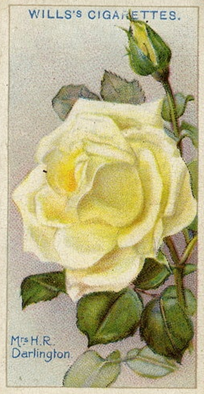
The picture is one from the W.D. & H. O. Wills cigarette cards No 41- 1926 which indicates the popularity of ‘Mrs H.R. Darlington’. The reverse of the card reads: ‘(No 41) MRS H.R. DARLINGTON (Hybrid Tea) A perfect white rose. The flowers are large, well formed, sweetly scented, and of considerable substance. It is a free grower, with dark green leathery foliage, and is very beautiful in the autumn, and suitable for almost any situation. Should be pruned to within three or four “eyes” during March. Introduced in 1920 and awarded the Gold Medal of the National Rose Society.’

 Should you have wished to grow this rose in 1922 Daniel Bros. Ltd of Norwich sold her for 2s 6d – half a crown – (around £7 today). In the same year, Frank Cant & Co. sold her for 5s.

Browsing old rose catalogues is a lot of fun if slightly time wasting. Most catalogues include hundreds and hundreds of roses in contrast to the rather limited selection we are offered today. One sees a lot of old favourites still grown today but a vast number have gone to the great compost heap in the sky. I wonder if ‘Mrs H.R. Darlington’ is still grown in Australia? Perhaps someone can comment on this? I see there is some discussion concerning an identification mix up with another rose ‘’Mrs. C. Lamplough’.

~~~~~~~~~~~~~~~~~~~~~~~~~~

And of Dora herself? Born Dora Hill in 1863 in Wolstanton, Staffordshire into a wealthy family. Her father John Sherriff Hill came from a Scottish merchant family trading in coal. Following a trip to Australia for health reasons he became involved in Australian trading and shipping. Dora was educated at West Heath school in Surrey.

After the death of Dora’s mother, John Sheriff Hill remarried, and the family moved to St Albans. They lived in Hawkswick a large house built for the brewing family Fearnley Whittingstall. There Dora lived the life typical of a well to do Victorian daughter supporting charitable functions such as an amateur concert to raise funds for the renovation of the church tower. I found she won £2 in a Morning Post competition in 1868, no details of this other than the title ‘Psalms’. Perhaps guessing from which Psalm, a particular line came from? This was an age where a good religious education formed a large part of education.

In January 1890 Dora married the barrister Hayward Radcliffe Darlington. It sounded like a magical wedding as the outdoor Chinese lanterns were hung in frosted trees and shrubs at the groom’s family home Bourton Hall. Typically, the entire wedding present list appeared in the press, with presents ranging from diamond jewellery to a hand embroidered tray cloth. From browsing this I can see the newlyweds had a surfeit of silver salt cellars. I can imagine elderly spinster ladies shaking open the paper and commenting on who gave what, perhaps some of the gifts might have been considered a little mean. After the wedding, the honeymoon was taken in a chilly Torquay.

Hayward Radcliffe Darlington had a great interest in horticulture. An expert on narcissus and roses, he went on to become president of the National Rose Society. He wrote extensively, both books and articles, his 1911 book ‘Roses’ is available online. Dora followed this literary trend with articles such as ‘Colour Grouping in the Rose Garden’ and ‘Roses and Rain’ both of which appeared in the NRS Annual.

Unlike Florence Oakley Fisher Dora does not seem to have been a competitor in rose and horticultural shows. Press mentions include unrelated interests; Dora was the honorary secretary to the Potters Bar Navy League. Her father had been a shipowner so perhaps this isn’t to be unexpected. The most amusing press mention was from October 1901 when both Hayward and Dora were fined 1s with 9s costs for reading their horses on a footpath. A trifle awkward for a barrister I would imagine.

Dora’s rose has faded into obscurity, but I think as one of the first three first female members of the NRS council Dora should be remembered today. Perhaps a rose breeder has a candidate rose for ‘Dora Darlington’?

Comments welcome as always. If you can add to Dora’s story that would be great. Also, comment if you know of ‘Mrs H.R. Darlington’ still growing somewhere, or perhaps you remember this rose from the past?

First published on my Facebook blog Rose of the Day on 12th March 2022

‘Dainty Bess’ and her creator

A look at a rose and her creator. Today we have ‘Dainty Bess’ and the Kent based rose breeder W.E.B. Archer & Daughter. Not so much seems to be known about William Archer and his daughter Muriel so I indulged in a bit of research, and uncovered a few long hidden facts. These rather forgotten rose breeders deserve attention.

Early Hybrid Tea roses have often drifted off to the big compost heap in the sky. Those that remain in commercial cultivation have qualities that make them worthy roses for any garden. I have a fondness for single roses and this rose is one of the better known – ‘Dainty Bess.’

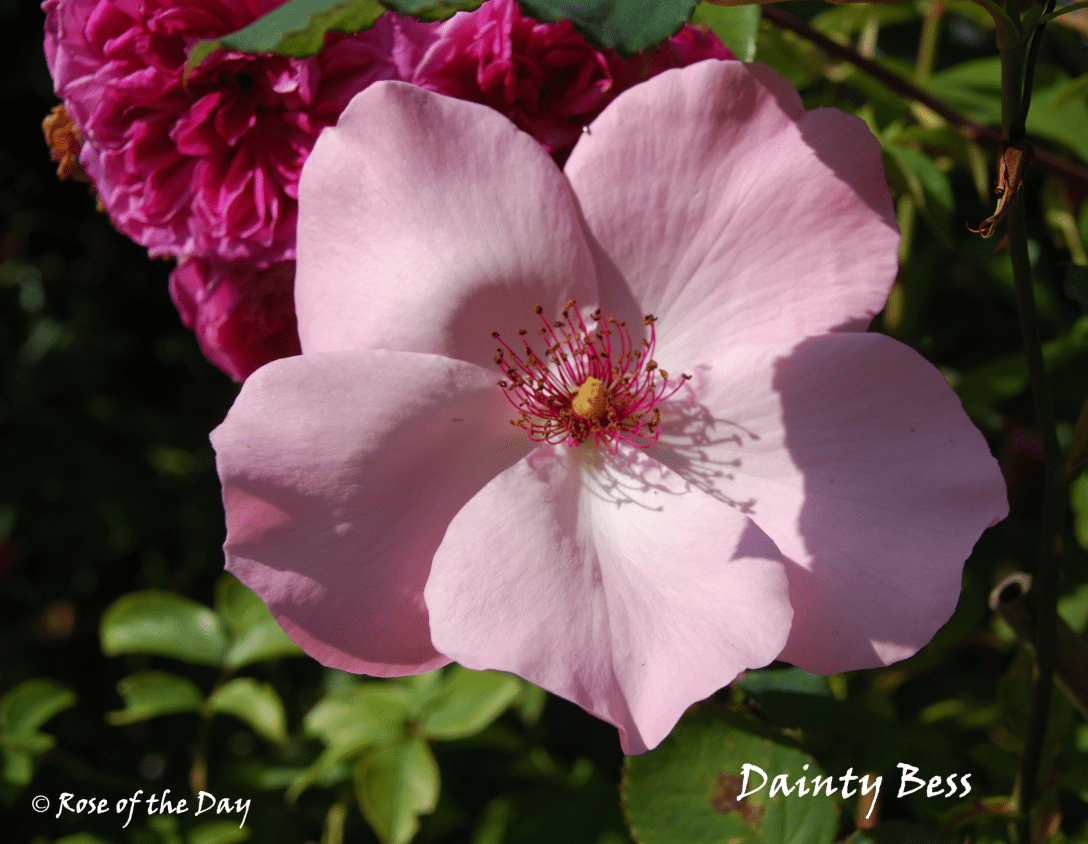
Elegant, pointed carmine pink buds unfold into a large single bloom. Fluted and ruffled petals of pale pink with slightly darker backs. The crowning glory of this rose, probably the reason for her continuing popularity is her crown of unlevel reddish yellow filaments tipped with golden stamens surrounding a bright yellow stigma. Each bloom has a slightly different crown, which adds to her charm. Long stems carry these attractive blooms in clusters up above the foliage. Repeat blooms exceptionally well, she is almost continuously in bloom throughout the summer. Great fragrance as well, sweetly light.

A small rose, she is only just over 1m high. There is a climbing variety as well introduced in 1935, growing to around 3m but does not bloom quite as continuously as this bush variety. ‘Dainty Bess’ would be great in a large container, a pair on either side of your front door would be very special. Some reports of black spot late in the summer, but she is so lovely you can forgive these minor faults. USDA zone 4b-9b. Widely available.

~~~~~~~~~~~~~~

W.E.B. – William Edward Basil  Archer led me on a merry dance through the archives. Baptised William Edward Archer he added Basil later and at one point used Basil as his first name. Name changes always hinder research!

William was born in Horton, Bradford, Yorkshire in 1861. His father, also William, is listed as a cabinet maker in 1851, Later, according to the census of 1861, he was an upholsterer employing six boys. William Edward followed his father’s trade as he is described as a furniture designer in the 1901 census when he is living with his wife Bessie and daughter Muriel Gertrude in Finchley, Middlesex. I found him again in 1911 eventually under the name Basil Archer in Coulsdon, still listed as a furniture designer and living with Bessie, Muriel, and his sister Francis. William appears to have been a successful designer of furniture, this area of Surrey is affluent now, and it was the same in 1911. It would be good to find his employer but no luck yet.

Between 1915 and 1918 William and the family moved to The Gables, Monks Horton in Kent. Sadly in 1920, his wife Bessie dies. I guess that by this time William has retired from furniture design, and begins to dabble in rose breeding.

In June 1924 for the first time, William takes one of his roses to the National Rose Society summer show. A rose he has produced from crossing the hybrid tea ‘Ophelia’ with the red hybrid tea ‘Kitchener of Khartoum.’ This new rose proved to be an instant success in winning a gold medal, the first awarded to an amateur rose grower in ten years. The Westminster Gazette reports that an expert valued the rose at several hundred pounds. This rose was ‘Dainty Bess’ named for William’s wife.

William’s amateur rose breeding soon turned into a business – W.E.B. Archer and Daughter. Muriel undertook the secretarial duties for this business, I do not know to what extent she was involved with the actual hybridising. In 1927 they took the Daily Mail cup together with 250 guineas (equivalent to around £15,500 today) for the best new scented seedling rose. A red Hybrid Tea, again William used ‘Kitchener of Khartoum’ as the pollen parent, which went on to be named ‘The Daily Mail Scented Rose.’

William and Muriel produced twenty eight roses between 1924 and 1940. The elegant ‘Dainty Bess’ and her refined daughter ‘Ellen Willmott’, together with ‘The Daily Mail Scented Rose’ and the climbing sport of this rose, and ‘Bonnie Jean’ remain in commercial cultivation. All of William and Muriel’s roses were introduced to Australia by Hazlewood Brothers. There may be some of the other varieties remaining there in cultivation, or at least growing in someone’s garden. Alas, all too many good roses fall out of fashion and fade to extinction.

It seems that the demands of growing food rather than flowers in WWII closed the business, although William was by this time 80 years old. He died in 1950 followed by Muriel, who had never married, two years later. In the short space of sixteen years, they produced roses of timeless beauty. One is left to consider what William could have done if he had been born into a nursery business rather than the furniture trade. I wonder if his furniture was as good as his roses?

This article first appeared on my Facebook blog on 19th February 2022.

Florence Oakley Fisher and her rose

This post consists of two parts: the rose ‘Mrs Oakley-Fisher’ and a brief biography of Florence Oakley Fisher.

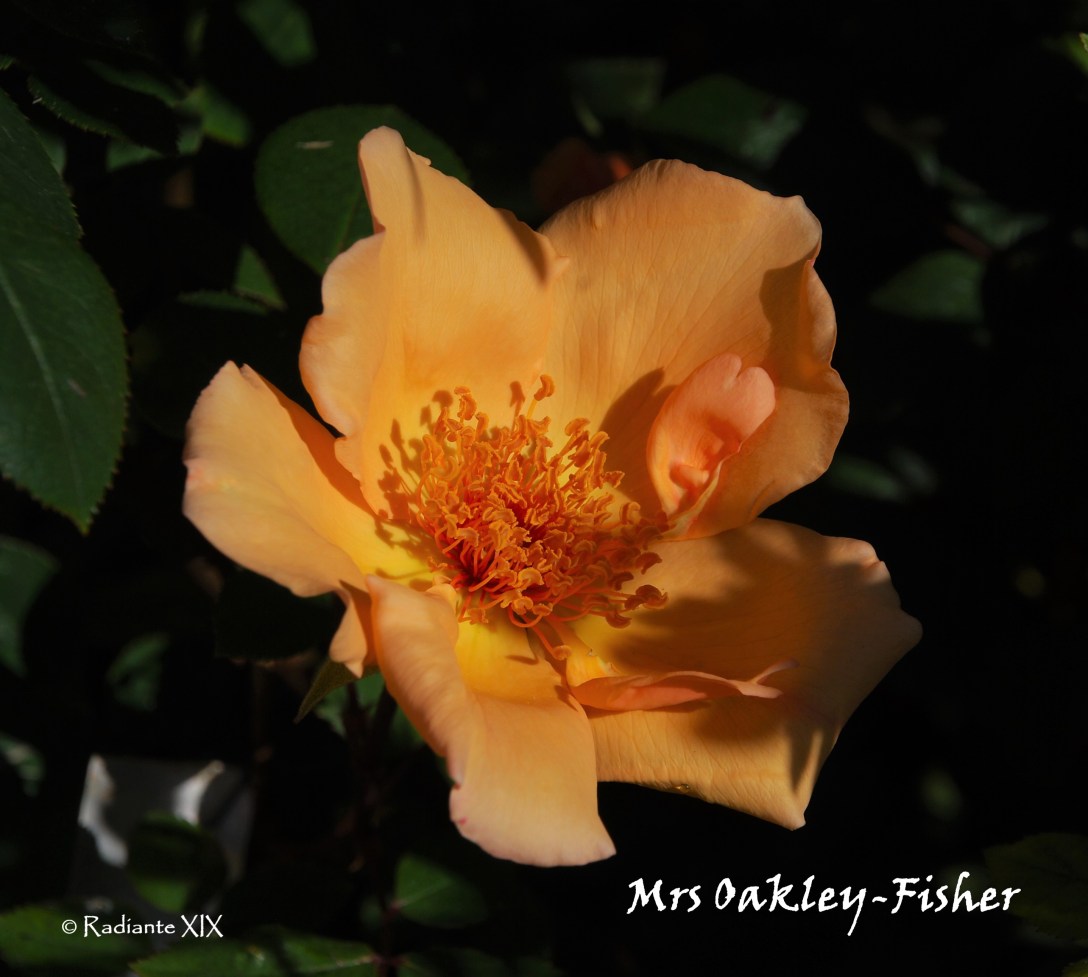
One of my favourite roses that grows just inside the garden gate is the 1921 Hybrid Tea ‘Mrs Oakley-Fisher’. A rose full of grace and charm with eye catching looks. She is as popular today as she was when first introduced.

The buds are a creamy orange streaked with carmine. Opens to a yellowy copper single bloom and then matures to an appealing yellow/apricot/amber/parchment before turning white. The petals have a silky appearance so the colour varies as the light changes. Long golden stamens make ‘Mrs Oakley-Fisher’ attractive to pollinators. Strong perfume that is a little unrose like, more an earthy ‘Tea’ than sweet. Repeat blooms consistently.

Fairly tall, around 1.25m. Healthy disease resistant foliage so she is suitable for a no spray garden. An easy rose to grow. Hardy USDA zones 7b and warmer. An 8.2 score from the American Rose Society – ‘a solid to very good rose, its good features easily outweigh any problems. Well above average.’ I cannot think of problems with ‘Mrs Oakley-Fisher’ but please comment if you have experienced issues with her.

Bred by Benjamin R. Cant & Sons but of unknown lineage. Rose shows were the main form of advertising rose varieties at the time and Cants were immensely successful exhibitors. Perhaps naming their latest rose after a new member of the RNRS council was a tactical move but Florence could well also have been a good friend of the family.

A rose that I would always grow in my garden. Cheerful is the best way I can describe her.

~~~~~~~~~~~~~

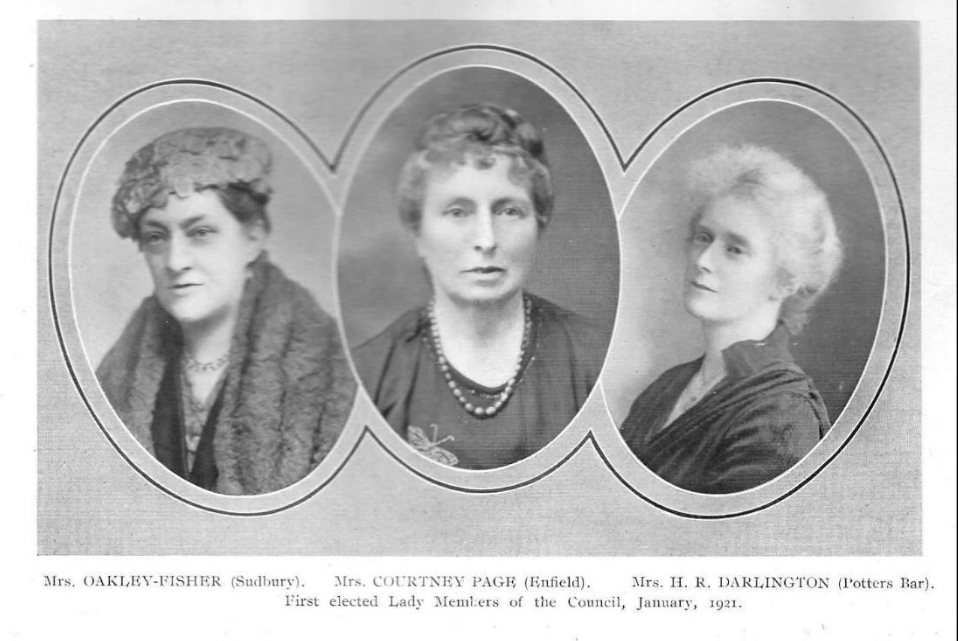
Florence Oakley Fisher together with Dora Darlington, wife of Hayward Radcliffe Darlington, a past President of the National Rose Society (NRS); and Lilian Courtney Page, wife of the Editor of the NRS Annual, John Courtney Page; became the first female members of the NRS council in 1921. (The NRS later gained a Royal prefix, the RNRS folded in 2017.) From the British Newspaper Archive, I discovered a small piece on this election. The NRS President Mr H. J. Holland stated that ‘he hoped they would find their duties more congenial than did the women who were now embarking on a certain new sphere of service.’ Make of that what you will! The photograph shows these three redoubtable ladies. Florence looks like a rather strong character. All three ladies had a rose named for them, but ‘Mrs Courtney Page’ is no longer commercially available. (A small note here that the official registered rose name has a hyphen, but Florence did not have this).

I am strangely fond of research and enjoy harvesting information from unlikely sources. My initial foray into the life of Florence Oakley Fisher turned up an article revealing she lived in Sudbury, Suffolk. I picked around this information fruitlessly until an Ancestry search through Electoral rolls found Florence living in ‘Egremont House,’ Sudbury, near Harrow in Middlesex with her husband George and their son Lionel Robert D’Arcy Fisher.

Florence was born in 1868 in Fairford, Gloucestershire, the daughter of Henry Dancy a draper, and his wife Henrietta. Educated at a ladies’ seminary in Oxford, now Pusey House. Florence married George Oakley Fisher, a widowed surveyor, and auctioneer in 1892. In 1901 they were living in Great Missenden and moved to their final home at Egremont House between 1901 and 1911.

The joy of searching through the British Newspaper Archives are the trivial details. Florence is advertising in 1926 for a cook and a housemaid. The advertisement states ‘good house, good wages, and outings, two in the family, good references required.’ I wonder if she was successful in her quest. This was a time when it was becoming difficult to get domestic staff.

Florence was a keen horticulturist, growing prize winning vegetables along with sweet peas and roses. From browsing back copies of the Rose Annual she appears regularly as a winner in the ladies’ classes, cut roses and rose arrangements, at the NRS rose shows. Back delving in the British Newspaper Archives, I find Florence having success at the Wembley Rose Show in June 1907. In the section for those who employ a gardener, she took second place in the twelve roses class where we learn her gardener is a W. Botten. Florence goes on to achieve a first in the three hybrid roses class, second in the three teas, third in two bunches -cluster, and finishing with a first in the basket of roses (ladies only). Later Florence was awarded second place for a ‘rather heavy’ arrangement of pink roses in the table decoration class.

The variety of rose is not always mentioned but in 1910 Florence has Madame Abel Chatenay and Prince of Wales Malmaison winning for her. In 1919 she exhibits rambler roses, but no variety was mentioned.

Towards the end of her life, Florence was to be found judging the ladies’ classes at these large horticultural shows, often with Lilian Courtney Page.

Dora Darlington and Lilian Courtney Page were frequent contributors to the Rose Annual. Florence didn’t pick up her pen, but she did pick up her baton. In 1912 she conducted an orchestra she trained herself in a performance of Romberg’s Toy Symphony. According to the report under her able baton, the orchestra gave a much enjoyed performance.

Florence remained on the NRS council until she died in 1930. I have not been able to find an obituary for her, not even in the NRS Rose Annuals. She lives on through her beautiful rose delighting everyone that sees her.