‘Thérèse Bugnet’

Today a jump from the heat loving Tea Roses to a cold hardy rose – the Hybrid Rugosa ‘Thérèse Bugnet’.

A rose that you could walk past when she is not in bloom thinking from the foliage that this is a shrub of another species. Long narrow matt leaves that are not typical of any other Hybrid Rugosa that I have seen. In the autumn the tall stems turn an attractive red.

The photograph shows a bloom just a little bit before its best. These sizeable blooms appear in clusters, with large wavy petals which unfold to a saucer shape. Dark pink initially before fading to a softer tone with those charming golden stamens. Typical sweet but sharp clove Rugosa fragrance that ‘lifts’, carrying in the air around the shrub. Repeat blooms from summer into autumn. Orange hips follow but I find not so many as expected.

A tall shrub, 1.5-2m which responds to pegging down, a small amount of work which gives more bloom. Not really thorn free but just a few. Like most hybrid Rugosas she dislikes being pruned. Resistant to blackspot. Suckers when grown on her own roots. The one kicker about this rose is the tendency for dieback, particularly when it occurs in the tallest and best stems. Shade tolerant though. Exceptional cold hardiness, USDA zone 3-9b, recommended for North Sweden. Widely available.

A straightforward easy rose to grow. Just the little niggle with dieback

This cold hardiness attribute combined with her name shouldn’t be too much of a surprise. Bred by one of the most extraordinary rose breeders I have ever come across, Georges Bugnet, (for those of you worried re the pronunciation it’s boon-yay). If there isn’t yet a book on Georges Bugnet then there should be. One of the major French writers of Western Canada, he published four novels, the best known being ‘The Forest’. Also, numerous essays, short stories, and poetry. Born in France in 1879, and educated at the Sorbonne, Georges immigrated to Canada with his wife Julia and lived in a homestead close to Edmonton in Alberta. Although not trained as a botanist he had a great interest in plants and began to breed one that could survive the harsh Alberta climate. Taking seeds from Russian plants he produced the Lagoda pine tree. He experimented with native Russian roses and the native Canadian species producing ‘Thérèse Bugnet’, in 1941, named for his sister. He continued to breed roses for fun producing 16 hybrid Rugosas, and giving the plants away to nurseries to propagate and sell. With nine children he was very interested in education and was very involved in the local schools and their education programmes. Georges had a long life, dying at the grand age of 101, in 1981. What an amazing man!

A straightforward easy shrub rose. Just that small qualm with dieback but the positives outweigh this one fault. To be honest though ‘Thérèse Bugnet’ is rather more of a landscape rose than one for a prime place in your garden,

This post originally appeared on my Facebook blog on 23rd March 2022
‘General Galliéni’

Some roses confound with their changeable colours. Ones that irritate with their habit of growing sideways, sometimes in preference to growing upwards. Those that prove unsatisfying to photograph as their blooms are untidy to the point of being misshapen. These are special roses, described to me by David Stone, former head gardener at Mottisfont, as ‘roses for the connoisseur’. They hate cold weather, preferring warm sun but will often turn their heads away or droop their necks. They thumb their noses, metaphorical ones, at fungal diseases. A reputation for fragility, but think more of a frail spinster aunt decked with lace who thought nothing of walking miles in vile weather. Secateurs will almost cause a faint though. Those sideways shoots always produce a cluster of blooms with every node below joining in for the burst of bloom. All are forgiven for their exotic, sensual perfume – the Tea Roses.

A huge number of Tea Roses were introduced in the fifty years or so before WWI. Many lost to cultivation now as their popularity waned and they were overshadowed by the new Hybrid Teas. ‘General Galliéni’ is one of the noble survivors, bred by Gilbert Nabonnand and introduced in 1899.

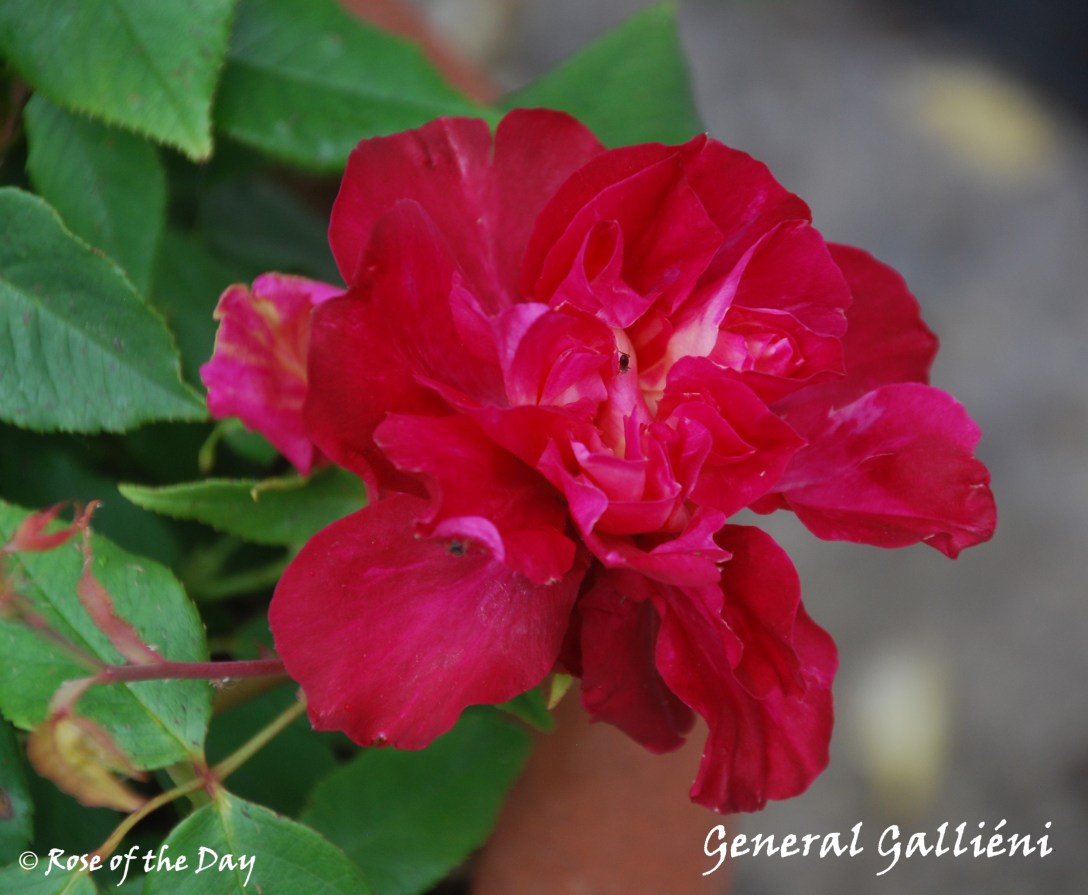
A mostly red rose with yellow petal bases, but ‘General Galliéni’ can be copper with orange tones, raspberry and cream, or peachy pink. Occasionally drifts to maroon, brown hued red or purple. No two blooms are ever quite the same hue. Nor the same shape. Often asymmetric with petals pinched up, the kind that makes you lower your camera thinking – next week they will be better. A perfect bloom with ruffled petals repays your wait, sometimes! This diversity creates a rose shrub of great charm. ‘General Galliéni’ demands your attention and rewards with a light but pervasive fragrance. Almost continuous in bloom with an early start and goes on to early winter.

His growth habits are no less untidy. Mine has a drunken lean despite my efforts to persuade him to stand up straight. These are roses that create their personal space which in turn means a gap between two or a friendly cuddle with a neighbour Tea. I have attempted some training with canes and ties, but he is a strong willed grower so I leave him to sprawl. Size? In the UK likely to be a metre in height and possibly wider. In Australia, 3m is more the norm.

Attractive light green foliage, a little sparse perhaps but zero fungal diseases. Occasional aphids perhaps but easily blitzed with soapy water. USDA zones 7-9 is the given range but Teas are happy in hot climates. Widely available.

Are you a rose connoisseur? Or does the untidiness of Tea roses not match your garden style? Worried about the hardiness? Growing the General in a container placed on wheels could help to place him in sheltered spots. I feel the Teas hate cold freezing rain rather than hard frosts. Maybe a brolly would be better?

And his namesake? Joseph Simon Galliéni (1849-1916) was both a French colonial administrator and a military commander.

His military career began in the Franco-Prussian war before he moved to the colonial service initially in Senegal before becoming governor of French Sudan. He developed the ‘tache d’huile’ method, the ‘oil spot’ technique still used in counterinsurgency today. Winning ‘hearts and minds’ instead of heavy firepower and bombardment. Promoted to General in 1896 and made Governor of Madagascar where he illegally deposed the Malagasy monarchy, exiling Queen Ranavalona to Reunion.

In 1905 he returned to France as Military Governor of Lyon and a position in the Superior War Council. He failed in his attempts to modernise the French Army in battle dress, they still wore the ‘pantalon rouge’, and in military tactics. He retired in early 1914 just before the death of his wife.

He was recalled in August 1914 with the outbreak of WWI and was appointed Governor of Paris. Here he encountered the war minister Adolphe Messimy, son of Madame Laurette Messimy. Her rose was featured on this blog on January 1st. He is credited with the victory of the First Battle of the Marne and in late 1915 took the post of Minister of War. Sadly, he served just a short term before dying of cancer in May 1916. Created Marshal of France in 1921.

If ever a man deserved a rose, it was this man.

Tea Roses are a cross between Rosa chinensis and Rosa gigantea. R. chinensis originates from the Chinese provinces of Guizhou, Hubei, and Sichuan – Zones 8/9. R. gigantea is a little more tender coming from the Chinese provinces of Sikkim, Yunnan, the Indian province of Manipur and Burma – Zones 9/10 so a subtropical rose. R.chinensis is quite happy at Zone 7b but R.gigantea is not happy below 8b. However, I have found references for this rose growing in the UK in the late 19th and 20th centuries when the winters were much colder than today. These are the roses that brought repeat and continuous blooming genes into rose breeding in the late 19th century.

I think the colour is related to the air temperature and humidity as he is much stronger in colour in the heat of summer and tends to have cooler colours as the temperature falls. But not always, he sometimes has a rather yellow bloom next to a red one. A little like Mutabilis except the blooms don’t change from yellow to red in the space of half a day.

I admit to an addiction to the Teas. I hope I can persuade more of you to try one or five. ‘General Galliéni’ is an excellent rose to start your collection.

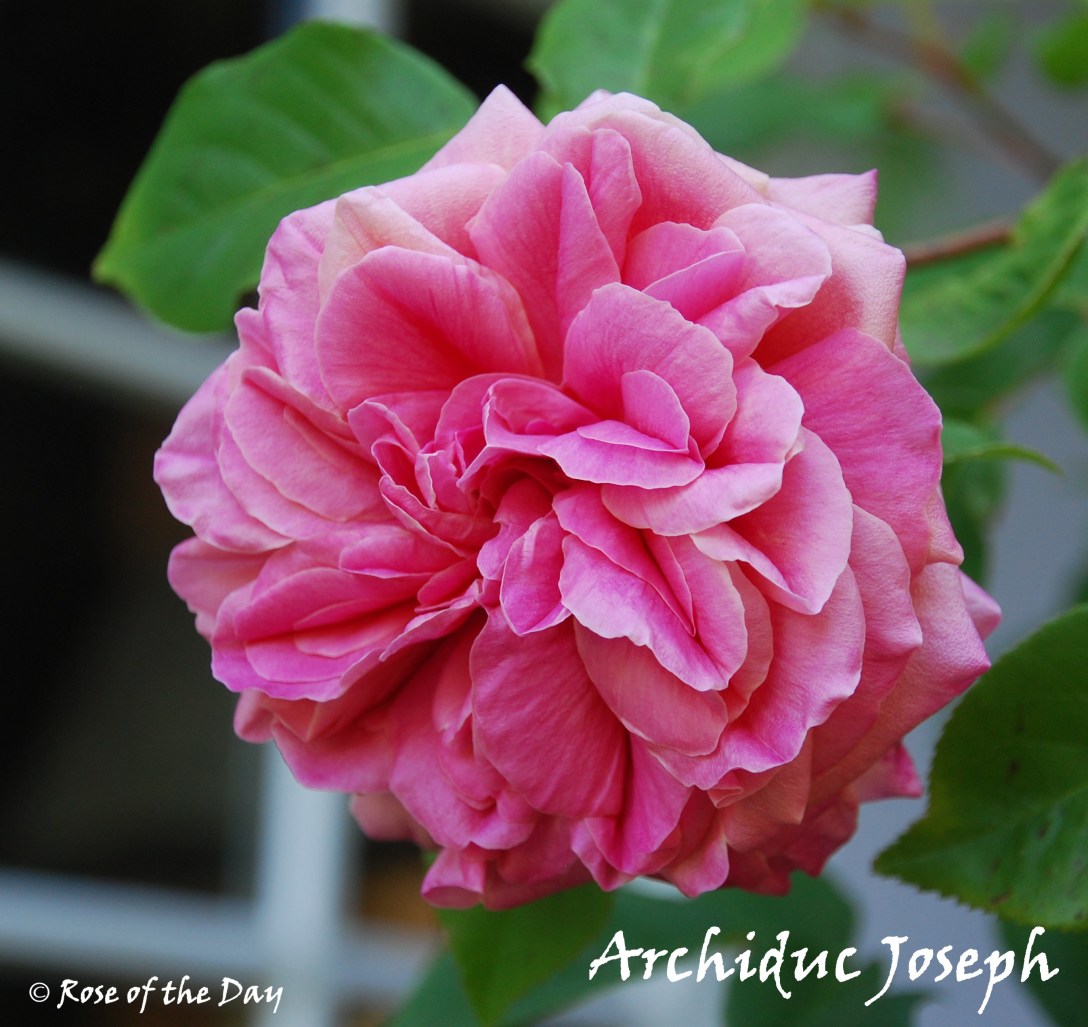
‘Archiduc Joseph’? Or maybe ‘Monsieur Tillier’??

A Tea rose with a twin identity today, ‘Archiduc Joseph’ or ‘Monsieur Tillier’? Are these two discrete roses or the same? Most authorities consider this rose to be the same but disagree on which of the two names to use.  I bought mine as ‘Archiduc Joseph’ from Peter Beales, so he remains with this name. Not the only Tea rose with a muddled identification, ‘Clementina Carbonieri’ and ‘Souvenir de Gilbert Nabbonand’ are believed to be just one rose.

‘Archiduc Joseph’ is a seedling from the Tea rose ‘Mme Lombard’, discovered in 1892 and introduced to the market by Gilbert Nabonnand of Golfe Juan on the Côte d’Azur. Gilbert introduced an astonishing two hundred and nine roses. He concentrated on China and Tea roses, but a fair number are now lost to cultivation.

However, if we think this rose is ‘Monsieur Tillier’ the breeder is Jean-Alexandre Bernaix of Villeurbanne-Lyon who introduced his rose in 1892. The breeding is not recorded.

‘Archiduc Joseph’ gives us small pink buds, either singly or in small clusters. Opening to a smallish double enchanting pink, orange, and coppery toned blooms. These colours can vary according to temperature, with purple hues also appearing. A ‘brick’ red tone is also mentioned in the literature.  The dark backed petals quickly reflex into quills, resulting in a small fiery sun of a bloom.  Intoxicating ‘Tea’ fragrance as well. He blooms practically continuously well into the autumn.

Healthy dark matt green foliage on smooth thornless stems. A neat tidy growing habit, he can reach 1.5m here in the UK but much taller, around 3m, in warmer climates. Disease resistant. Not a lover of secateurs, just leave him to quietly grow. Hardy USDA zone 6b-9b, these are roses that appreciate sunny sheltered spots. Widely available but he may be sold under the name ‘Monsieur Tillier’ in the States and Australia.

Pinning a namesake is tricky where one has several individuals who have carried a particular title, there are a fair number of Archiduc Josephs. A single reference ties this rose to Joseph Charles Louis of Habsburg-Lorraine, Archduke of Austria, and Count Palatine of Hungary (1833-1905). A patron of Nabonnand, a botanist, and creator of the Margitsziger Park in Budapest, and in his spare time he compiled a Romany grammar. His sister Elisabeth Françoise Marie of Habsburg-Lorraine is the likely namesake of the Hybrid Perpetual ‘Archiduchesse Élizabeth d’Autriche’.

If this is ‘Monsieur Tillier’ this rose is named for the former head of the National School of Horticulture in Versailles.

Name issue aside ‘Archiduc Joseph’ is a charming rose that grows easily and keeps on giving blooms over a long season. Not a cold climate rose for my readers who garden in more chilly areas but if you are in USDA zones 6b and warmer this is a rose to consider.

Originally appeared on my Facebook blog ‘Rose of the Day’ 15th March 2022