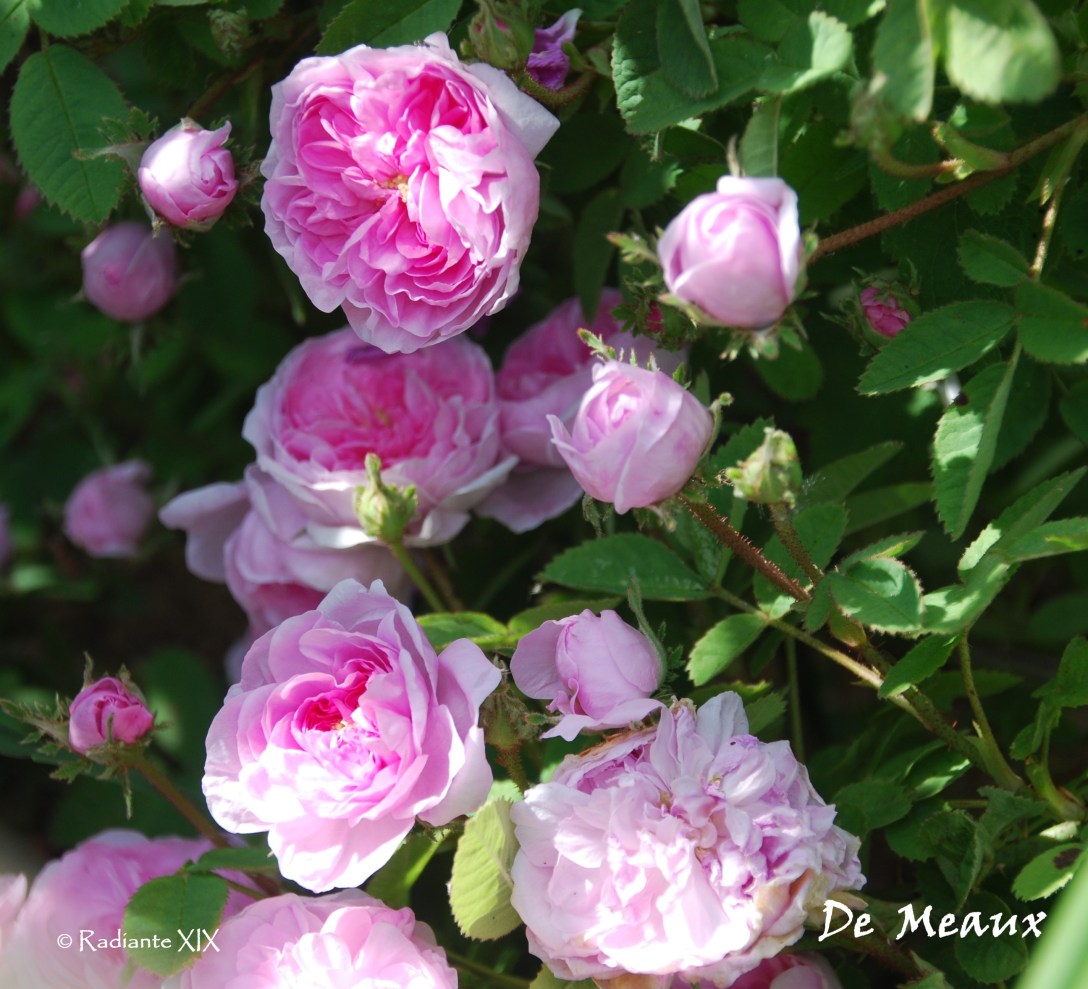
The petite ‘De Meaux’

A move today from the heat loving Tea and Chinas to a small cold hardy rose, the Centifolia ‘De Meaux.’ A rose that looks fragile but actually is as tough as old boots.

Highly suitable for a small garden or large container ‘De Meaux’ will reach around a metre in height on tiptoes. I had to rescue mine as she was swamped by her taller neighbours. She now grows on the edge of a bed with smaller companions although I see that ‘Nozomi’ is stretching new stems towards her. I will confess I moved ‘De Meaux’ last summer immediately after blooming in June. She was only a second season rose with a small root system and we had the wettest June for years, so she happily grew away.

Small fat pink balls wrapped in feathery sepals are the best way to describe the buds of ‘De Meaux.’ These open to a pompom like bloom, mid pink to begin with before fading to pale pink. The tightly packed petals are slightly frilly adding to her charm. These blooms arrive in early summer in clusters, and she gives a lot of bloom. Sweet fragrance typical of the Centifolia group. She is a summer blooming rose, just one glorious flush.

Grey green foliage with red bristly stems. High disease resistance, again typical of the Centifolia group, Most, if not all, of the once blooming roses have excellent disease resistance. They predate the introduction of ‘Rosa foetida’ into rose breeding, a rose that brought the much sought yellow to modern roses but with the penalty of susceptibility to fungal infection. Being a small rose pruning can be restricted to the removal of an old stem or two immediately after blooming in the summer, or you can leave her alone. Should you grow her on her own roots she will spread by throwing up suckers. I have seen her grown as a low hedge as well.

A sport of the prolific ‘Rosa centifolia’, and believed to date from the seventeenth century. From her name, I assume she originated in the town of Meaux, just outside Paris. You will find her listed in most nurseries as ‘De Meaux’ but like a lot of very old roses, she has several aliases. The word pompom occurs in a fair number of them. Widely available. Hardly USDA zones 4b-9b. Listed in the excellent book ‘Growing Roses in Cold Climates’ as hardy to minus 32C (-25F) but some winter protection is advised. The stems are thin so they could be vulnerable in hard frosts.

An undemanding pretty little rose who will charm everyone with her pink pompoms in the attractive grey green foliage.

This post first appeared in my Facebook blog on 26th January 2022
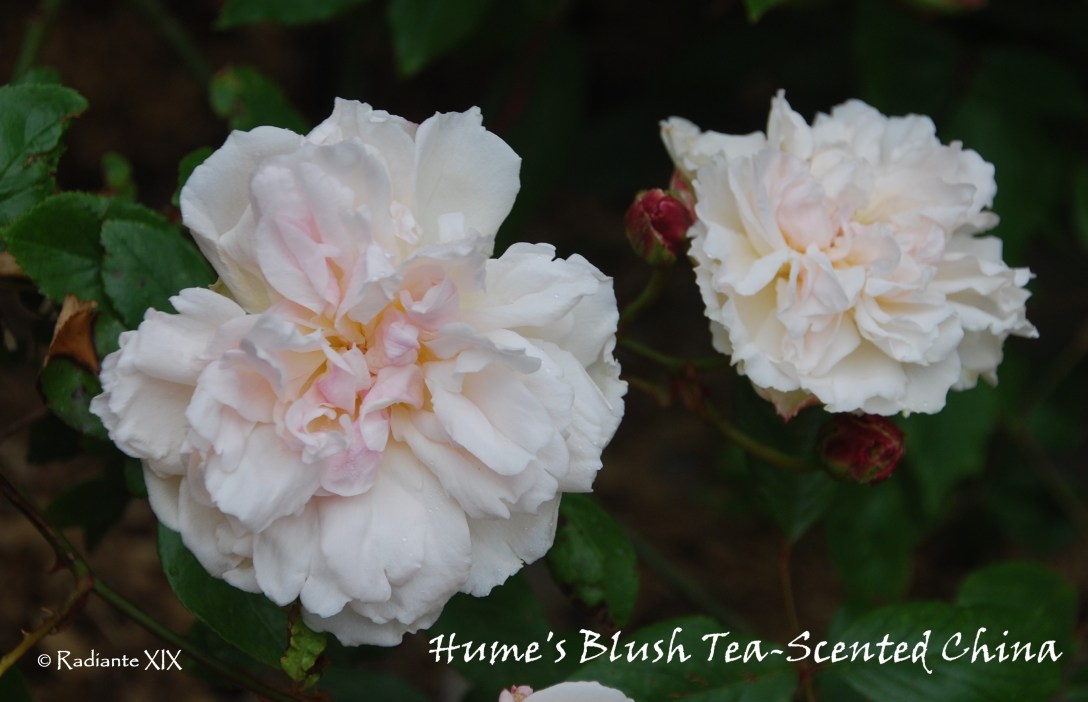
One of the big four:

Hume’s Blush Tea-Scented China

There are four ‘stud’ roses; Slater’s Crimson China, Old Blush, Park’s Yellow Tea- Scented China, and Hume’s Blush Tea-Scented China. It was likely that many more were imported from China in the early nineteenth century. European plant collectors fell in love with their fragile fabulously fragranced blooms which appeared repeatedly throughout the year. These roses played a vital role in the development of our modern roses.

Today’s rose is ‘Hume’s Blush Tea-Scented China’, not a name that trips easily from my typing fingers so she is known in my garden as ‘HBTSC.’ Also known as ‘Spice,’ a name she acquired on the island of Bermuda where she can be found growing wild. to complicate the story she is also known as ‘Rosa odorata var. odorata’. Just a small caveat here though. The rose, or roses sold today as ‘HBTSC’ may not be the original introduction. There is disagreement over her identity, to put it mildly.

Introduced by Sir Abraham Hume, 2nd Baronet, of Wormleybury, Hertfordshire in 1809. Sir Abraham’s family was heavily involved in the building of ships principally for the East India Company. Sir Abraham had many interests, collecting paintings, diamonds, and plants. ‘HBTSC’ was one of the plants collected by the East India Company’s inspector for Tea in Canton John Reeves for Sir Abraham and brought back to Britain.  Indeed, John Reeves sent back azaleas, camellias, chrysanthemums as well as roses to Britain on the East India Company’s ships. We are in his debt for the many plants that now grow in our gardens.

This rose is reputed to be one of the roses allowed through the Naval blockade of the Napoleonic wars to travel to the garden of Empress Josephine at Malmaison in 1811. (I am in the middle of the exasperating post Brexit business of importing roses from France to the UK. I wonder if Josephine had any tips I can use to smooth their passage?)

‘HBTSC’ does indeed blush. Her buds are a strong pink, increasingly streaked white as they open to a large pale pink bloom. In strong sunlight, the blooms quickly blanch to white whilst retaining a ‘blush’ at the petal bases. A strong perfume that improves with direct sunlight and heat. This is a rose that doesn’t sleep in Zone 8. She has copious continuous blooms in the summer. Slows a little in the winter but always a bloom or five somewhere in the winter.

Rather sprawling in growth habit and not too large around a metre high but often much wider. Mine is against a warm sheltered wall where she lolls gracefully.  Foliage is typically a little sparse, with attractive red tinted new growth. Some thorns and prickles. Very disease resistant, no black spot or downy mildew. Hardy USDA zone 7b and warmer. Widely available.

I think ‘Hume’s Blush Tea-Scented China’ is a rose that should be more widely grown. Not just for her importance as a progenitor of the modern rose, she is completely undemanding and very easy to grow. Needs very little pruning, Chinas don’t like it. Ideal for those with a busy lifestyle. Grow her as she will give you a bloom almost every day of the year. What more can you ask of a rose?

This post first appeared in my Facebook blog on 22nd January 2022

‘La Belle Sultane’

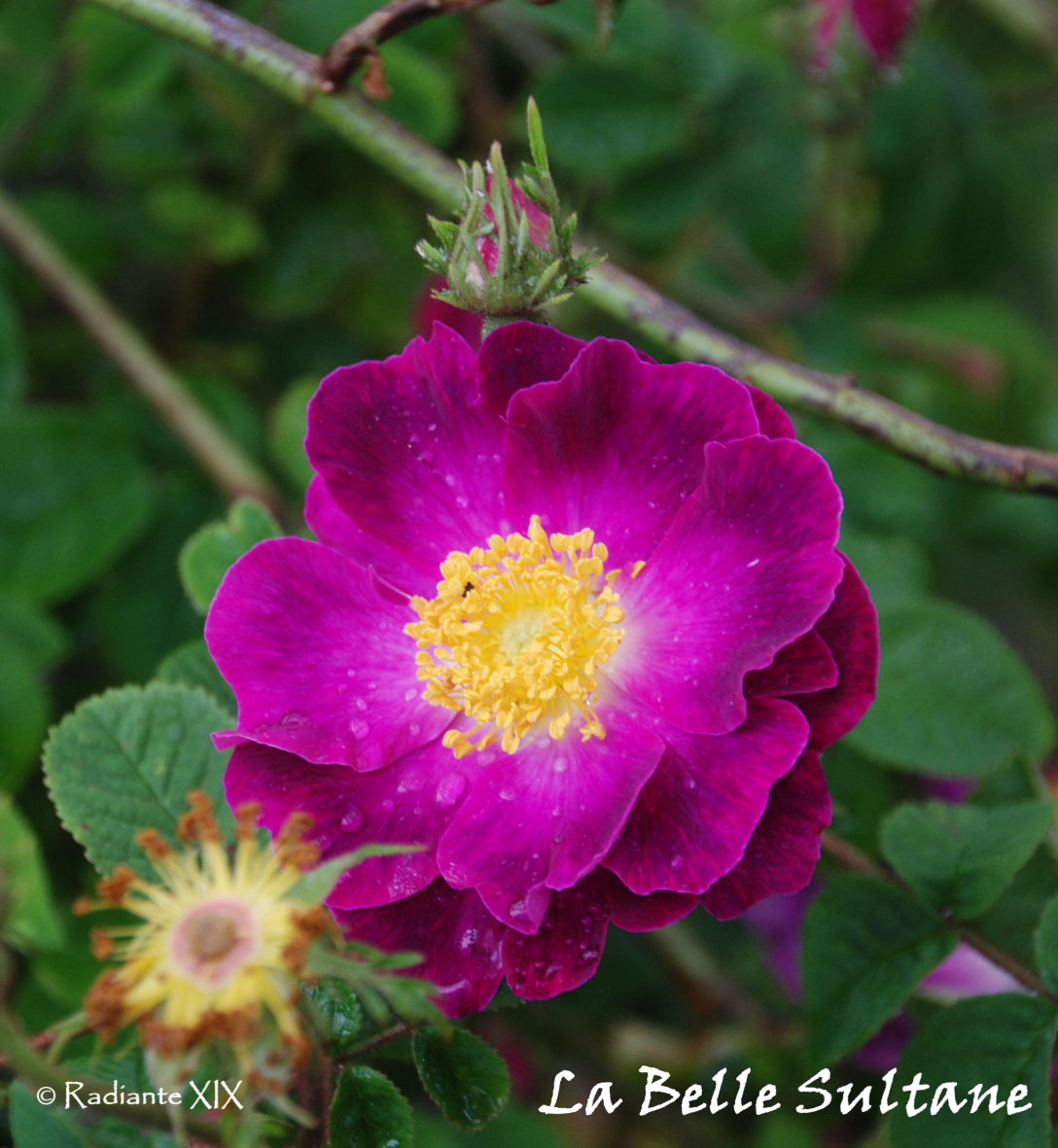
I am sure everyone wants to grow a rose that not only looks stunning but provides sustenance for pollinating insects. Today’s rose does both beautifully, the Gallica rose – ‘La Belle Sultane.’

This is a rose that stops you in your tracks. The colour, those dark purple, violet, crimson, and maroon tones highlighted by the white petal base and crowned with vivid golden yellow stamens. A velvet like texture, silk velvet of course, to the petals. I am fond of Tuscany Superb, but I think ‘La Belle Sultane’ has the edge. Fat little buds with feathery sepals open to this semi double beautiful queen rose, an apt name if ever there was one. Strong perfume as well, typical of the Gallica family. She blooms just once in June with a flood of blooms.

Tall arching stems, around 1.5 m and about the same in width. Can be larger in warm climates. Stems covered in red bristles but still prickly. A crop of round red hips will appear in the autumn. Exceptional disease resistance, falling into the 0-5% category in the 1998 Montreal Botanic Garden survey on rose disease. Easy to grow and tolerant of poor cultivation. Hardy USDA zones 4b-8b. Scoring an 8.4 in the American Rose Society 2022 handbook, – ‘A very good to excellent rose, one recommended without hesitation.’

Believed to originate from the Netherlands in the 1700s but was introduced by Dupont around 1811. She does have several names – ‘Gallica Meheca,’ ‘Aigle Rouge,’ and ‘Violacea.’ Some debate whether ‘Violacea’ is a different rose. However, you are likely to find her as ‘La Belle Sultane’ rather than her alternatives. Widely available.

Bees and other insects dependent on pollen will flock to this rose, likewise your friends when they visit you on those long hot June days.

First published 12th January 2022 on my Facebook blog Rose of the Day

The hot pink ‘Nur Mahál’

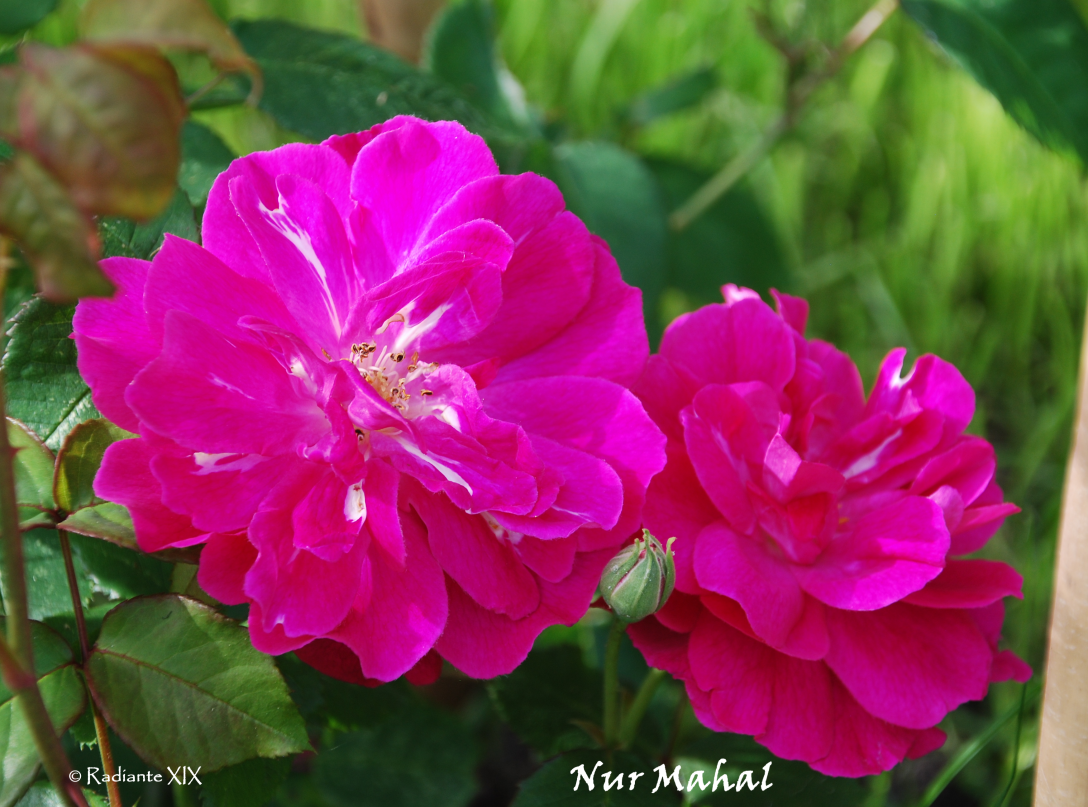
A recent addition to my Pemberton and Bentall Hybrid Musk collection is the shocking pink ‘Nur Mahál.’ Not a colour for everyone but she makes one smile.

Introduced in 1923 ‘Nur Mahál’ was a departure from Joseph Pemberton’s pale subtle coloured roses. The name, also a departure from his classical inspiration. Initially presented under a seedling number her name was proposed by a lady of the Raj who had lived in India for many years. Perhaps the hot pink colour spoke of India to her? The colour of ‘Nur Mahál’ comes from her seed parent ‘Château de Clos Vougeot’, a glorious dark red Hybrid Tea.

Nur Mahál, also known as Nur Jahan, deserves to be more widely known. Very much a woman who changed the world but has faded into obscurity. A favoured wife of the fourth Mughal Emperor Jahangir she became the real power behind the throne. Married in 1611, the twentieth wife of the Emperor, she was given the title Nur Mahál – Light of the Palace. She gradually assumed control of the empire from her opium and alcohol addicted husband. A highly capable ruler, she was also responsible for the great cultural and artistic achievements of Jahangir’s reign. In a time when most women lived in purdah, she championed the emancipation of women. The gardens of Kashmir and Agra were created under her patronage. Allegedly she discovered ‘Attar of Roses.’ A busy lady! Five years after her marriage she was granted the title of Nur Jahan – Light of the World. On Jahangir’s death, there was the usual power struggle between the many sons, and she was exiled to Lahore. If you are inspired to read more try ‘Empress: The Astonishing Reign of Nur Jahan’ by Ruby Lal was published last year.

As with all the Hybrid Musks, clusters of bloom are produced, and these get better and better as the summer progresses. Splashed with white as you can see in the photo, enhancing the bright pink. A lighter perfume than most of the other Musks though. Practically thornless with dark foliage ‘Nur Mahál’ will reach around 1.75m, taller in warmer climes, and rather wider. Disease free and easy to grow, these Hybrid Musks can be just left to grow and delight everyone who sees them. Hardy USDA zones 6b-10b and widely available.

‘Nur Mahál’ performed well for a first season rose in last summer’s chilly rain and dry autumn. I am looking forward to many summers of her glowing pink.

First published on my Facebook blog Rose of the Day 9th January 2022

An early Tea rose – ‘Safrano’

Today a rose that I grow mainly for its historic value, but she is enchanting and remains popular, the Tea rose – ‘Safrano.’

A very early Tea, dating from 1839 and bred by an amateur grower Mons de Beauregard in Anger France. He bred just two roses, ‘Joseph’ now lost to cultivation and ‘Safrano.’ I hope he made some money from his ‘Safrano.’ In the late nineteenth century entire fields of ‘Safrano’ were grown in the South of France, and the buds and blooms were dispatched across Europe. Today the fashion for buttonholes has disappeared and florists want strong stemmed tough long lasting bright blooms, ‘Safrano’ doesn’t fulfil these modern demands.

A curious little soul, ‘Safrano’ hates the rain but can ‘bolt’ on very hot days running from her exquisite, furled bud to a spent bloom in under a day. A challenge to photograph I promise, when the bloom is perfect just run for your camera. Colours range from a bright salmony pink streaked with yellow fading to a buff parchment and finally white. She is highly variable and can disappoint with a pale insipid bloom but return a delicious bloom a few days later. Unusual in her petal count as this also changes a lot according to temperature and humidity. Fragrance is not too strong but ‘Tea’ like, earthy and captivating.

Here in the UK, she will probably only achieve a metre in height but considerably larger in hotter climates. Slightly fragile twiggy growth but I notice she gets stronger with age. Likewise, the bloom necks initially were weak, so she hung her head, but this too has improved over time. Although noted for being relatively hardy for a Tea a warm sunny sheltered spot would delight her. Ideal for a large container. Of course, being a Tea, she is disease resistant. Hardy USDA zones 7b-9b. Widely available. Said to grow wild in the South of France!

One reads that ‘Safrano’ is an early hand pollinated rose, ‘Park’s Yellow Tea-Scented China’ the seed parent and ‘Desprez à Fleur Jaune’ the pollen parent. However, this seems to have been a guess around a hundred years after her creation. Park’s Yellow certainly but the pollen parent isn’t known. This was natural pollination, with no little hogs’ hair brush involved. ‘Safrano’ has huge historic value as her genes are a major contributor to today’s modern roses, with just under 20,000 descendants.

Maybe not a rose for everyone and every garden situation. Tuck her in a sunny corner, enjoy her blooms, and relate her history to garden visitors over a glass of Sauvignon.

Originally published on my Facebook blog Rose of the Day 6th January 2022

‘Indigo’, not a blue rose at all!

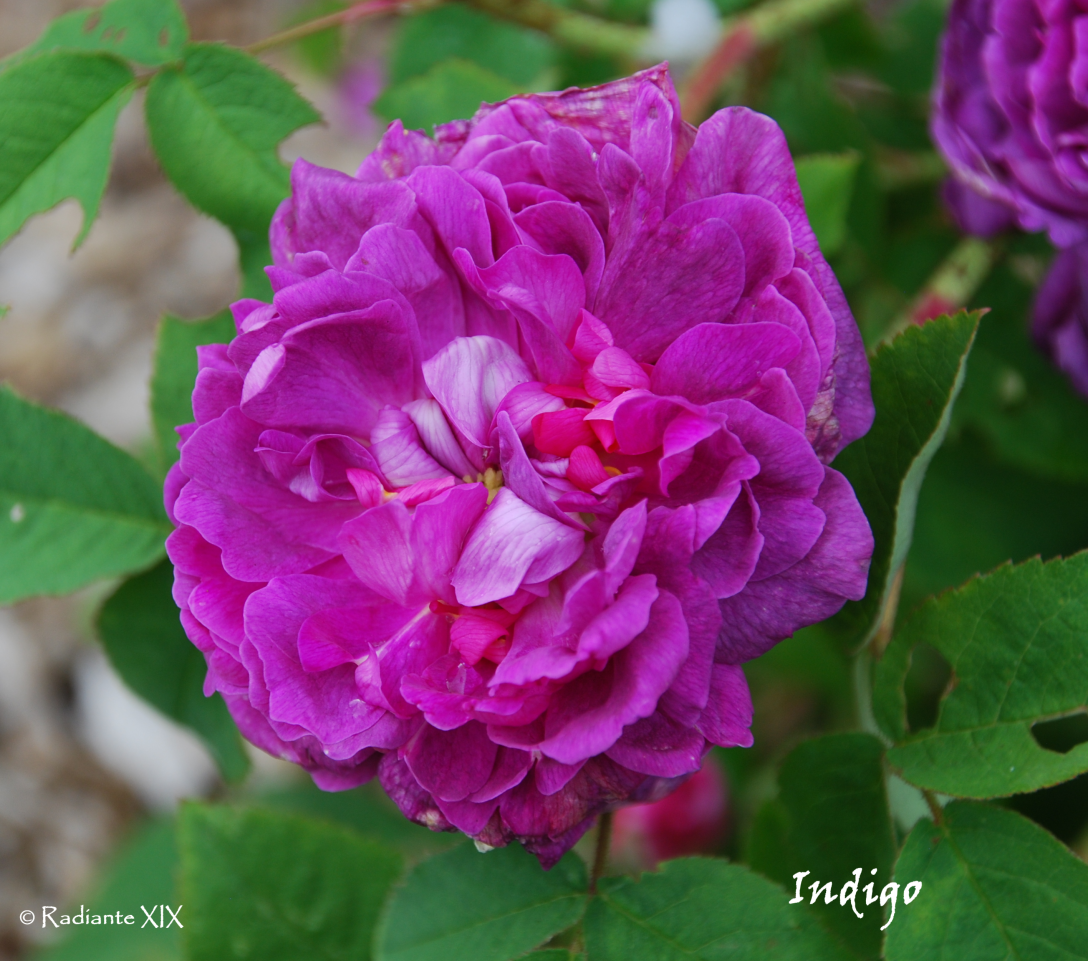
Visit a DIY store and you will be bemused by the names of paint. ‘Elephant’s Breath,’ hmm could that even be a colour? Dead Salmon seems unappealing even when the dead means flat as in not shiny. Pink was originally a murky yellow green only moving to describe light red in the late seventeenth century. The name of today’s rose appears to fall into these vague or confusing colour categories as we have the Portland rose – ‘Indigo.’ Not a deep midnight blue at all but mauve. Roses do not have the gene that produces the blue pigment delphinidin, (unless genetically modified) but nineteenth-century growers endlessly pursued the dream of breeding a blue rose. Perhaps naming this rose for a strong blue colour was a marketing ploy to tempt buyers?

Whatever the story behind the name ‘Indigo’ is a pretty rose. She can vary in colour according to sunlight and temperature, ranging from a dark purple through to mauve, sometimes with a streak of white or crimson. The petal backs are a little paler giving an attractive appearance. She will fade slowly as the large bloom matures ending up as a slaty pinkish grey. A small yellow button peeps through the double petals. Blooms appear either singly or in small clusters from June through to autumn. Delicious fragrance.

An early rose dating from pre-1845, bred by Jean Laffay. ‘Indigo’ reaches around one metre and is quite upright, so she does not take up so much space. Dark prickly stems with matt green foliage. Disease resistant although mildew might visit in very dry summers. Said to grow well in poor soil. USDA zo

‘Madame Laurette Messimy’ – an easy rose for busy gardeners

Last summer the manager of one of the UK’s leading rose nurseries told me that buyers want easy to grow, disease free roses with good fragrance that bloom continuously or at least repeat bloom at short intervals. This statement was to explain their policy of dropping the older varieties in favour of the modern ones. Is it just modern roses that fall into this exacting category? I would argue that a number of the older roses are easy to grow, resistant to disease and delight with fragrant blooms from June to late autumn. Of course, there are older varieties that do not fit the bill and there are miserable, spot ridden modern roses that disappoint.

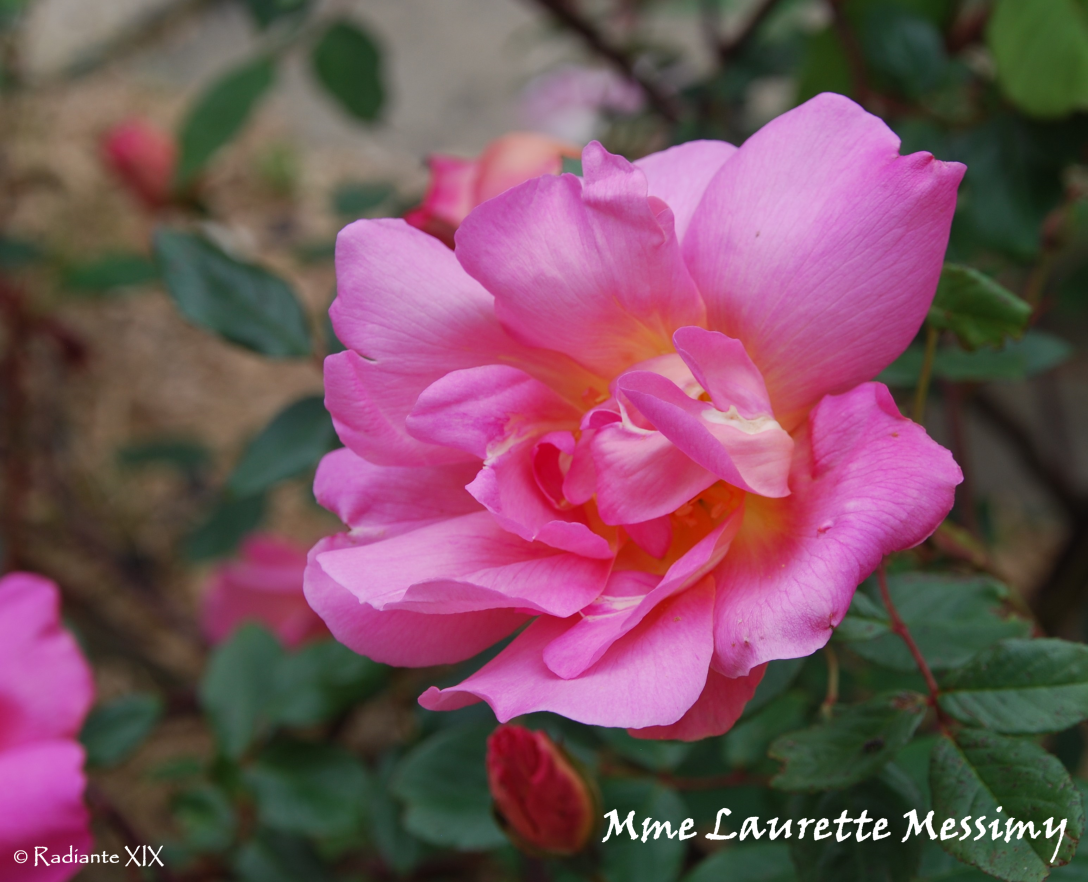
Today’s rose is one that ticks most of the boxes – ‘Madame Laurette Messimy.’ A China rose of huge charm and elegance. Her semi double blooms are not always the tidiest, but this is part of her charm. Highly variable in the colour ranging from pale pink through to bright salmon flushed with yellow, coral, and peach. Her poor point is the fragrance, elusive describes it best. Some days nothing and then she surprises with a soft light perfume. To make amends for the lack of perfume she gives a lot of bloom and just keeps going. On the first day of 2022 in the current exceptionally mild weather she has blooms and buds. Chilly weather will slow her down, but it is rare not to find a bloom or two. Not a great fan of the rain though. In June she was in full bloom and looked magnificent. Then the monsoon rain arrived, and she buckled under the weight of sodden petals. Honestly, she looked like a drunken wedding guest surrounded by damp confetti. Happily, she revived with a bit of sun and warmth.

Airy in her growth habit with dark plum stems which are almost thornless, just the odd prickle. Very healthy, as are all the Chinas. Aphids might appear but not a spot of fungal disease. Tall for a China, she is around 1.20m here in Suffolk and the same width. Would prefer for you not to approach with the secateurs, just leave her alone unless she is encroaching onto another favoured plant. Hardy USDA zones 7b-10b. Widely available.

‘Madame Laurette Messimy’ has two Tea parents, the seed parent Rival de Paestum and the glorious Madame Falcot the pollen parent. Bred by Jean-Baptiste André Guillot and introduced in 1887.

Who was the real Madame Messimy? Born Laurette Marie Anne Girodon in 1845, she married the notary Paul Charles Léon Messimy. I can find little information about her but her eldest son led an interesting life. Adolphe Messimy initially was a military officer, then a journalist and politician. He served as Minister of War in 1912 and again in 1914. He resigned early in WWI and returned to the army as an officer. A brave soldier, promoted to General by 1917 and awarded the Croix de Guerre. Said to be one of the many lovers of Mati Hari during her spying career.

I feel Madame Laurette Messimy is a stellar rose and well worth growing. She is a plant and stand back rose with little or no maintenance, ideal for busy (or lazy) gardeners.

Originally published 1st January 2022 on my Facebook blog Rose of the Day.