
These posts originally appeared on my Facebook blog Rose of the Day.
1 February 2019

Alleged to be one of, if not the best, crimson Hybrid Tea rose. Introduced in 1963, from the famous nursery of Meilland, – ‘Papa Meilland’ and named for the breeder Alain Meilland’s grandfather Antoine. For those who are new to roses, Alain Meilland’s father started the nursery and bred the world’s most famous rose ‘Peace’. The nursery continues to produce outstanding roses, Alain himself introduced over two hundred and eighty roses.
‘Papa Meilland’ is a classic Hybrid Tea rose, long elegant pointed buds, always one bud on a long stem making him a superb rose for cutting and exhibition. Those buds unfurl to a large high centred crimson bloom that is held up high above the foliage. Velvety petals, around 35 of them, often have a small thin streak or splash of white. As he matures the petals reflex strongly giving the characteristic rather pointed silhouette of the Hybrid Tea. Intensely perfumed, said to be one of the strongest fragrances in the rose world. Repeat blooms reliably.
Feted with many awards, he sits in the World Rose Hall of Fame. An important parent rose he has seventy five descendants including a climbing variety which is identical but not quite as free flowering.
This is a rose that divides rose lovers. Some love it, others hate it, and someone of us, me included are indifferent to its charms. You know I am not a great lover of the reds. His fans love the perfume, the velvet petals, and those long stems that may ensure first prize at the rose show. Why do others dislike him so much? The foliage, dark and leathery, is susceptible to both mildew and blackspot so he needs a regular dose of fungicide to keep him healthy. He can be very slow to establish around two to three years before he gives his best. Surprisingly not that hardy, a cold hardy winter will kill him even here in Britain.
Jokingly I will say that like a lot of men, he needs care and cosseting to give his best. If you are a gardener who prefers easy roses with high disease resistance, then Papa Meilland is not for you at all. Those who love him forgive his problems and breathe his wonderful fragrance all summer.
Saturday 2 February

I often wonder whether doctors and surgeons watch medical soap operas. Do CID officers watch murder serials? Should they watch do they grind their teeth and mutter over the errors? BBC Radio 4 has a certain long running soap based on the everyday story of country folk ‘The Archers’. At the sound of the first notes of the signature tune I usually retune the radio but sometimes I catch odd snippets. Let me tell you that life as a farmer is absolutely nothing like that portrayed and as for the daft errors, they leave one speechless. However, I must be in the minority as it is the longest running radio soap in the world so it must be popular. Today’s rose is named for the mythical village where the drama is set – ‘Ambridge’.
A rather lovely David Austin rose, an older one dating from 1990. No longer in their catalogue and its plant patent has expired so you can find it propagated and offered by other nurseries now. Still a very popular rose. Creamy peach buds on long stems open to very full petalled apricot pink blooms. Initially, cup shaped the blooms flatten to a rosette shape and fade to pale pink. Strong myrrh fragrance. Repeat blooms consistently throughout the summer.
On the small side only around 75cm to 1m and a little wider. Upright but quite bushy in growth habit. A good candidate for a container. Said to be shade tolerant. Hardy USDA zone 5b-10b. Some growers report that she ‘balls’ in wet weather. Disease resistance is somewhat variable with reports of mildew and blackspot but may well depend on where in the world you are. The seed parent is ‘Charles Austin’ who also has this variable disease issue.
I would be interested to hear your experiences if you grow her.

Sunday 3rd February
Today a rose for which I can find remarkably little information. The national collection of Pre-1900 roses is held at the National Trust property Mottisfont Abbey in Hampshire. There are some later roses in the garden, and today’s rose is one of those, the Hybrid Wichurana ‘Snowdrift’, introduced in 1913. Growing on a frame in one of the beds this rose was a breathtaking sight, really appearing to be covered in snow
Large clusters of round greenish white buds open to small pure white double blooms with a contrasting golden stamen crown. Good strong fragrance. A strong vigorous grower, all Hybrid Wichuranas ramblers need space. She can reach nearly 4m in height so the Mottisfont gardeners must prune her hard to keep her within bounds on her frame. Characteristic light green shiny foliage and I guess she will have a good crop of hips later in the autumn.
Bred by Michael Walsh, a Welshman who emigrated to the States in 1875 and worked as head gardener in Woods Hole, Massachusetts for Joseph S. Fay. He clearly had a very accommodating and supportive employer, as he ran a large and successful rose nursery from their property. Michael bred over forty roses, notably, Wichurana hybrids, his most well known roses are ‘Lady Gay’ and ‘Excelsa’.
I have been unable to find a stockist in the UK. Helpmefind lists just two nurseries in Canada but I have found the information on stockists is not always up to date. Perhaps she is available in the States somewhere? She is a superb rose and such a pity that she is not more widely available.
If you grow her please comment and give your experiences of growing this splendid rose.
Tuesday 5th February
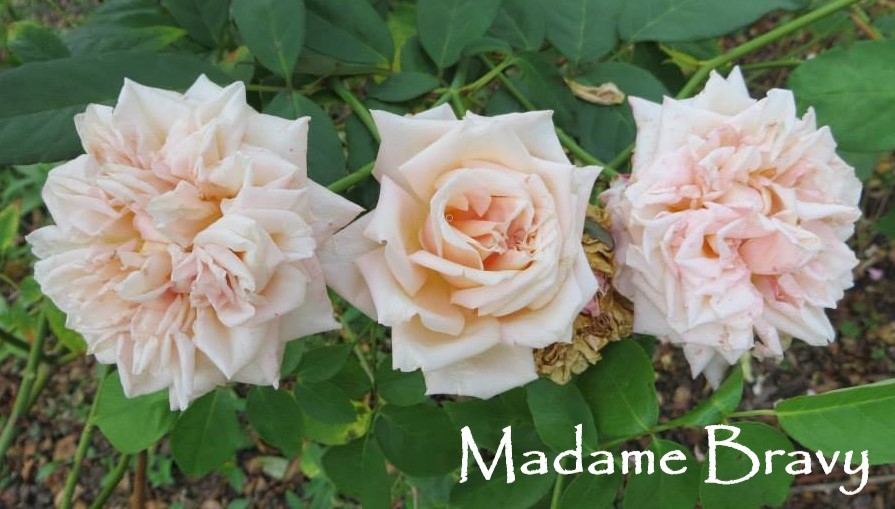
A little rose of many names, I promise that I don’t search these out. I select a likely candidate rose and start my research with half an idea that an old rose may have been christened a few times.
Today a Tea rose dating from 1846, bred by a gardener with the surname Guillot, first name unknown, at the Chateau d’Azelles, Pont de Chéruy, He named her ‘Danzille’ and passed her onto Jean-Baptiste André Guillot of Lyons. I would like to think there was some family relationship here, but nothing recorded. Jean-Baptiste was the breeder of ‘Madame de Watteville’ (featured on this page on 23 January 2019) and his nursery Roseraie Guillot remains, six generations later, a major rose breeder in France. Jean-Baptiste renamed ‘Danzille’ as ‘Madame Bravy’, but she has throughout the years acquired the appellations – ‘Adèle Pradel’, ‘Danzille’, ‘Isidore Malton’, ‘Mme Denis’, ‘Mme de Sertot’, ‘Mme Maurin’ ‘Alba Rosea’ ‘Josephine Malton’. This is enough to make one weep! I wonder if this is some kind of record of aliases? However, she was first sold as ‘Madame Bravy’ therefore the relevant authorities consider this to be the correct name so it’s the one under which you will find her for sale. Who was Madame Bravy? The wife of a G. Bravy of the Société d’Horticulture de l’Hérault. I assume someone that Jean-Baptiste wished to honour or flatter, or more likely Monsieur Bravy paid a handsome sum for the naming rights.
I found this comment on her names in The Rose Annual (Royal National Rose Society) 1975 38-53. Tea-Scented Roses A Survey L. Arthur Wyatt.
“Although ‘Niphetos’ was also used for breeding, of even greater importance was ‘Mme Bravy’, sent out in 1846. This is an excellent grower, very free with its cupped cream blooms with pink overtones and a fragrance which has been likened to “expensive face-cream”. In the days when honesty in the horticultural trade left much to be desired, unscrupulous nurserymen across the Channel found it financially expedient to cash-in on the high reputation of ‘Mme Bravy’ by re-introducing it at various intervals under no fewer than six names. English growers, caught by this deception, expressed their annoyance in the gardening press in no uncertain terms … and the annoying practice persists”
Charming large cupped blooms with outer petals of soft creamy pinky white with short central petals of shell pink. Her strong fragrance is said to be that of raspberries or perhaps the aforementioned expensive face cream! Blooms in flushes throughout the summer. ‘Madame Bravy’ is a small rose, only around a metre in height so an excellent rose for a container. Good light green foliage and said to be very hardy, USDA zone 6-11.
Sadly, she doesn’t seem to be available in Britain. It looks as though both David Austin and Peter Beales stocked her in the past but no longer. I see several nurseries in the US, Europe and Australia are alleged to stock her, I haven’t checked each one. It would be great to hear from someone who knows or grows this petite beauty.
6th February Wednesday
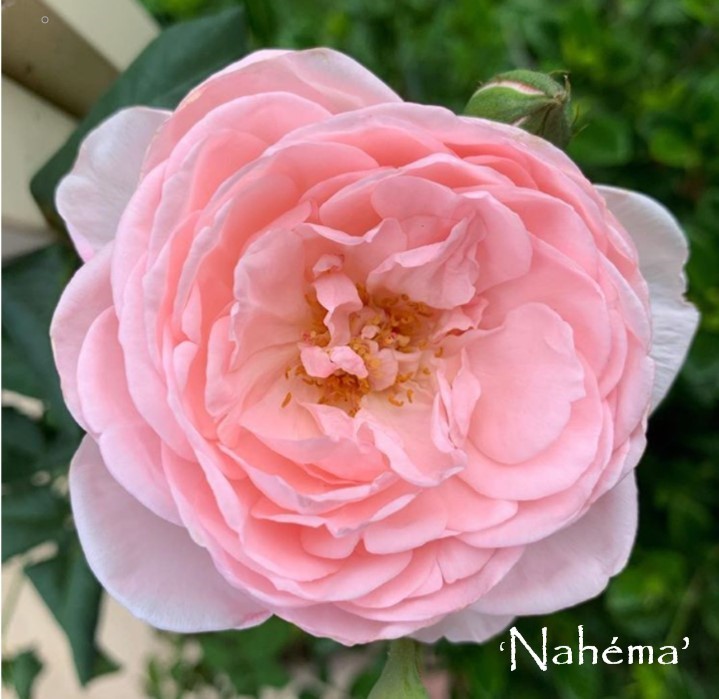
Perfume is a very personal thing. My mother wore ‘Chanel No 5’ which I confess almost made me sick as a child, and I haven’t improved with age. Mind you I think my mother soaked herself in it! I prefer light woody perfumes and have been known to wear aftershave before it was fashionable to do so. Today’s rose carries the name of a rather heavy perfume Nahéma by Guerlain. I dislike the perfume, but I certainly like the climbing rose ‘Nahéma’.
Coming from the French breeder Delbard one can expect a rose with superb fragrance and this one doesn’t disappoint. An intense zesty fruity fragrance that carries in the air. Lipstick pink buds unfold to a classic soft pink bloom. Large cup shaped and very full petalled, a joy to see, flattening out as they mature and revealing small central quills. She produces a lot of bloom in glorious flushes throughout the summer. Her foliage is quite dark and glossy which provides a good contrast to the blooms.
Interesting breeding as she has a Delbard seed parent the Hybrid Tea ‘Grand Siècle’ and a David Austin pollen parent the large shrub rose ‘Heritage’. She appears to have been bred in the 1990s but was only introduced in 2006. Unlike her namesake perfume, she has been a successful rose from her introduction. The perfume ‘Nahéma’ was initially not popular and caused Guerlain some financial angst before it was relaunched with a slightly different formula.
Predicted maximum height at 3.5m and rather narrower. One can see from the pruning and training posts on climbers that the height and width are under your control or they should be. The Delbard website states she has ‘bonne résistance’ but some growers report she suffers from mild black spot.
A superb rose to climb over a pergola on a terrace so you can sit underneath her in the evening with a cold beer and breathe in her fabulous fragrance.
Thursday 7 February
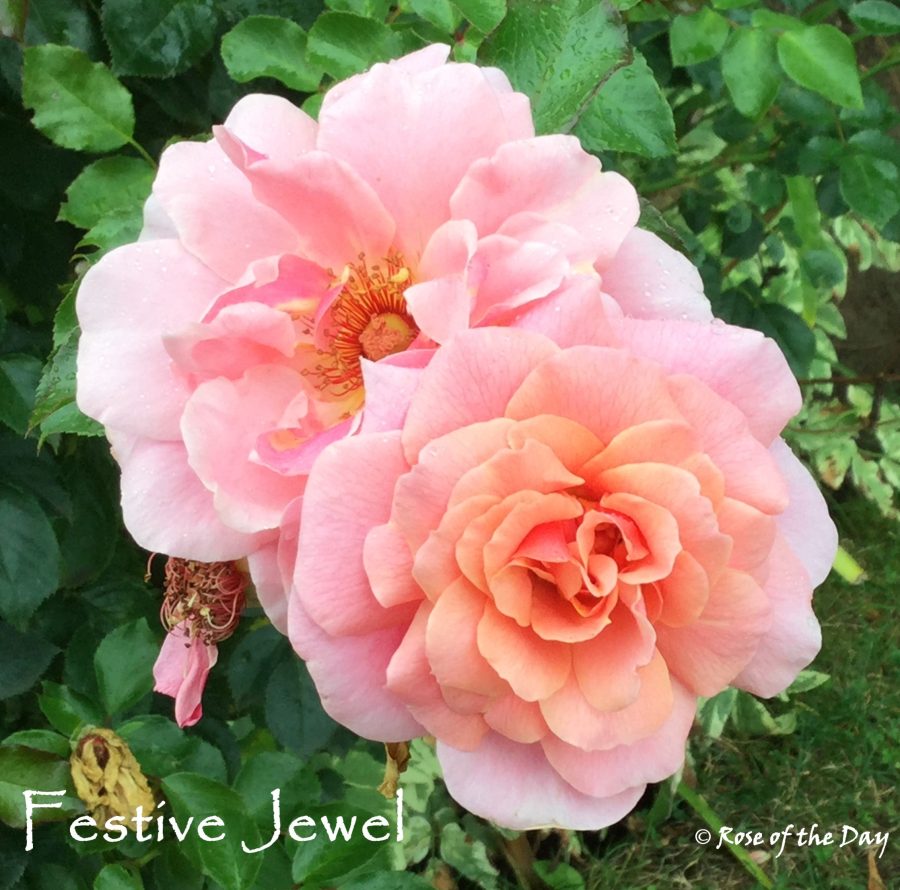
I have featured a couple of roses recently that are unavailable in Britain which makes a bit of a change from the ones that are only available here. When I selected today’s rose, I thought ‘well this one will only be available here which will cause some teeth gnashing from my overseas followers’. However, according to the ever useful helpmefind website she looks as though she is available in the US and Germany. A rose bred by Amanda Beales, the daughter of Peter and introduced in 2006 – ‘Festive Jewel’.
Clusters of fat bright pink buds unfurl to a classic Hybrid Tea shaped bloom with a high centre. The young blooms are of a bright salmon pink but this fades to a charming apricot pink as the bloom flattens revealing a big golden stamen crown. The petals have a delightful wavy edge. Strongly fragranced, her pollen parent is the highly fragranced Portland rose ‘Comte de Chambord’ which has passed on the scent genes. The clusters of bloom are carried on strong stems, so she makes an excellent rose to cut for your house.
She is a fairly large shrub or a small climber if you prefer. Predicted max. height is around 1.5m with a breadth of 0.9m. Glossy bright green foliage, such a good contrast to the bright pink. Healthy as well. Hardy USDA zone 6b-9b.
Her name flummoxed me for a short while. She was named by the St Edmunds Lodge of Norfolk Freemasons to raise funds for Masonic charities. I assume a proportion of the sales went to St Edmunds Lodge. But why a Festive Jewel? Of the joys of writing a rose blog, I find myself reading all sorts of seemingly unrelated material! The Freemasons support a lot of charities and run rather original fundraising events. These events are known as Festivals, each province running one every eleven years with each Festival lasting five to ten years. At the end of the Festival, a banquet is held, and the final amount is revealed. The ‘Jewel’ is a medal awarded to those who contribute funds. There is a whole hierarchy of members involved in this, this is a bit outside Rose of the Day I feel. However, I will look at the rather rundown grim Freemasons lodge in the local town in a new light now. So, to bring the story to an end, the rose is called after the Festival Jewel.
The Peter Beales roses are often only available from their nursery. I wonder if the Freemason connection is related to the wider availability? I don’t have this rose in my garden, but I feel I should make space for her. The blooms are exquisite with such good colour, and the fragrance is wonderful. I do hope that you can find her in a nursery near you. Please do comment if you grow her or have seen her for sale outside Britain.
Friday 8th February

Another Friday Favourite, – the Portland Rose ‘Comte de Chambord’. I mentioned this rose yesterday as the Comte was the seed parent of ‘Festive Jewel’.
I can perfectly understand why ‘Comte de Chambord’ is a favourite rose. The blooms are fantastic, and the fragrance is out of this world. A French rose, you guessed that from the name, introduced sometime around 1860 and bred by Robert and Moreau. We often don’t get any idea of the lineage of these older roses as they were naturally not hand pollinated. However, with this rose, we know the seed parent was the gloriously fragrant Hybrid Perpetual ‘Baronne Prévost’ with the ‘Portland’ rose providing the pollen.
Attractive buds with long feathery sepals either in small clusters or singly, these buds swell to fat little globes and the blooms almost pop open. Large very full petalled blooms, sometimes quartered, of deep pink with paler outer petals. Just heaven to look at and even better to bury your nose to inhale his strong sweet fragrance. A big initial flush of bloom and then a quiet almost continuous wave of bloom throughout the summer. Not a lover of wet weather when his blooms will ‘ball’ but more come along quickly to replace the spoiled ones.
Attractive greyish green foliage, on stems with crimson prickles and thorns. A soft contrast to the blooms. He is a bit of a martyr to black spot though, so you will need to spray him to keep him at his best. Quite upright in growth and fairly tall, he can reach just under 2m. I do prune this rose reasonably hard as he grows in a rather windy open area and the long stems either break or get whipped to a thread.
Named for Henri, Comte de Chambord, a member of the Bourbon family. Briefly, he held the French throne as Henry V from the 2nd to the 9th August 1830 before being deposed. Another rose namesake played a small part here. Following the July Revolution Charles X, Henri’s grandfather abdicated, and the throne passed very briefly, twenty minutes, to Louis Antoine, Duc d’Angouléme. His wife the ‘Duchesse d’Angouléme’ has a namesake rose. Louis abdicated in favour of Henri, but after seven days the National Assembly decided Henri’s cousin Louis Philippe of Orléans was the rightful heir. Like the Duchesse d’Angouléme, Henri went into exile in Britain, retaining the title Comte de Chambord as the fabulous Château de Chambord was his only property in France. Curious that two roses are named for players in this struggle for the French throne.
History aside, ‘Comte de Chambord’ is a rose very worthwhile growing if you love the classic pre-1900 roses and can just give him a small amount of care. He will reward you with those stupendous blooms and superb fragrance.
Do let me know your favourite roses and I will do my best to feature these on the Friday favourite slot.
Saturday 9 February

I have a fairly broad taste in music, but when in my study writing and researching these posts I usually listen to classical music. Occasionally one will hear the folk song ‘Blow the Wind Southerly’ sung by the great English contralto Kathleen Ferrier, considered to have been one of the greatest singers in the world. A great singer deserves a great rose, today we have the Floribunda – ‘Kathleen Ferrier’.
This rose is a large Floribunda, so large that most nurseries classify her as a shrub rose, she can easily reach over 1.5m. When I photographed her in the Peter Beales garden in September last year, I had to stand on tip toe to get a shot of the pretty blooms. Large clusters of bloom on long stems held high above the foliage are a lovely sight except when one has a camera! Attractive crimson buds open to crimson semi double blooms which fade to a pink with a touch of salmon. These open to a flat saucer shape, displaying the white petal bases and the golden stamen crown. The bees will love you if you plant her in your garden, but the stamens do turn brown a little too quickly. Sweet light perfume, it was a dull drizzly day when I visited the garden, but the scent was very noticeable. Some growers report little or no fragrance but it’s definitely detectable. Flushes of bloom throughout the summer.
‘Kathleen Ferrier’ was bred not by an English nursery but in the Netherlands by Buisman and introduced in 1952 just a year before the death of Kathleen Ferrier. I hope she was able to see her fabulous namesake rose. The pollen parent was the charming 1920s Hybrid Tea ‘Shot Silk’, who passed on her lovely colouring to her daughter rose.
A vigorous rose with healthy shiny dark green leaves, the new growth has a striking bronze tinge. Hardy USDA zone 6b-9b.
She will need a bit of space but if you are looking for a simple charming rose then she fits the bill nicely.
.Sunday 10th February
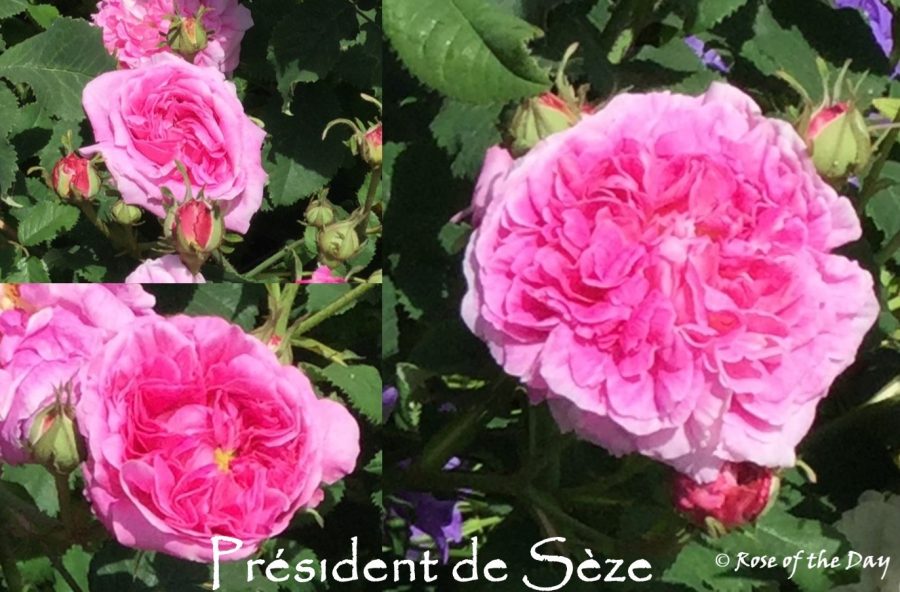
A very lovely Gallica rose, photographed in June at Mottisfont Abbey Gardens in Hampshire, this is ‘Président de Sèze’. A rose renowned for the range of colours displayed. The plump buds appear in small clusters and are lipstick crimson, but as the bloom emerges the hue changes to bright pink with paler petal backs. The outer petals fade first to a pale pink, lilac, pink tinged cream and finally almost white whilst the central petals retain their colour for longer. These stupendous large blooms are very full petalled with a delightful muddled quartered formation. Flattening as they age to show a mass of central quills and a greeny yellow eye. Just stunning! An equally fabulous fragrance, strong and intense. However, you can’t have it all as the Président has just one glorious flood of bloom in June. Foliage is rather pale but very healthy, much more so than most of the other Gallica roses.
Tall arching growth, around 1.20 – 1.50m tall but narrower at .90m. Hardy USDA zone 6b-9b. Gallicas are fairly tough roses and cope with poor soil and drought.
Introduced in 1836 and bred by an amateur rose breeder Madame Hébert from Rouen. Not too much is known about Madame Hébert, she could have been the wife of Michel Hébert, public prosecutor at the court of Rouen or another Madame Hébert an actor resident in Rouen at the same time. I think an actor would have been too busy to breed and grow roses, but a lawyer’s wife would have the time and wherewithal for this hobby. As a lawyer’s wife Madame Hébert would have known of the French lawyer, Raymond de Sèze, the defender of King Louis XV1 in the French revolution and named her rose for him.
A small squabble over the identity of this rose and another ‘Jenny Duval’. Some authorities believe these two are the same, but Gallica rose aficionados dispute this entirely. ‘Jenny Duval’ undergoes a similar colour change as she blooms which may be the source of the confusion. Whether anyone has looked at the genome of these two I don’t know.
Should you want to add this beautiful rose to your collection you will need to pay attention to the identity. This can be tricky I know with a disputed identity, talking to the nurseries is usually the best method to ensure you gain the correct rose. ‘Jenny Duval’ is also a super rose. If anyone grows both, perhaps they can comment on the similarities or differences.
Tuesday 12 Feb
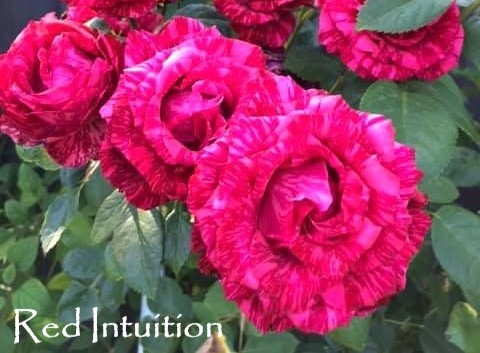
A striped rose today, I am partial to a stripy and this one ‘Red Intuition’ comes from one of my favourite rose breeders the French nursery Delbard. She is a sport from a bright red Delbard Hybrid Tea ‘Belle Rouge’. Discovered in 1999, it must be very exciting to find such a superb sport, but not introduced until 2004. There is a little bit of genome instability in this line as ‘Red Intuition’ went on to sport the charming ‘Pink Intuition’ who hit the market the year before her parent.
‘Red Intuition’ is described as a ‘Florists’ rose, this is a Hybrid Tea grown for the florist market. Florists roses are usually grown under glass, and may not be as hardy as a typical Hybrid Tea. I see the USDA zone for her is 7b and warmer. I see she is available in the southern US, Australia and Europe. I can’t find a stockist in Britain and she doesn’t appear on the Delbard website.
Characteristic HT high centred blooms so you get an amazing swirling pattern of petals of dark red with streaks, freckles and flicks of dark pink. Rather like exotic icing on very fancy cupcakes. Fragrance doesn’t get a great mention, but it would be an unusual Delbard to be poorly scented. Almost continuously in bloom though as compensation.
Tall, around 1.5m with glossy healthy foliage. She sounds like a fabulous rose but perhaps our cool summers (well not last summer!) might not be to her liking. I would be interested to hear from those of you who grow her.
Wednesday 13 Feb
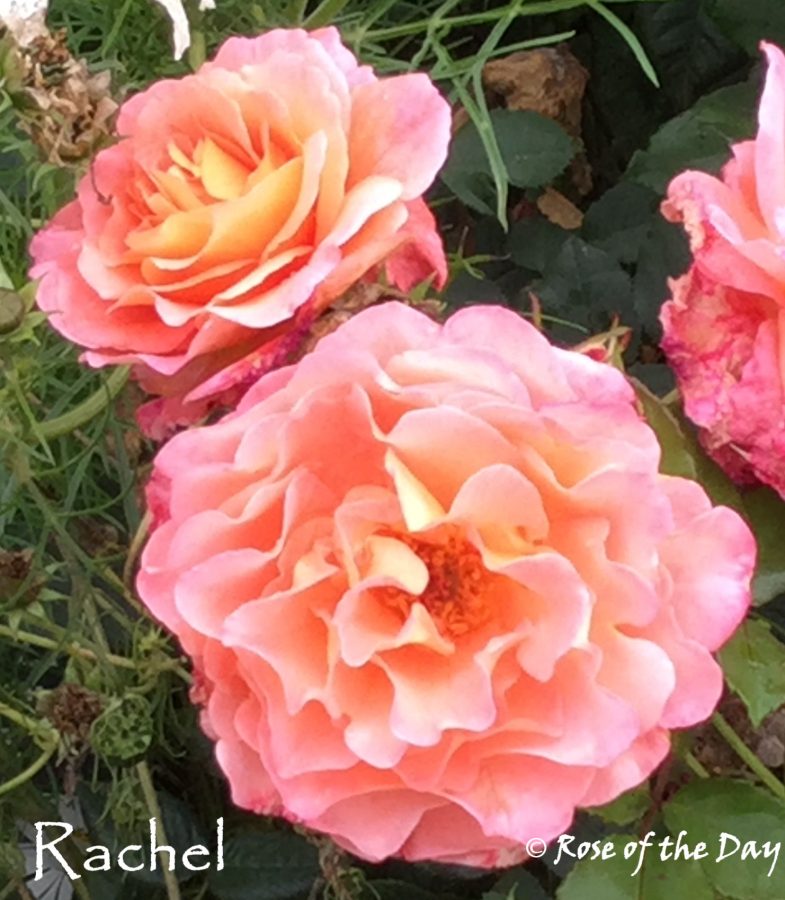
I am fond of the stripy roses, but I also love those combined pink, peach, apricot, lemon and buff tones found in some roses. The changing graduation in tones as these blooms mature is superb and draws one back throughout the day to have another look. Today’s rose has those subtle tones, the Hybrid Tea – ‘Rachel’.
A small caveat there with the name, sorry as I found yet another rose with several names! Bred by Hans Jurgen Evers of the German nursery Tantau and introduced in 1999 as ‘Augusta Luise’ with the ICRA appellation ‘TANgust’.
(For new followers who may not know this system. An International Cultivar Registration Authority (ICRA) ensures that the names of plants are not duplicated. The rose ICRA is the American Rose Society. Each rose has an exhibition name, in this case, ‘Augusta Luise’ and an ICRA appellation. This appellation has the first three letters of the registered breeder so TAN for Tantau and then a short name so ‘gust’ is used here. Although duplicate exhibition names are not permitted there seem to be a lot of them, the rose will only have one ICRA ‘code’ name. So, if you really want to check you get the right rose ask the nursery using that code name.
‘Augusta Luise’ is also marketed as ‘Rachel’ in the UK, ‘Hayley Westernra’ in New Zealand. Keeps one on one’s toes this naming business, and please pay attention with this rose as there are at least ten other ‘Rachels’!
Name issues dealt with so onto the lovely rose herself. The clusters of buds are coral pink, and initially the blooms are also the same coral pink Good HT high centres so the lovely swirl of central petals have an apricot tone. As the bloom flattens you get this wonderful fading of the coral pink to apricot, pale pink, honey, peach and finally a pinky buff. Truly wonderful and that’s not all as she has a superb fragrance. Flushes of bloom throughout the summer.
Dark glossy foliage but varying reports on black spot resistance. Predicted height 0.7-1.2m. Hardy USDA zone 6b-9b. Widely available.
A rose that one could find a space for, I think!
Thursday 14 Feb
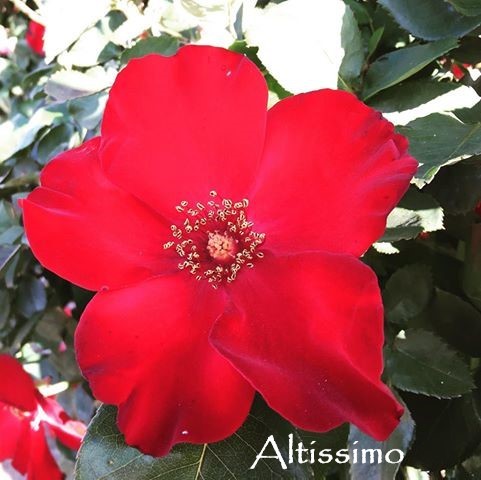
Red roses and St. Valentine’s day go hand in hand so today we have a red rose. You may remember that red roses are not my favourite colour. I do, however, like single roses so we have a kind of compromise a single red rose – ‘Altissimo’.
An appropriate name for a climbing rose – ‘Altissimo’ meaning the highest. Not a rose in the first flush of youth but a grand older lady dating from 1966 from the French growers Delbard. An immensely popular rose and looking at the photograph of her bloom one can see why. Spectacular saucer shaped blooms of five petals but she may add one or two more. An absolutely true red, with no white base and the petal back is the same colour. This eye opening colour sets off the large yellow stamen crown perfectly. These blooms occur in small clusters and she flowers fairly constantly through the summer. Not the greatest of fragrance but has a light clove scent.
A vigorous rose, the stems are rather stiff, so you need to train this rose when the stems are pliable. The second photograph shows her being grown as an informal hedge where the long stems have been trained horizontally onto wires. This ensures that the buds break all along the stem rather than a cluster at the end which is waving at the house gutter. She can reach 3m when grown as a climber, but you can grow her as a shrub but again pull those stems down. Either peg the ends of the stems down or tie weights on them.
Dark foliage with new purplish growth so the red blooms really pop. If you don’t deadhead, she will reward you with a great crop of hips. Very disease resistant. Hardy USDA zone 5b and warmer. This rose has won a shedload of awards and medals and is a consistent winner for those who show roses.
An important parent rose as well with 179 descendants. The striped climber ‘Crazy For You’ (‘Fourth of July’) is a first generation child and ‘Hot Chocolate’ is a second generation offspring.
A superb rose if you have a little bit of space for a shrub or a big wall.
I see one of the alternative names for ‘Altissimo’ is ‘Sublimely Single’. Mmm, perhaps not such a great rose for St Valentine’s day!
Friday 15 Feb

Today we have the Friday favourite, the old Gallica – ‘Tuscany’ also known as the ‘The Old Velvet Rose’. This last name is an apt one as the petals have a wonderful velvet look and texture.
The rosarian Graham Stuart Thomas considers this rose to be one of the very best Gallicas whilst admitting that the fragrance lets her down a little. She dates to around 1600 and is believed to be the ‘Velvet Rose’ described by the herbalist John Gerard in 1596. A venerable lady indeed.
Plump purple buds unfold into the most beautiful bloom. Intense purple maroon colour with a high contrast from the copious golden stamen crown. Occasional white flecks. Flat saucer shape and critically 25 to 28 petals, I will come back to the petal count later. The fragrance is good and strong but whether it isn’t as good as other Gallicas I will leave you to test.
She is a small shrub around 1.25m and will sucker if you grow her on her own roots. Dark foliage that can be susceptible to black spot. Only the one magnificent flush of bloom in June and she retires for the season.

There is another ‘Tuscany’ rose, this is a later introduction and is thought to have been a sport of ‘Tuscany’, this is the much more widely available ‘Tuscany Superb’. Introduced in 1837 from an English nursery, Thomas Rivers & Son. Why is she superb? Well, she grows rather larger at 1.50m high and the foliage has larger luxuriant leaves. The blooms are much larger, and the colour is reputed to be more intense. Same velvet texture and also a few white flicks. Large golden stamen crown but there are fewer stamens. I have posted two photographs. ‘Tuscany’ from Mottisfont garden so that is the correct rose and ‘Tuscany Superb’ (TS) from my own garden. If you look at these two you will see the difference in the stamens. The petal count is important here. ‘TS’ has 35-70 petals compared to the 25-28 of ‘Tuscany. ‘TS’ has less perfume and a tendency to fold her petals over her face hiding the stamen crown. She also will produce small hips, Tuscany doesn’t. Single bloom period for ‘TS’ but I do get odd late blooms
Both hardy USDA zone 5b-8b. Neither has an ICRA appellation so you will need to be sharp eyed to get the correct one. Does anyone grow both in their garden? Do you see the differences? Do please comment.
Saturday 16 Feb
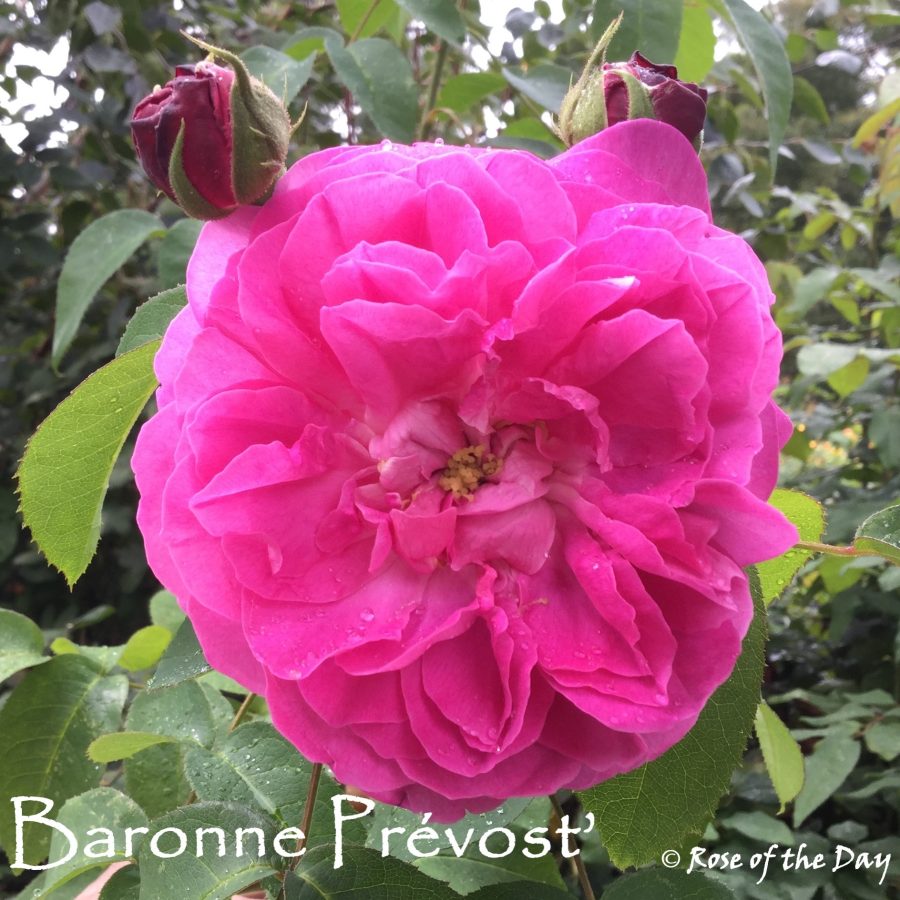
Last Friday 8th February we had a favourite rose ‘Comte de Chambord’ (or perhaps ‘Mme Boll’) and today we have his seed parent the early Hybrid Perpetual ‘Baronne Prévost’. Bred by the French breeder Jean Desprez in 1841 who then sold his rights to this rose to Pierre Cochet for a hundred francs. Approximately £358 today but a better indication using the average 1840s wage in France of around 2.5 francs a day estimate the rights to this rose were sold for around six weeks’ wages. This rose became very popular, I wonder if Desprez regretted the sale. Today ‘Baronne Prévost’ remains one of the oldest Hybrid Perpetuals available.
Jean Desprez named his rose for the sister, Mme. la Baronne Prévost, of his Dahlia growing friend Guenoux. I haven’t been able to find out anything about this Prévost family, if anyone knows any more perhaps you can comment?
The dark pink buds are large and globular, opening to sizeable blooms 15cm in diameter. Flat fully petaled in a quartered formation, bright pink to begin with before fading to a soft mid pink. A few quills surround a little yellow button eye. A very pretty rose with a strong fragrance. Graham Stuart Thomas relates that this rose repeat blooms all summer, but other authorities report a large summer flush with occasional later blooms. A strong ros,e and a long lived one as well. She is often found as a venerable lady growing in derelict gardens having survived neglect and changes in fashion.
Tall and upright in growth habit, up to 2.5m high and around 1.2m wide, a little shorter in cooler climates. Attractive foliage but not completely black spot resistant. A tough rose and hardy USDA zone 4b and warmer.
‘Baronne Prévost’ has been known to ‘sport’, producing the two striped sports ‘Baronne Prévost Marbrée’ and ‘Panache d’Orléans’. David Austin used the Baronne’s ‘son’ ‘Comte de Chambord’ to produce ‘Gertrude Jekyll’ and ‘The Countryman’.
This is a truly fabulous rose. The RHS encyclopaedia of roses rates it highly and states that she should be one of everyone’s top ten old roses. Praise indeed! She needs a little space and perhaps some fungicide, but I think you wouldn’t be disappointed if you grow her.
Sunday 17 Feb

During the 1980s David Austin was going through a bit of a Shakespearean naming phase and this rose is named for the heroine of The Merchant of Venice- ‘Wise Portia’.
A rose of great promise and wonderful colours. Sizeable light crimson magenta blooms that gracefully fade to pale magenta and then lilac. Full petalled rosette formation with a strong fragrance. The blooms last well when cut for the house. Reliably repeat blooms from summer to autumn.
Search for her though in the UK and you would be very lucky to find a stockist. Did she fall victim to fashion and slip into obscurity? She has a lot of superb attributes but a lot of poor ones as well. The availability in Australia and the southern US gives the clue, she was an unhappy rose in the cool damp summers of the 1980s. A heavy sufferer from both blackspot and mildew, her heavy blooms hung damply on their weak necks. Foliage wasn’t very special, and the growth was spindly. However, transport her to hotter dryer climates and you have a very different rose. The disease issue abates, the growth is strong, and the foliage is what one expects of a rose.
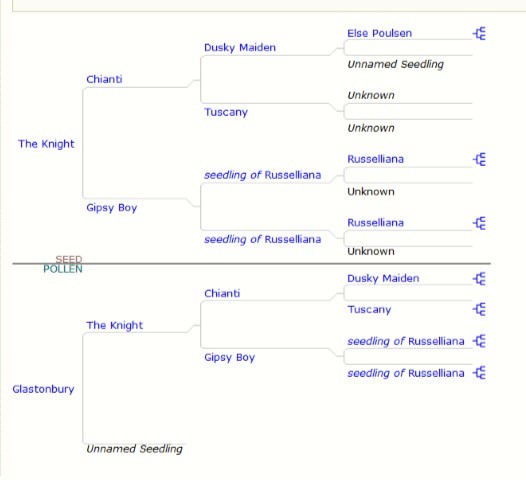
Today I have included a photo of her ‘pedigree’. I have compiled vast genealogical trees of my own and my husbands’ families so these trees appeal to my slightly OCD nature. I find it interesting looking at these pedigrees of roses as line breeding – breeding with close relatives – is commonly found. Friday’s favourite Tuscany’s offspring ‘Chianti’ is there on both the seed and pollen lines. ‘Wise Portia’s lovely colour comes down this line.
Not a rose for the UK but given climate change perhaps she might be a happier rose than in the past. I guess she may well still be cossetted in an English garden. Do you grow her or know of her? Did you consign her to the bonfire? Do comment.
Tuesday 19 February
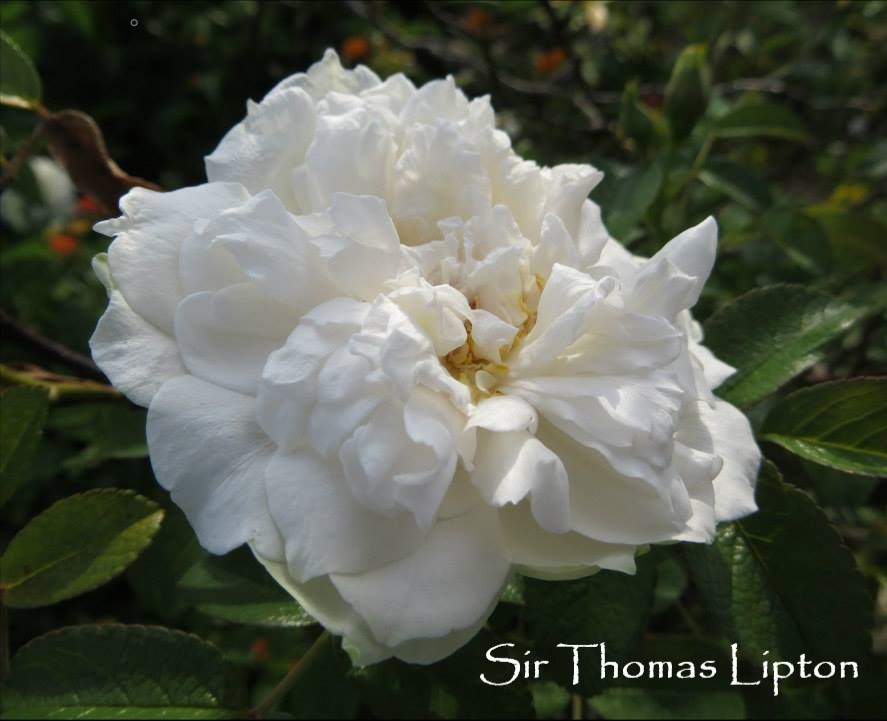
Fine tea, fine J class yachts and a five time gracious loser in the America’s Cup. All attributes of a wealthy self made man and today we have his namesake rose ‘Sir Thomas Lipton’. Sir Thomas was Scottish by birth, but his rose comes from America. Bred by Dr. Walter Van Fleet in Watsontown, Pennsylvania, one of the twenty nine roses bred by this amateur breeder.
Introduced in 1900 by Conard & Jones Co and considered by many to be one of the finest early Hybrid Rugosas. Slight doubt over the order of parentage, which is the seed or pollen parent. One obviously must be a Rugosa – Rosa rugosa f. alba Rehder in this case. The other parent is the charming polyantha ‘Clotilde Soupert’ featured earlier on this page on 30th January, 2019. Breeding roses must be tremendous fun. From the same breeding lines, there is a delicious pink Hybrid Rugosa ‘New Century’.
Very similar to ‘Blanc Double de Courbet’ but perhaps a better rose. ‘Sir Thomas Lipton’ has blooms of pure icy glistening white but just occasionally a paintbrush touch of pink appears. Clusters of fat little buds open to rather small blooms with a muddled petal formation, rather camellia like, that flatten later to reveal golden stamens. A huge flush of bloom initially and then he just keeps on blooming all summer. Of course, the strong Rugosa perfume drifts on still air so you can scent him before you see him.
Dark foliage with puckered leaves, a bit of a tendency towards rust and blackspot, unfortunately. A tough rose in other respects to heat, drought, poor soil, and cold damp weather. Strong growing, often considered to be a climber more than a shrub. You can grow him as either, but he can reach 2.5m high and around 1.5m in width. He is a very thorny rose, described as ‘an evil fur’ by one grower. Don’t plant him where you need to brush past him!
Wednesday 20 Feb

A rose that will certainly wake you up this morning. An American bred Hybrid Tea from the prolific nursery of Jack E. Christensen, introduced in 1984 – ‘Voodoo’.
Long elegant buds with elongated feathery sepals burst open to a large fully petalled orange bloom. Just how bright and orange she will be is going to be dependent on the temperature. Some growers describe her as salmon pink, yellowy orange, pink orange, even a red orange. She can display all these combinations as the high centred bloom unfolds so the petals reflex. The photograph shows her fading to a lovely lemony parchment. Variable reports on her fragrance from nothing to powerful, but as we have previously discussed fragrance can be elusive for some people in some growing conditions. I often comment that a rose has good fragrance only to receive a message or a comment that the rose has poor fragrance and vice versa.
Repeat blooms so well that she is almost continuously in bloom. The blooms as carried on long stems so a great rose for flower arranging, even my sort of flower arranging which is popping blooms straight in a vase!
Typical HT dark glossy but leathery foliage, good contrast to the bright blooms. A strong growing rose and healthy, well the odd report of late black spot. If you live in an area where black spot is prevalent then you may need to keep an eye on her. Upright in growth habit, reaches around 1.5m in warm climates but shorter in cooler areas.
Widely available in the States, Australia and New Zealand. I haven’t been able to trace a British or European stockist. Perhaps if you know of such a stockist you can comment?
Her strong colours may need careful placing in the garden to not jar the eye too much. Of course, colour placement is a very personal choice. A great rose that gives a good display for minimal input. I often say for lazy gardeners but that might be construed as a bit of an insult although I don’t consider myself to be an industrious gardener.
Thursday 21 Feb

A rose that surpasses everything? That’s a tall order I think, but that’s the translation of ‘Surpasse Tout’. However, not all rose authorities agree on this sentiment though! A fine Gallica rose dating from around 1792 or perhaps 1832 or even 1814. Let’s just say she is an old rose bred by someone whose name has been long forgotten.
Globular buds of dark pink open to cupped blooms of a rich carmine pink. These are large blooms and very full petalled, these petals have a rather mottled appearance with darker veins and paler backs. As the petals reflex, she fades to a pale cerise, the bloom flattens so the yellow button eye is shown in the centre of a swirl of petals. These beautiful blooms appear in clusters of around 3-7 on longish stems. Strong intense fragrance. Just one glorious burst of bloom though. I photographed her on an extremely hot day last June at Mottisfont Abbey gardens. She does have a lot of spent blooms, as the hot weather had been very intense that week.
A vigorous rose with bushy branches of the typical ridged foliage of the Gallicas. Practically thorn and prickle free. Not so large at 1.25m high and about 1m wide so good for a smaller garden or the front of the border. Hardy USDA zone 4b-8b. Having the one single bloom period means that you will be pruning her after blooming. Not hard just removing some older stems and branches.
She has a few additional names, ‘Belle Junon’, ‘Junon’, ‘Cerisette la Jolie’, ‘Cramoisi Triomphante’ and ‘Rouge Agréable’. In the tradition of these older classic roses, some of these may well be different roses entirely. Not so helpful when you are trying to buy this rose so pay attention when perusing the rose catalogues. Most nurseries offer her as ‘Surpasse Tout’ though.
A beautiful classic old fashioned rose that will bring joy and grace to your garden.
Friday 22 Feb

Today’s Friday favourite is the David Austin climbing rose ‘Wollerton Old Hall’.
Bred before 2010 from un named David Austin seedling rose, and introduced in 2011 as a shrub rose. However, the vigorous growth soon meant she moved into the climber section. Initially, the maximum predicted height was around 1.5m, now it is 3.75m. Curious that the vigour and height were not noticed during the extensive field trials!
Pointed apricot buds with a streak of dark pink unfurl to warm buttery yellow full cupped blooms. The shape of these is highly characteristic of the later David Austin roses. The petals have the ‘heart’ shaped wavy edges and are recurved, that is folded over the centre of the bloom. Rather peony like in fact. The colour fades through pale apricot, buff parchment, cream and a pink touched white. Highly variable depending on the climate.
Strong perfume, myrrh with hints of citrus which sounds delicious.. I was a bit surprised to find another grower describing the fragrance as medicinal. Maybe there is a hint of the typical yellow rose ‘edgy’ scent in this rose perhaps.
The DA website reports this rose is happy in all aspects. Perhaps if you grow ‘Wollerton Old Hall’ you can relate your experiences.
Named for the gardens of Wollerton Old Hall in Shropshire. This is on the opposite side of the country to me, so I haven’t visited them. From their website, the gardens appear to be truly magnificent.
Saturday 23 February
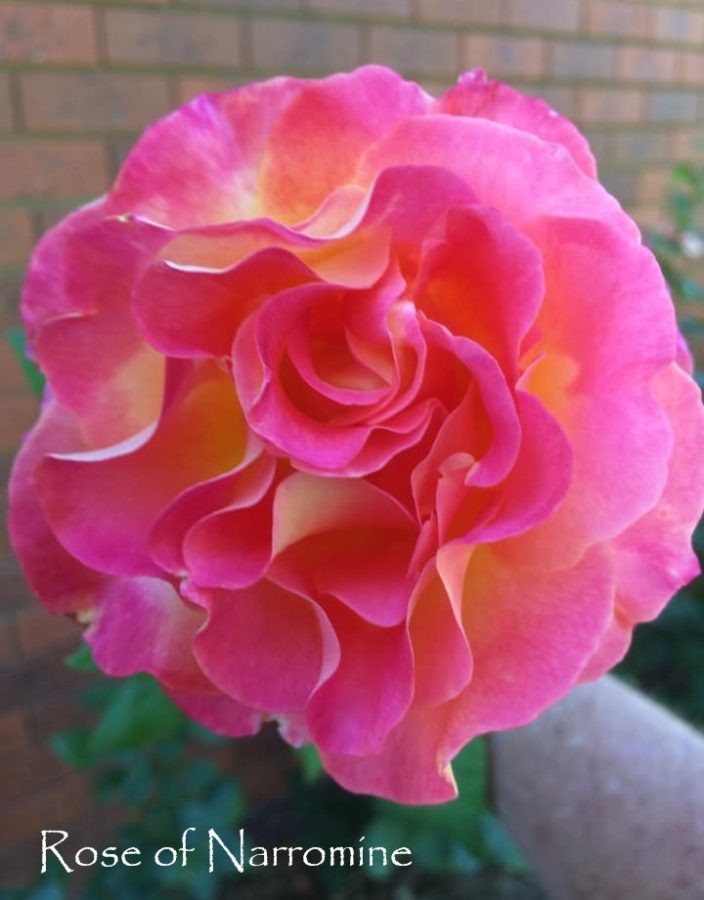
I usually post a rose under its exhibition name, but I was sent today’s rose under its alias, so I am using this name – ‘Rose of Narromine’. An American Hybrid Tea bred by Dr. A. Michael Dykstra in 1997 and introduced into Australia in 2010 by Swane’s Nursery.
For those unfamiliar with Swane’s Nursery, they are one of Australia’s premier rose nurseries. Originally based in Sydney, they have a large rose Farm in the town of Narromine, NSW, hence the name of this rose.
A spectacular rose of pink and yellow tones. The petal bases are yellow with hot hot pink edges. The glowing yellow centre, a true ‘Heart of Gold’ gives this rose its exhibition name. The intensity of the colours will be dependent on the temperature, the higher the scale the hotter and brighter those colours. Large blooms as well of around 13cm with a strong beautiful fragrance.
Not a rose for the small garden perhaps as she has a predicted height of 1.6-1.9m. Good disease resistance. Hardy USDA zone 7b-10b. Availability? Certainly, in the States and Australia but I haven’t been unable to find her elsewhere. There are two other Heart of Gold roses, so much for the International Cultivar Registration Authority (ICRA) not allowing duplicate names! ‘Rose of Narromine’ has the ICRA appellation ‘WEKdykstra’, the other two are ‘MACyelkil’ 1987 McGredy and ‘COCarlotte’ 2001 Cocker. These two are rather similar coloured roses as well. Perhaps if you love these hot sunset colours then the two other ‘Heart of Gold’ roses may fill the slot?
I love this photograph with the frilly petal edges. Do you grow this rose? Do share your comments and thoughts.
Sunday 24 Feb

I would love to know how this rose got its name, but it is a ‘Tall Story’! Honestly, I have not been able to find the reasoning behind the name.
This rose is often described as a procumbent rose which leads one to believe it will be 2m wide and maybe 50cm high. Certainly, it makes a rather loose and lax shrub. You can peg it down, this is where you literally pull the long flexible canes down to the ground and fix them with pegs or weights. A small note here though. Make sure the ground underneath is free of any perennial weeds. The best method is to remove all weeds, and cover with weed suppressant fabric and bark chip mulch. Unless of course, you enjoy weeding amongst the thorns! This method can be used on climbers as well, so they are horizontal climbers!
Without pegging down ‘Tall Story’ makes a 1.2m x 1m shrub but she is better with some form of support frame when she may reach up to 2m. Clusters of charming lemon buds open to semi double lemony blooms with an absolutely glorious golden stamen crown. Crowded with stamens of varying lengths, just beautiful. As the blooms mature the outer petals fade to a pale lemon white boosting the glowing golden centre. Reliable repeat blooms through to the autumn. Intense fragrance which unusually remains strong throughout the day into the evening. Rose fragrance is released as the temperature climbs in the morning and the volatile chemicals disappear throughout the day so evening scent is usually never that strong.
Bred by the famous Northern Ireland nursery of Dickson and introduced in 1984. Unusual cross with a seed parent the Floribunda ‘Sunsprite’ and a pollen parent of the rather small patio Polyantha ‘Yesterday’. It must be a great gift to select good parent roses, but I think all breeders are sometimes surprised by the children!
Healthy shiny mid green foliage provides a good foil for attractive blooms. Hardy USDA zone 4b-9b. Available in Britain, Europe and the States. Not sure about Australia though.
I saw this rose at Peter Beales nursery last September and thought she was very attractive. As I have been researching and writing this post, I am kicking myself for not buying her. She sounds such a star and I have a place for her where her fragrance could drift over our terrace. I will have to trip over to Peter Beales on my return from the Netherlands and buy a container plant!
Tuesday 26 February

I am a big fan of the Hybrid Musk roses. They are tough and hardy, great foliage with usually good disease resistance, pretty blooms that repeat all summer well into late autumn, and good fragrance. They are also accommodating roses coping with poor growing conditions and a bit of neglect.
Today’s rose is one of the Reverend Joseph Pembertons’s less well known Hybrid Musks, the lemon coloured ‘Daybreak’ dating from 1918. Joseph Pemberton bred around 52 roses in between his clerical duties and his charity work. Some of these are now no longer commercially available and are likely to be extinct unless they survive in an old garden. The popular ‘Prosperity’, Penelope, ‘Francesca’, and ‘Felicia’ are widely seen but what happened to ‘Joan’? Slid into oblivion it seems.
Seed parent is the seminal ‘Trier’, a favourite seed parent for Joseph’s roses. ‘Pax’, Felicia’ and ‘Moonlight’ are all first generation ‘Trier’ children. The ‘Trier’ ‘bloodline’ runs down into four and a half thousand roses, so it is indeed an important rose.
‘Daybreak’ shouldn’t be lost to the rose growing public. She has clusters of fat bright yellow buds held up on chocolatey brown stems. Opening to large pale yellow semi double blooms, the petal formation can be described as loose. Large dark golden stamen crown, good for the pollinators. She has a rather blowsy untidy appearance but in a way that adds to her charm. The petal colour fades to lemon then a lemony white. A bit of a tendency for these old faded blooms not to drop cleanly but to hang as unappealing brown ‘crisps’, her only fault really. She needs either dead heading or a bit of a shake to encourage her to let go. The fragrance is the typical strong intense Musk. Repeat blooms all summer into late autumn.
The young foliage is a dark bronzy brown which turns in time to dark green. Sets off the yellow and lemon blooms very well. Compact bushy growing habit and she will easily make 1.5m in height and around 1.25m wide. Hardy USDA zone 4b-9b.
This is a rather understated rose really which may account for her drifting out of popularity. It would be a shame to lose her as her good points outweigh the poor point of a messy petal drop. I accept that tastes in roses change over time, but I think this rose is still worthy of a place in a classic rose garden.
Wednesday 27 February

On a little bit of a theme here as today we have an unusual, and also a rather rare rose today, the charming China rose – ‘Papillon’. Peter Beales has this rose in their catalogues as a pink ‘China’ with a probable introduction of 1882. Other authorities have another rose, a pink Tea rose, dating from around 1881 from the French grower Nabbonand. Other reports that ‘Papillon’ is a medium red. When Peter Beales are alive, he spent a lot of time ensuring that the identification of these older roses was correct. When he found he had misidentified a rose he was honest and admitted the error. Researching this rose and comparing photographs I think the rose featured today is the French Tea rather than the China.
Small bright pink buds develop rather pale pink feathery edges as they begin to unfurl. Almost looking as though the bush is suffering severe drought or heat stress. They continue to open into a cupped bloom, opening further to a typical ‘China’ loose untidy petalled rose. The deep veined petals have rather ragged edges with curious colouring. Pinky white with copper tones, white splashes and a big untidy golden stamen crown. The petals look rather butterfly like hence the name. Very free flowering, continuously through the summer and well into autumn.
Good healthy foliage with new growth of coppery green. I love roses with these different coloured young growth as this provides more colour in the garden and a great contrast to the blooms. Slow growing but should reach 1.2m in cooler climates but often reaches 3m in hotter areas so often grown as a climber or pillar rose. Hardy USDA zone 6b-9b.
Availability? Well depends on which one! The China is fairly widely available, but the Tea is not. Peter Beales are out of stock for this season, but they take orders for next winter. They may well have container grown plants in the summer though.
I am interested to see if any of you grow this version of ‘Papillion’ or the China variety. If you do perhaps you can post your comments and photos? If you don’t have any current photos perhaps you can take your camera out when she is in bloom and message these to me?
Thursday 28 February

Today a climber, from the German nursery Kordes, introduced in 1996 so she has stood the test of time, – ‘Jasmina’. One of their Arborose series which are climbers that promise to give more bloom than the average climber.
Large clusters of round pale greenish white buds, touched with pink, unfold into fully petalled cupped blooms of an old fashioned classic appearance. You could easily mistake her for a David Austin rose with that round cupped quartered petal formation with those wavy petal edges. Her colour is a violet toned pink, but she does show considerable variation according to the climate. The hotter the temperature the paler pink she appears. Fragrance is said to be sweet and fruit like, but some reports of a sharp unpleasant fragrance. Sense of smell is in the nose, or more correctly in your genetic makeup, so different people can smell undertones imperceptible to others. She is a little bit of a head hanger so the higher she grows the better you can appreciate the blooms. Certainly, with large heavy blooms she needs a strong support frame and will need hard pruning in the dormant season back to the wall otherwise she could suffer from broken branches. Blooms in flushes throughout the summer. A few reports that the blooms may ‘ball’ in damp humid conditions.
Glossy healthy foliage, the breeders claim high disease resistance but again some growers have experienced blackspot. If you are in an area where blackspot is prevalent then you may need to pay attention to her. Tall bushy and vigorous growing habit and reputed to have good cold resistance as well. Hardy USDA zone 5-9. Predicted maximum height is around 2m with a 1m width so she is a good climber for the smaller garden.
Widely available in Britain, Europe, the States and Australia. Australian gardeners may find her listed as ‘Climbing Jasmina’.
This does sound like a worthy rose to grow. Any comments, positive or negative, welcome as potential growers will find these useful.
 Rose of the Day