The sprawling ‘Raubritter’

Living in the flat Suffolk countryside I yearn for a hillside garden with terraces and banks. One always wishes for the impossible! Today’s rose ‘Raubritter’ is one to grow falling down a bank or over the side of a terrace.

Bred in Germany in 1936 by Wilhelm Kordes, the pink hybrid Macrantha shrub ‘Daisy Hill’ provided the seed with the vigorous red hybrid Wichurana rambler ‘Solarium’ donating the pollen. ‘Raubritter’ is a procumbent rose, with long snaking stems. I planted her in a bed to grow as a shrub, but those long stems are proving to be a trip hazard on the nearby path. I gave her a small frame, but she is having none of it. Reputedly she will scramble up a tree or hedge up to around 3m.

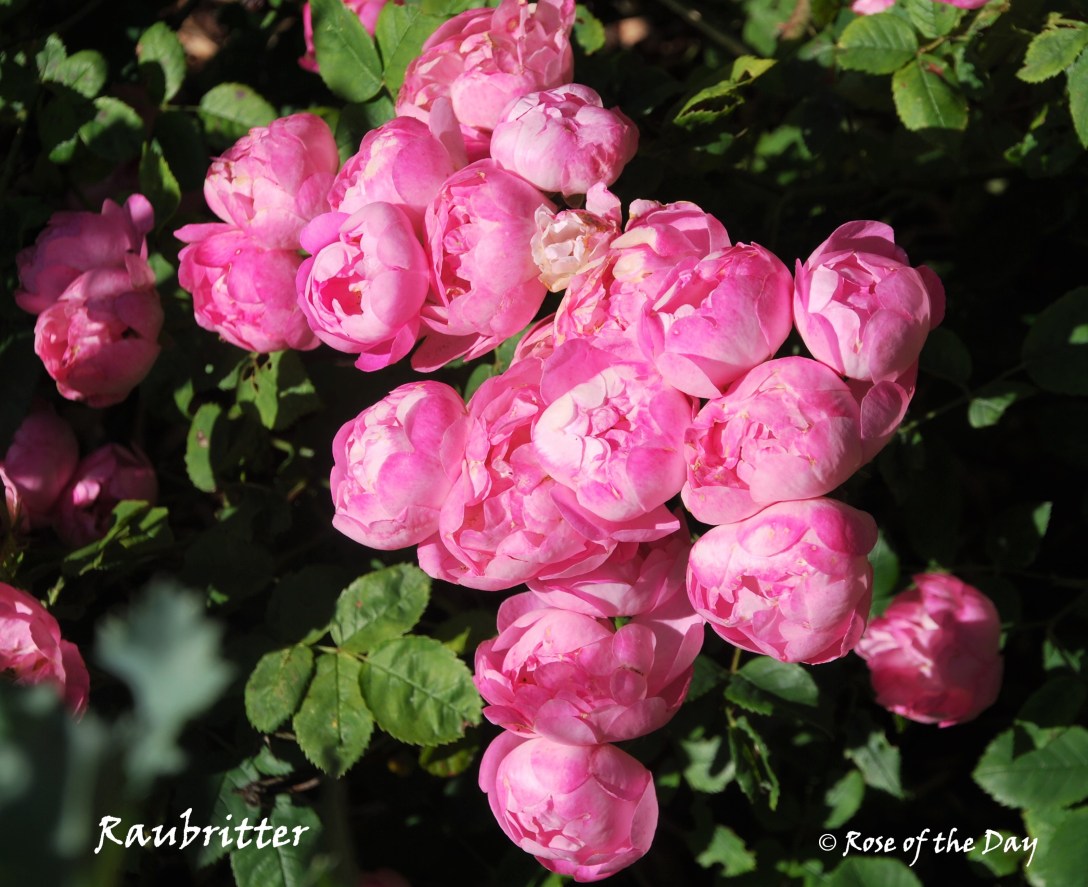
Small pointed rose buds appear in large clusters in early June opening to the most astonishing bloom. The profusion of buds open to silvery pink globes each with a small opening at the top, very un-rose like. The small opening gradually widens until a beautiful dusky pink peony like bloom emerges. Just so beautiful, one could look at them all day. Fragile and delicate but remarkably weatherproof and long lasting. A fresh sweet fragrance drifts from these superb blooms. Just one magnificent flush but you do get a wealth of these attractive blooms for an extended period.

A tendency for mildew infection is reported in the literature but mine has been extremely healthy in a dry bed. Otherwise, she is very vigorous with slender prickly stems and narrow wrinkled foliage. Hardy USDA zone 6b-9b. Reputed to be very frost resistant. American Rose Society grading 8.1 (A solid to very good rose. Its good features easily outweigh any problems. Well above average).

This dainty ethereal rose has an entirely inappropriate name. A Raubritter was a feudal robber baron or knight imposing unfair taxes and demands on his subjects. I can think of a few rampaging thorn ridden ramblers for whom the name Raubritter would be extremely apt but not this pretty rose.

The modern healthy continuous flowering ground cover roses may have overtaken her, but I still think ‘Raubritter’ is well worth growing. Mine is just in the wrong place to show her best. In the autumn she is to move to a sloping bank where she can fall over the retaining wall. If you are lucky enough to visit Mottisfont you will find ‘Raubritter’ adorning the small central ornamental pool, a wonderful sight.

Originally posted on my Facebook blog Rose of the Day on 2nd July 2022

‘Yolande d’Aragon’

Today’s rose is one that does not sit neatly into a ‘class’, described as a hybrid Gallica, Portland, or Hybrid Perpetual. A genetic study does show she is closer to the Gallicas than the Portlands. To be honest, a lot of the old garden roses are ‘mongrels’ with attributes from their parents who in turn were a bit of a mixture. Whatever her antecedent ‘Yolande d’Aragon’ is a glorious rose.

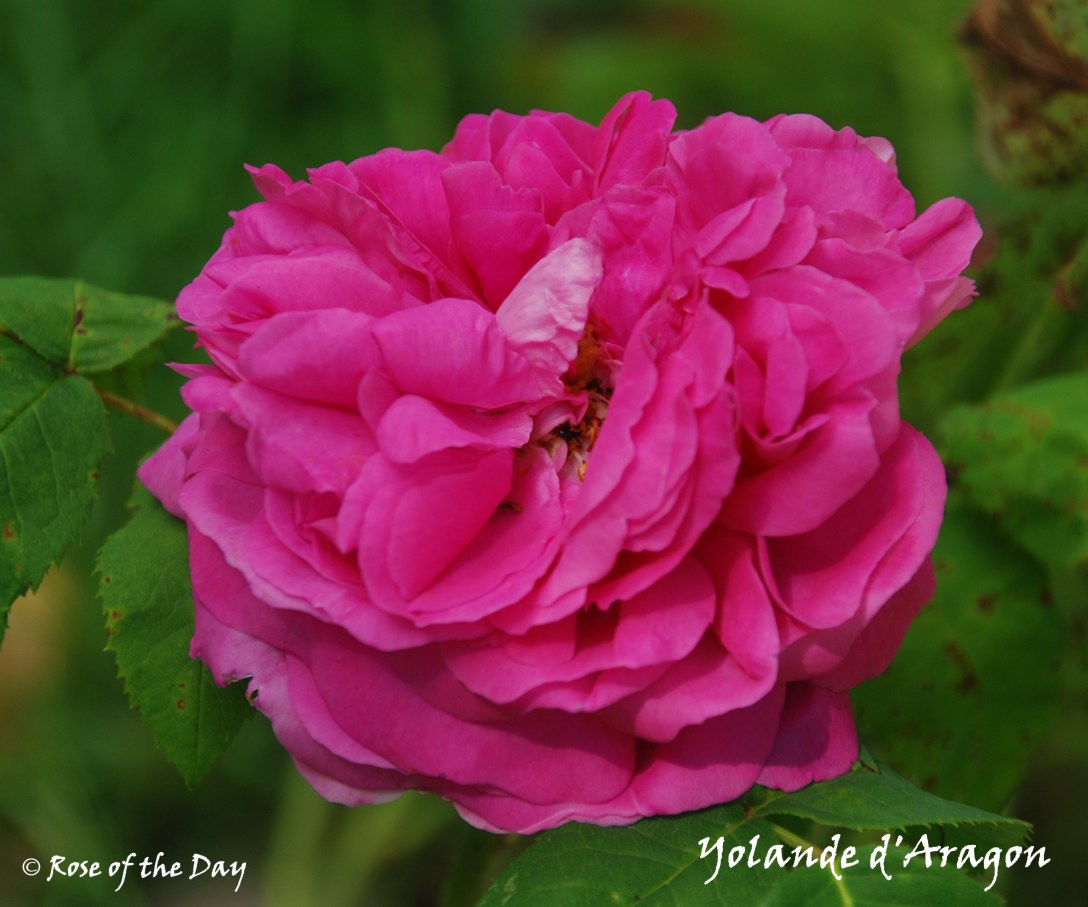
Dating from 1843, introduced by Jean-Pierre Vibert, and is reputed to be a seedling of the Damask Perpetual ‘Belle de Trianon. Yolande produces clusters of dark pink buds dressed in feathery sepals. Large, cupped blooms of deep pink with pale backs. Stuffed with petals in a rosette swirl. Breathtakingly strong old rose fragrance, you must keep returning for another deep inhale. One big summer flush followed by intermittent blooms or even a second flush. Mine is a young rose but last summer she had a lot of late bloom.

Will reach around 1.5m tall with a width of 1m. She is of the era of strongly disease resistant roses but here she had shown some black spot this summer. It has been a weird season though. A very dry mild winter and equally dry spring often with strong cold winds with the odd hot sunny day thrown into the mix. The roses did not know whether to grow or quietly sleep, producing a lot of stressed small foliage. Even the Pemberton Hybrid Musks suffered with the early foliage succumbing to fungal infection. The flush of foliage following rain was and remains healthy so perhaps Yolande’s spot is the result of the weather rather than inherent disease propensity.

A popular rose and widely available. Graded an 8.5 from the American Rose Society – a very good to excellent rose, one recommended without hesitation. Hardy USDA zones 4b-9b.

https://upload.wikimedia.org/wikipedia/commons/6/6b/Marriage_of_Yolande_of_Aragon.jpg

Depiction of the marriage of Louis II of Anjou and Yolande of Aragon from Froissart’s Chronicles 1470. (http://www.bl.uk/catalogues/illuminatedmanuscripts/ILLUMIN.ASP?Size=mid&IllID=22147)

Yolande d’Aragon (1379-1442) played a significant role in the complex ‘Game of Thrones’ in both Spain and France. Born a princess of the small Spanish state of Aragon, her parents arranged her marriage in 1400 to end a feud between the Aragon and Anjou families. Yolande initially resisted this marriage to Louis II, Dule of Anjou. However, it turned out to be a long successful marriage with five children. Yolande became a committed supporter of the French royal family in the last years of the Hundred Year War. Her involvement deepened when her daughter Marie of Anjou married Charles the youngest son of the mad Charles VI.

Charles became heir to the French throne when his eldest brother John died. Following the death of Charles VI, the infant Henry VI of England was proclaimed King of France. Yolande encouraged Charles to fight for his throne. She supported Joan of Arc’s ambition to lead the French army in the successful battle against the English, so Charles became King of France. Yolande’s great diplomatic skill continued to be employed in quelling feuds and squabbles between the French aristocratic families. Not the atypical interfering mother-in-law I think. Certainly, a lady who deserves a rose that is a little out of the ordinary.

I forgive ‘Yolande d’Aragon’ for her few spots this season as the blooms and fragrance are quite special. In her second summer here, she has grown vigorously despite being in a slightly shady position. Do you grow her? How is her disease resistance with you? Comments are welcome as always.

First posted on my Facebook blog Rose of the Day on 27th June 2023

‘Thérèse Bugnet’

Today a jump from the heat loving Tea Roses to a cold hardy rose – the Hybrid Rugosa ‘Thérèse Bugnet’.

A rose that you could walk past when she is not in bloom thinking from the foliage that this is a shrub of another species. Long narrow matt leaves that are not typical of any other Hybrid Rugosa that I have seen. In the autumn the tall stems turn an attractive red.

The photograph shows a bloom just a little bit before its best. These sizeable blooms appear in clusters, with large wavy petals which unfold to a saucer shape. Dark pink initially before fading to a softer tone with those charming golden stamens. Typical sweet but sharp clove Rugosa fragrance that ‘lifts’, carrying in the air around the shrub. Repeat blooms from summer into autumn. Orange hips follow but I find not so many as expected.

A tall shrub, 1.5-2m which responds to pegging down, a small amount of work which gives more bloom. Not really thorn free but just a few. Like most hybrid Rugosas she dislikes being pruned. Resistant to blackspot. Suckers when grown on her own roots. The one kicker about this rose is the tendency for dieback, particularly when it occurs in the tallest and best stems. Shade tolerant though. Exceptional cold hardiness, USDA zone 3-9b, recommended for North Sweden. Widely available.

A straightforward easy rose to grow. Just the little niggle with dieback

This cold hardiness attribute combined with her name shouldn’t be too much of a surprise. Bred by one of the most extraordinary rose breeders I have ever come across, Georges Bugnet, (for those of you worried re the pronunciation it’s boon-yay). If there isn’t yet a book on Georges Bugnet then there should be. One of the major French writers of Western Canada, he published four novels, the best known being ‘The Forest’. Also, numerous essays, short stories, and poetry. Born in France in 1879, and educated at the Sorbonne, Georges immigrated to Canada with his wife Julia and lived in a homestead close to Edmonton in Alberta. Although not trained as a botanist he had a great interest in plants and began to breed one that could survive the harsh Alberta climate. Taking seeds from Russian plants he produced the Lagoda pine tree. He experimented with native Russian roses and the native Canadian species producing ‘Thérèse Bugnet’, in 1941, named for his sister. He continued to breed roses for fun producing 16 hybrid Rugosas, and giving the plants away to nurseries to propagate and sell. With nine children he was very interested in education and was very involved in the local schools and their education programmes. Georges had a long life, dying at the grand age of 101, in 1981. What an amazing man!

A straightforward easy shrub rose. Just that small qualm with dieback but the positives outweigh this one fault. To be honest though ‘Thérèse Bugnet’ is rather more of a landscape rose than one for a prime place in your garden,

This post originally appeared on my Facebook blog on 23rd March 2022

‘General Galliéni’

Some roses confound with their changeable colours. Ones that irritate with their habit of growing sideways, sometimes in preference to growing upwards. Those that prove unsatisfying to photograph as their blooms are untidy to the point of being misshapen. These are special roses, described to me by David Stone, former head gardener at Mottisfont, as ‘roses for the connoisseur’. They hate cold weather, preferring warm sun but will often turn their heads away or droop their necks. They thumb their noses, metaphorical ones, at fungal diseases. A reputation for fragility, but think more of a frail spinster aunt decked with lace who thought nothing of walking miles in vile weather. Secateurs will almost cause a faint though. Those sideways shoots always produce a cluster of blooms with every node below joining in for the burst of bloom. All are forgiven for their exotic, sensual perfume – the Tea Roses.

A huge number of Tea Roses were introduced in the fifty years or so before WWI. Many lost to cultivation now as their popularity waned and they were overshadowed by the new Hybrid Teas. ‘General Galliéni’ is one of the noble survivors, bred by Gilbert Nabonnand and introduced in 1899.

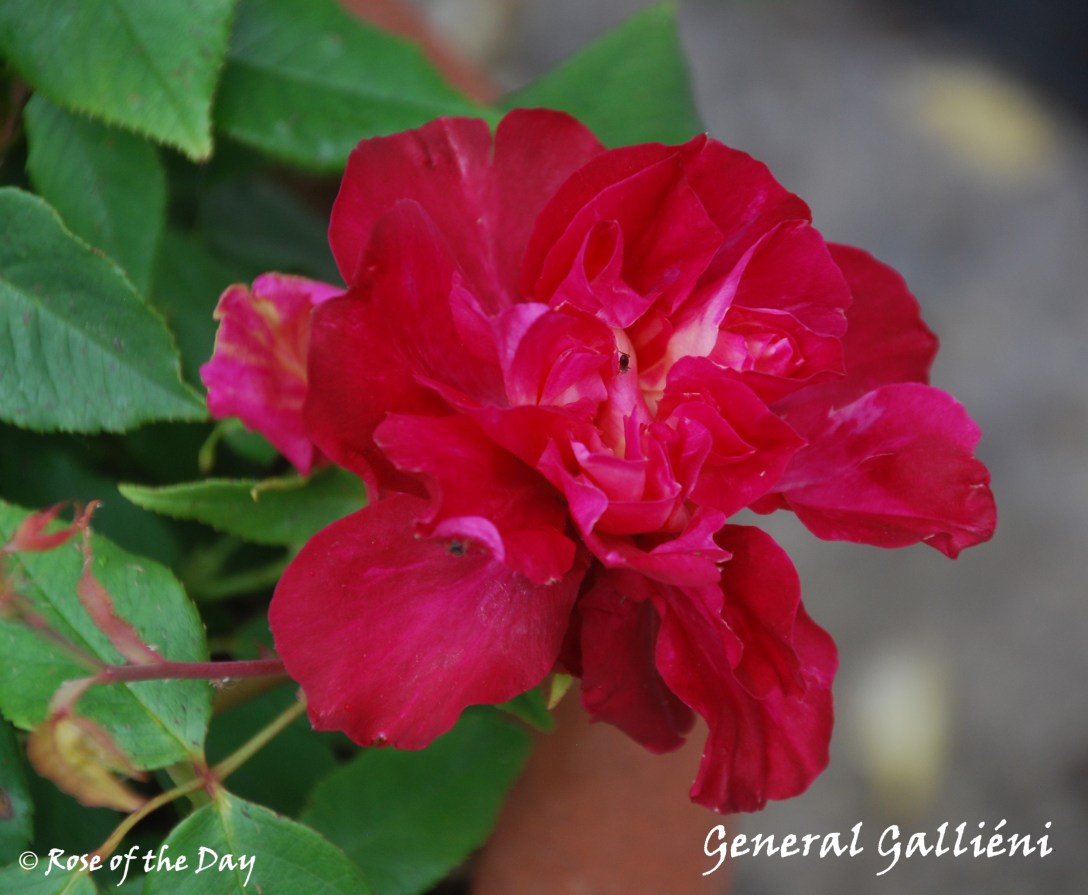
A mostly red rose with yellow petal bases, but ‘General Galliéni’ can be copper with orange tones, raspberry and cream, or peachy pink. Occasionally drifts to maroon, brown hued red or purple. No two blooms are ever quite the same hue. Nor the same shape. Often asymmetric with petals pinched up, the kind that makes you lower your camera thinking – next week they will be better. A perfect bloom with ruffled petals repays your wait, sometimes! This diversity creates a rose shrub of great charm. ‘General Galliéni’ demands your attention and rewards with a light but pervasive fragrance. Almost continuous in bloom with an early start and goes on to early winter.

His growth habits are no less untidy. Mine has a drunken lean despite my efforts to persuade him to stand up straight. These are roses that create their personal space which in turn means a gap between two or a friendly cuddle with a neighbour Tea. I have attempted some training with canes and ties, but he is a strong willed grower so I leave him to sprawl. Size? In the UK likely to be a metre in height and possibly wider. In Australia, 3m is more the norm.

Attractive light green foliage, a little sparse perhaps but zero fungal diseases. Occasional aphids perhaps but easily blitzed with soapy water. USDA zones 7-9 is the given range but Teas are happy in hot climates. Widely available.

Are you a rose connoisseur? Or does the untidiness of Tea roses not match your garden style? Worried about the hardiness? Growing the General in a container placed on wheels could help to place him in sheltered spots. I feel the Teas hate cold freezing rain rather than hard frosts. Maybe a brolly would be better?

And his namesake? Joseph Simon Galliéni (1849-1916) was both a French colonial administrator and a military commander.

His military career began in the Franco-Prussian war before he moved to the colonial service initially in Senegal before becoming governor of French Sudan. He developed the ‘tache d’huile’ method, the ‘oil spot’ technique still used in counterinsurgency today. Winning ‘hearts and minds’ instead of heavy firepower and bombardment. Promoted to General in 1896 and made Governor of Madagascar where he illegally deposed the Malagasy monarchy, exiling Queen Ranavalona to Reunion.

In 1905 he returned to France as Military Governor of Lyon and a position in the Superior War Council. He failed in his attempts to modernise the French Army in battle dress, they still wore the ‘pantalon rouge’, and in military tactics. He retired in early 1914 just before the death of his wife.

He was recalled in August 1914 with the outbreak of WWI and was appointed Governor of Paris. Here he encountered the war minister Adolphe Messimy, son of Madame Laurette Messimy. Her rose was featured on this blog on January 1st. He is credited with the victory of the First Battle of the Marne and in late 1915 took the post of Minister of War. Sadly, he served just a short term before dying of cancer in May 1916. Created Marshal of France in 1921.

If ever a man deserved a rose, it was this man.

Tea Roses are a cross between Rosa chinensis and Rosa gigantea. R. chinensis originates from the Chinese provinces of Guizhou, Hubei, and Sichuan – Zones 8/9. R. gigantea is a little more tender coming from the Chinese provinces of Sikkim, Yunnan, the Indian province of Manipur and Burma – Zones 9/10 so a subtropical rose. R.chinensis is quite happy at Zone 7b but R.gigantea is not happy below 8b. However, I have found references for this rose growing in the UK in the late 19th and 20th centuries when the winters were much colder than today. These are the roses that brought repeat and continuous blooming genes into rose breeding in the late 19th century.

I think the colour is related to the air temperature and humidity as he is much stronger in colour in the heat of summer and tends to have cooler colours as the temperature falls. But not always, he sometimes has a rather yellow bloom next to a red one. A little like Mutabilis except the blooms don’t change from yellow to red in the space of half a day.

I admit to an addiction to the Teas. I hope I can persuade more of you to try one or five. ‘General Galliéni’ is an excellent rose to start your collection.

‘Mrs H.R.Darlington’ – a lost rose

The format of posts for this blog is usually a rose, together with a description and cultivation notes, plus the back story of the name. Today I confess to not having the rose at all as it seems to have drifted to extinction, and not left a photograph behind to charm everyone. It is the story of the namesake that I wish to tell you.

Three weeks ago, we had the elegant ‘Mrs Oakley Fisher’ named for one of the first three women elected to the board of the National Rose Society. Today it is the turn of Dora, the wife of Hayward Radcliffe Darlington, the president of the National Rose Society.

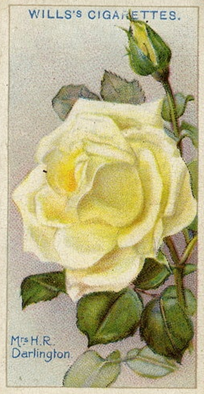
Dora’s rose ‘Mrs H.R. Darlington’ was introduced in 1919 by Samuel McGredy II. A Hybrid Tea described as having cream yellow blooms, being free flowering, and very vigorous. In Australia, the colour was more towards a clean white. She sounds stunning, with large petalled well shaped blooms that could reach nine inches (23 cm) across. I suspect some exaggeration there, but she was noted for large perfect blooms. Recommended for both garden and exhibition use. Her faults were a tendency to ball, burn in the sun, and not transplant too easily. One could say the same of a lot of white and pale coloured roses. Reading through the literature available ‘Mrs H.R. Darlington’ appears to have been more popular in Australia. She was regarded purely as an exhibition rose in the UK.

The picture is one from the W.D. & H. O. Wills cigarette cards No 41- 1926 which indicates the popularity of ‘Mrs H.R. Darlington’. The reverse of the card reads: ‘(No 41) MRS H.R. DARLINGTON (Hybrid Tea) A perfect white rose. The flowers are large, well formed, sweetly scented, and of considerable substance. It is a free grower, with dark green leathery foliage, and is very beautiful in the autumn, and suitable for almost any situation. Should be pruned to within three or four “eyes” during March. Introduced in 1920 and awarded the Gold Medal of the National Rose Society.’

 Should you have wished to grow this rose in 1922 Daniel Bros. Ltd of Norwich sold her for 2s 6d – half a crown – (around £7 today). In the same year, Frank Cant & Co. sold her for 5s.

Browsing old rose catalogues is a lot of fun if slightly time wasting. Most catalogues include hundreds and hundreds of roses in contrast to the rather limited selection we are offered today. One sees a lot of old favourites still grown today but a vast number have gone to the great compost heap in the sky. I wonder if ‘Mrs H.R. Darlington’ is still grown in Australia? Perhaps someone can comment on this? I see there is some discussion concerning an identification mix up with another rose ‘’Mrs. C. Lamplough’.

~~~~~~~~~~~~~~~~~~~~~~~~~~

And of Dora herself? Born Dora Hill in 1863 in Wolstanton, Staffordshire into a wealthy family. Her father John Sherriff Hill came from a Scottish merchant family trading in coal. Following a trip to Australia for health reasons he became involved in Australian trading and shipping. Dora was educated at West Heath school in Surrey.

After the death of Dora’s mother, John Sheriff Hill remarried, and the family moved to St Albans. They lived in Hawkswick a large house built for the brewing family Fearnley Whittingstall. There Dora lived the life typical of a well to do Victorian daughter supporting charitable functions such as an amateur concert to raise funds for the renovation of the church tower. I found she won £2 in a Morning Post competition in 1868, no details of this other than the title ‘Psalms’. Perhaps guessing from which Psalm, a particular line came from? This was an age where a good religious education formed a large part of education.

In January 1890 Dora married the barrister Hayward Radcliffe Darlington. It sounded like a magical wedding as the outdoor Chinese lanterns were hung in frosted trees and shrubs at the groom’s family home Bourton Hall. Typically, the entire wedding present list appeared in the press, with presents ranging from diamond jewellery to a hand embroidered tray cloth. From browsing this I can see the newlyweds had a surfeit of silver salt cellars. I can imagine elderly spinster ladies shaking open the paper and commenting on who gave what, perhaps some of the gifts might have been considered a little mean. After the wedding, the honeymoon was taken in a chilly Torquay.

Hayward Radcliffe Darlington had a great interest in horticulture. An expert on narcissus and roses, he went on to become president of the National Rose Society. He wrote extensively, both books and articles, his 1911 book ‘Roses’ is available online. Dora followed this literary trend with articles such as ‘Colour Grouping in the Rose Garden’ and ‘Roses and Rain’ both of which appeared in the NRS Annual.

Unlike Florence Oakley Fisher Dora does not seem to have been a competitor in rose and horticultural shows. Press mentions include unrelated interests; Dora was the honorary secretary to the Potters Bar Navy League. Her father had been a shipowner so perhaps this isn’t to be unexpected. The most amusing press mention was from October 1901 when both Hayward and Dora were fined 1s with 9s costs for reading their horses on a footpath. A trifle awkward for a barrister I would imagine.

Dora’s rose has faded into obscurity, but I think as one of the first three first female members of the NRS council Dora should be remembered today. Perhaps a rose breeder has a candidate rose for ‘Dora Darlington’?

Comments welcome as always. If you can add to Dora’s story that would be great. Also, comment if you know of ‘Mrs H.R. Darlington’ still growing somewhere, or perhaps you remember this rose from the past?

First published on my Facebook blog Rose of the Day on 12th March 2022

‘Dainty Bess’ and her creator

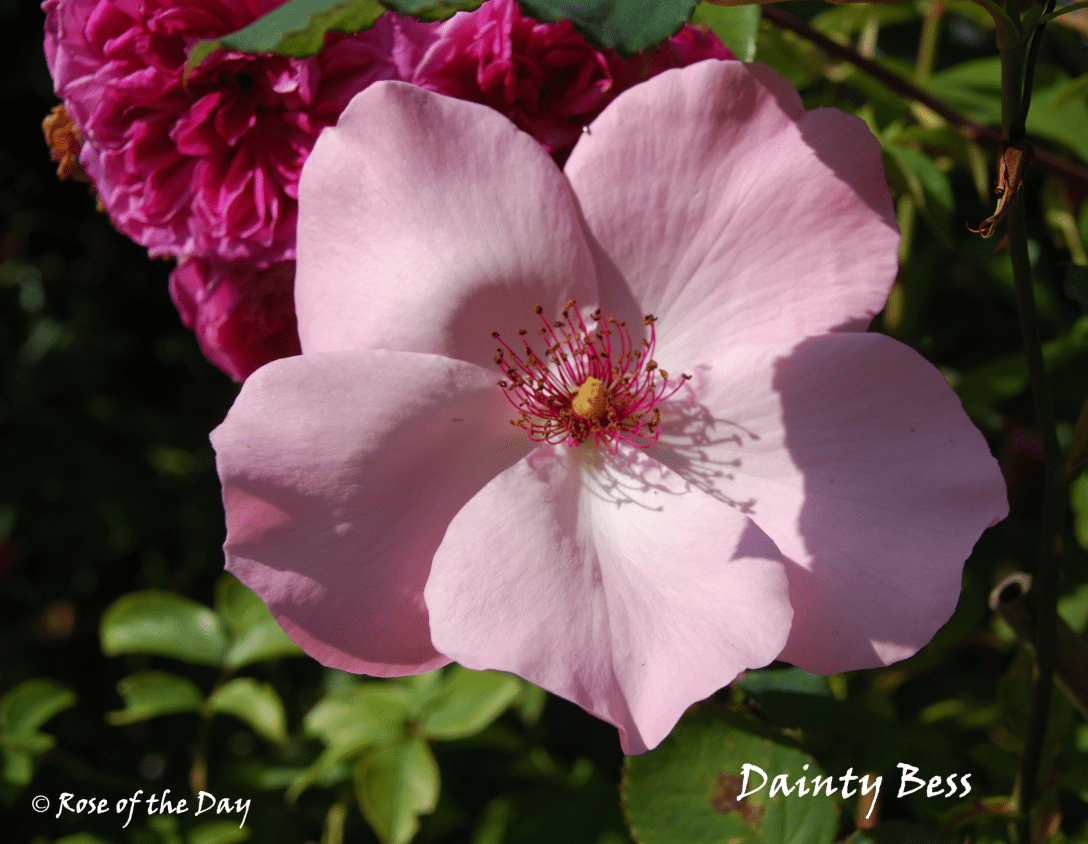
A look at a rose and her creator. Today we have ‘Dainty Bess’ and the Kent based rose breeder W.E.B. Archer & Daughter. Not so much seems to be known about William Archer and his daughter Muriel so I indulged in a bit of research, and uncovered a few long hidden facts. These rather forgotten rose breeders deserve attention.

Early Hybrid Tea roses have often drifted off to the big compost heap in the sky. Those that remain in commercial cultivation have qualities that make them worthy roses for any garden. I have a fondness for single roses and this rose is one of the better known – ‘Dainty Bess.’

Elegant, pointed carmine pink buds unfold into a large single bloom. Fluted and ruffled petals of pale pink with slightly darker backs. The crowning glory of this rose, probably the reason for her continuing popularity is her crown of unlevel reddish yellow filaments tipped with golden stamens surrounding a bright yellow stigma. Each bloom has a slightly different crown, which adds to her charm. Long stems carry these attractive blooms in clusters up above the foliage. Repeat blooms exceptionally well, she is almost continuously in bloom throughout the summer. Great fragrance as well, sweetly light.

A small rose, she is only just over 1m high. There is a climbing variety as well introduced in 1935, growing to around 3m but does not bloom quite as continuously as this bush variety. ‘Dainty Bess’ would be great in a large container, a pair on either side of your front door would be very special. Some reports of black spot late in the summer, but she is so lovely you can forgive these minor faults. USDA zone 4b-9b. Widely available.

~~~~~~~~~~~~~~

W.E.B. – William Edward Basil  Archer led me on a merry dance through the archives. Baptised William Edward Archer he added Basil later and at one point used Basil as his first name. Name changes always hinder research!

William was born in Horton, Bradford, Yorkshire in 1861. His father, also William, is listed as a cabinet maker in 1851, Later, according to the census of 1861, he was an upholsterer employing six boys. William Edward followed his father’s trade as he is described as a furniture designer in the 1901 census when he is living with his wife Bessie and daughter Muriel Gertrude in Finchley, Middlesex. I found him again in 1911 eventually under the name Basil Archer in Coulsdon, still listed as a furniture designer and living with Bessie, Muriel, and his sister Francis. William appears to have been a successful designer of furniture, this area of Surrey is affluent now, and it was the same in 1911. It would be good to find his employer but no luck yet.

Between 1915 and 1918 William and the family moved to The Gables, Monks Horton in Kent. Sadly in 1920, his wife Bessie dies. I guess that by this time William has retired from furniture design, and begins to dabble in rose breeding.

In June 1924 for the first time, William takes one of his roses to the National Rose Society summer show. A rose he has produced from crossing the hybrid tea ‘Ophelia’ with the red hybrid tea ‘Kitchener of Khartoum.’ This new rose proved to be an instant success in winning a gold medal, the first awarded to an amateur rose grower in ten years. The Westminster Gazette reports that an expert valued the rose at several hundred pounds. This rose was ‘Dainty Bess’ named for William’s wife.

William’s amateur rose breeding soon turned into a business – W.E.B. Archer and Daughter. Muriel undertook the secretarial duties for this business, I do not know to what extent she was involved with the actual hybridising. In 1927 they took the Daily Mail cup together with 250 guineas (equivalent to around £15,500 today) for the best new scented seedling rose. A red Hybrid Tea, again William used ‘Kitchener of Khartoum’ as the pollen parent, which went on to be named ‘The Daily Mail Scented Rose.’

William and Muriel produced twenty eight roses between 1924 and 1940. The elegant ‘Dainty Bess’ and her refined daughter ‘Ellen Willmott’, together with ‘The Daily Mail Scented Rose’ and the climbing sport of this rose, and ‘Bonnie Jean’ remain in commercial cultivation. All of William and Muriel’s roses were introduced to Australia by Hazlewood Brothers. There may be some of the other varieties remaining there in cultivation, or at least growing in someone’s garden. Alas, all too many good roses fall out of fashion and fade to extinction.

It seems that the demands of growing food rather than flowers in WWII closed the business, although William was by this time 80 years old. He died in 1950 followed by Muriel, who had never married, two years later. In the short space of sixteen years, they produced roses of timeless beauty. One is left to consider what William could have done if he had been born into a nursery business rather than the furniture trade. I wonder if his furniture was as good as his roses?

This article first appeared on my Facebook blog on 19th February 2022.

‘Madame Knorr’

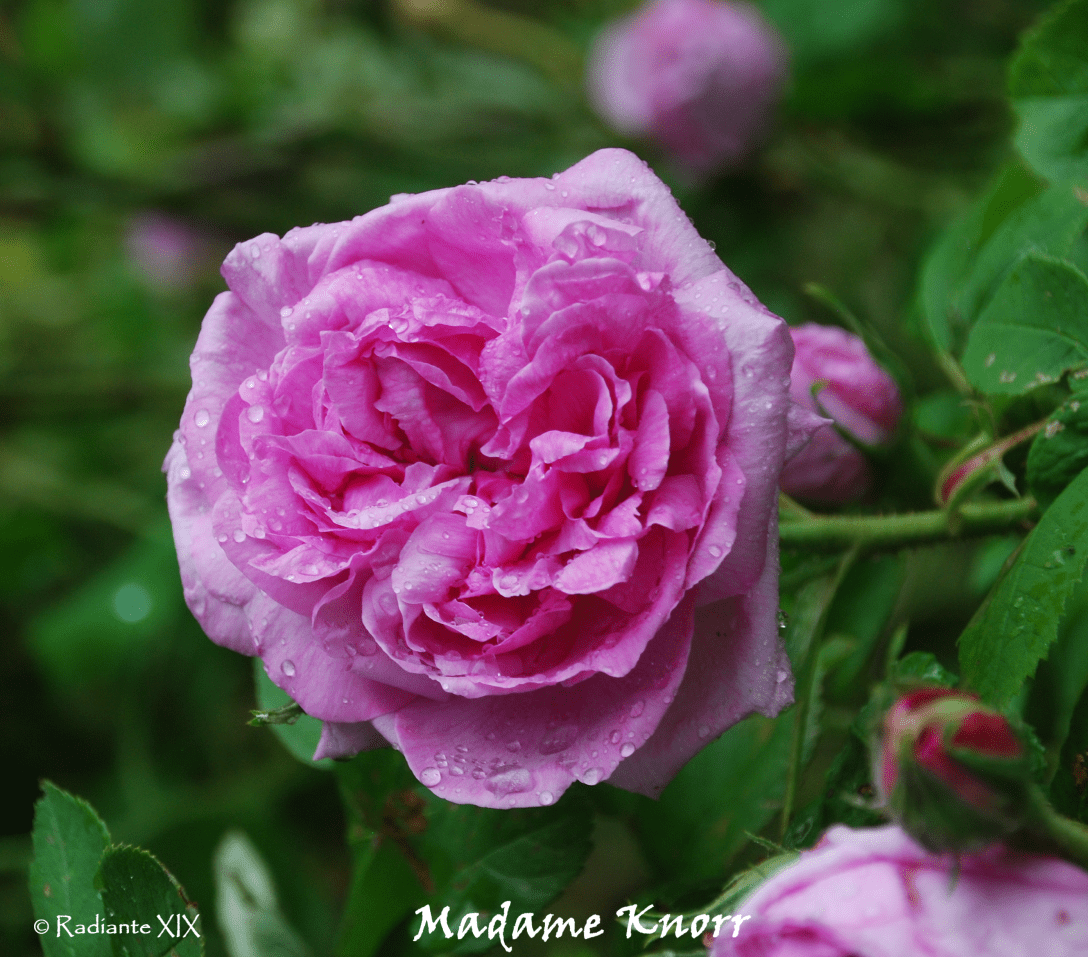
Today’s rose ‘Madame Knorr’ is one of the ‘Portland’ class. Portlands are a small class of roses with obscure origins, perhaps the best known being ‘Comte de Chambord’. The original ‘Portland’ arrived in France via England with the name ‘Rosa portlandica’ and became known as the ‘Duchess of Portland’ It was believed that a Duchess of Portland imported this rose at the time of introduction, 1809. This date places the rose in the lifetime of the third Duchess of Portland who had little interest in gardening. However, the second Duchess Margaret Cavendish Bentinck (1715-1785) was a patron of gardening and grew the rose that later bore her name, pushing the introduction date into France to 1775.

‘Duchess of Portland’ was originally believed to be a Damask x China. DNA analysis disproves ‘Slater’s Crimson China’ as one of the parents, and instead suggests a Gallica/Autumn Damask lineage. The Portland repeat blooming comes from the Autumn Damasks. However, not every Portland gives good repeat blooms

‘Madame Knorr’ was bred by Victor Verdier in Paris and was introduced in 1855 at a time when the Portland roses were sliding out of fashion as their descendants the Hybrid Perpetuals became popular.  Although photographed on a wet June day last summer she was a handsome rose. Small bright buds unfurl to a large silvery pink bloom. Short necked so the blooms nestle into the foliage. A darker centre with pale backed petals always gives such an attractive picture. Very fragrant even in cool damp conditions. She blooms once with a big flush in June with scattered blooms later.

Who was Madame Knorr? The invaluable website Helpmefind (www.helpmefind.com) has a comment that this rose is possibly named for Henriette Knorr (1828-?) née Ziegenmayer first wife of Carl Heinrich Knorr 1800 -1875, Amalie Henriette Caroline Seyffardt 1806-1867. Carl set up the food company Knorr, now part of the Unilever group.

Excellent disease resistant matt grey green foliage. Makes a small bushy 1m high shrub. The Portlands are tough roses, coping with the cold and intense heat. ‘Madame Knorr’ isn’t listed in the inestimable ‘Growing Roses in Cold Climates,’ (see below re availability). The authors recommend protection for these roses should you grow them to protect as much of the stems as possible. Most authorities give a USDA zone of 6b-9b. If any of you grow her in cooler zones please comment.

‘Madame Knorr’ appears to be widely available in Europe, also Australia, and New Zealand. She appears to be grown in the States but quite how widely I am not sure. Do comment on this point. There are references to her being identical to ‘Comte de Chambord’ aka ‘Madame Boll,’ or rather sold under the wrong name. Comments again are helpful.

An interesting rose, perhaps if I were collecting Portlands I would add her to my garden, but I am just a bit obsessed with my Teas, Chinas, and Pembertons now. Too many roses and too little time!

Initially published on 5th February 2022 on my Facebook blog Rose of the Day.

‘Autumn Delight’ delights in the summer as well.

A two part post today. First, we will look at a rose, and secondly a cultivation method.

The rose is another attractive Hybrid Musk (HM) ‘Autumn Delight’. Bred by John Bentall, Joseph Pemberton’s assistant, and introduced in 1933. The parentage is unknown, but she has all of the hallmarks of the earlier HM roses bred by Joseph himself.

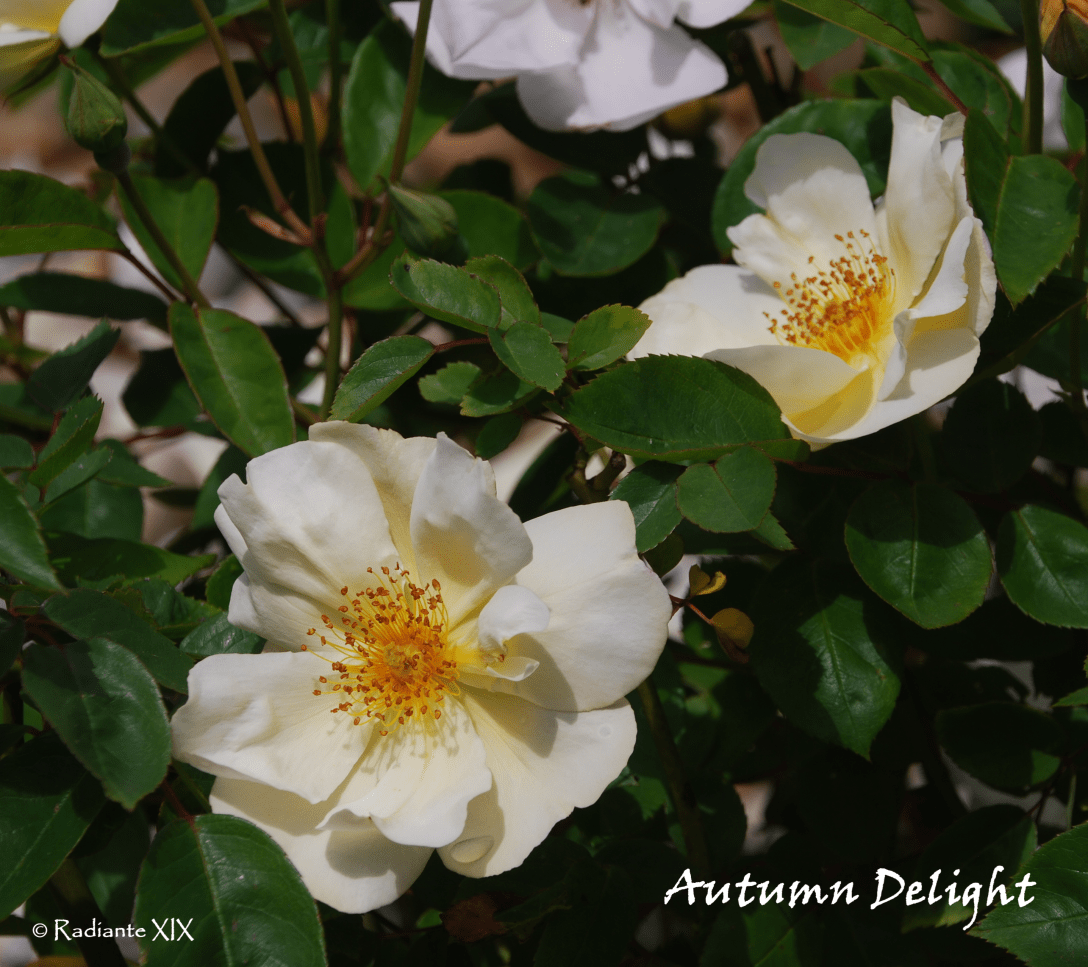
Long pointed buttery yellow apricot buds streaked with strong pink appear in clusters.  Opening to a large creamy single bloom that fades to white whilst retaining a glowing lemon petal base. The lemon glow enhances the long golden stamens, a delight certainly for all bees and pollinating insects. A long lasting bloom as well. She has the signature ‘musk’ perfume that lifts from the blooms to drift across the garden. As with the other HM roses, she gets better and better as the summer turns to autumn, becoming a real autumn delight with large clusters of bloom. No hips though which is a bit of a disappointment.

Exceptionally healthy with good dark foliage, ‘Autumn Delight’ will suit a no spray garden. Having visited Pemberton’s house at Havering-atte-Bower in Essex, sandy soil on a chalk ridge, I think you could grow his HM roses on brick rubble. They are tough girls! Around 1.20-1.50m tall and a little wider. You can prune her or just leave her alone. I leave all my HM roses alone other than the removal of an old stem or two in the winter. Hardy USDA zones 6b-10b. The American Rose Society gives her just a miserly 7.1 –‘an average rose’. I feel she is way better than that but perhaps she doesn’t perform well in the States. Comments are welcome on this point.

For me ‘Autumn Delight’ is a rose with more plus points than minus ones. Since writing this post I am happy to say that ‘Autumn Delight’ is part of the National Collection – Rosa (Hybrid Musk intro by Pemberton and Bentall 1912-1939) held here in my garden.

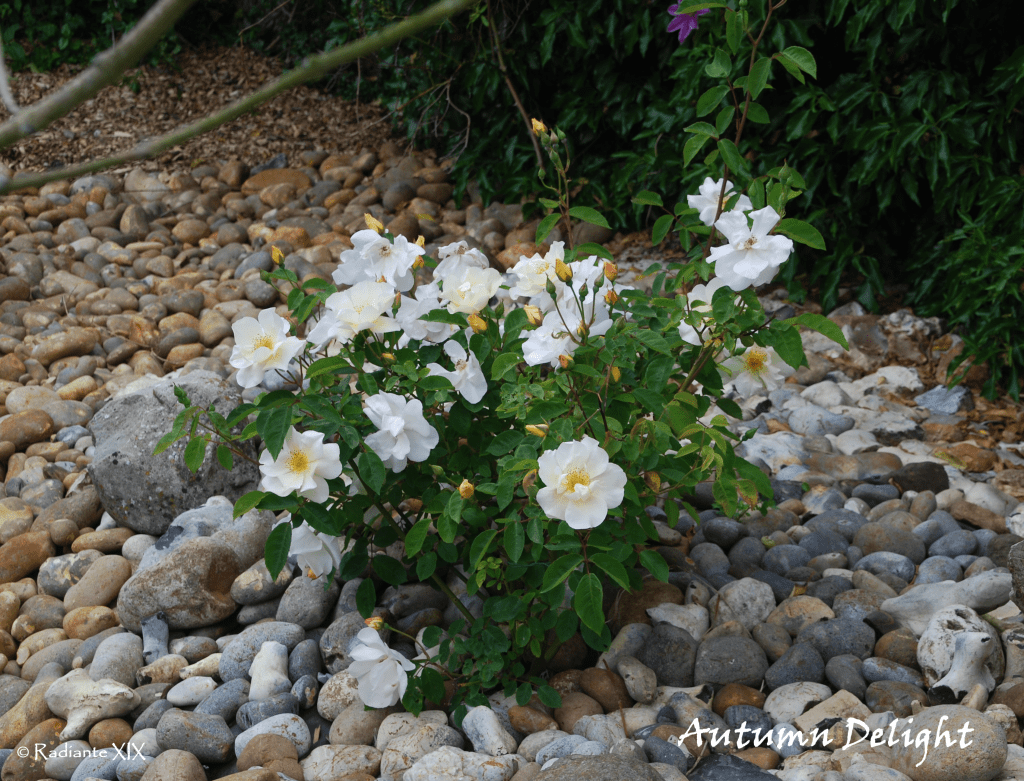
Part two of this post looks at cultivation. The sharp eyed amongst you will have noticed in the photo that ‘Autumn Delight’ appears to be growing in a rock garden. In the first lockdown, I ripped out a carpet of that devilish ornamental nettle Lamium. Yes, it is pretty but invasive. I laid weed matting and created a ‘Zen’ garden of stones with a small birdbath. Initially, I collected large flints from the fields beside the house and carefully arranged them.

Now you would think that a layer of stones is a barren environment. Not a bit of it. There are always small birds on the stones hunting insects. When I move the stones spiders and beetles are everywhere plus a fair number of toads. They have shelter, warmth, and it is damp as well. A perfect habitat for invertebrates and toads. There are also grass snakes here and I see them sunbathing on the stones. Plus of course no damn weeds!

I extended the ‘Zen’ garden last summer to include ‘Autumn Delight’. A fair number of my roses have weed mat with a wood chip mulch around them. This does keep the weeds down but I find weeds will grow happily in wood chip mulch as it degrades. I have now put a ‘stone’ mulch around several roses, and it is easier to strim and clear around these stone mulches. I now buy what is called ‘reject stone’ from aggregate merchants rather than stone picking the fields. Better for my back!

Perhaps not for a small, neat garden but in my rather wild garden these stone mulches work well in that they cut down the workload whilst providing a home for ‘critters’.

This post first appeared on my Facebook blog Rose of the Day on 3rd February 2022

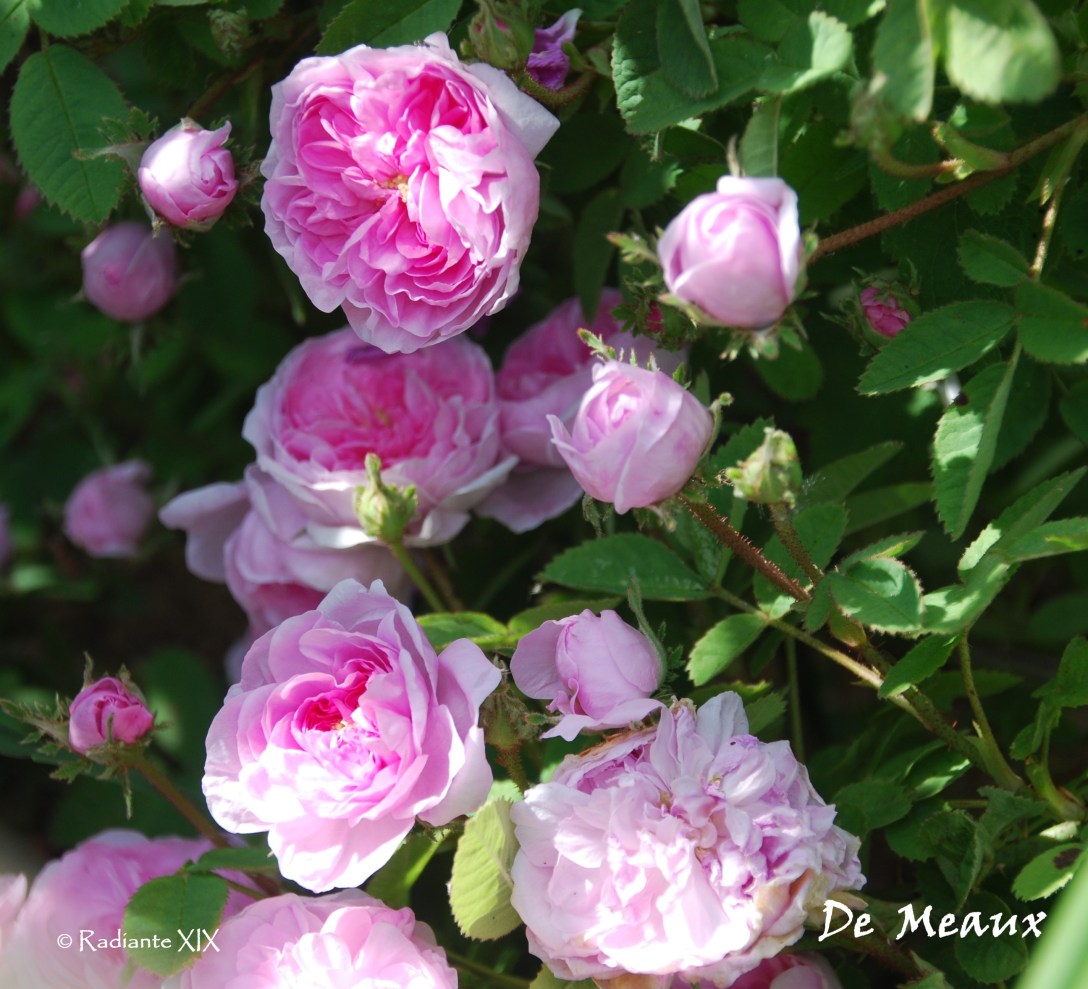
The petite ‘De Meaux’

A move today from the heat loving Tea and Chinas to a small cold hardy rose, the Centifolia ‘De Meaux.’ A rose that looks fragile but actually is as tough as old boots.

Highly suitable for a small garden or large container ‘De Meaux’ will reach around a metre in height on tiptoes. I had to rescue mine as she was swamped by her taller neighbours. She now grows on the edge of a bed with smaller companions although I see that ‘Nozomi’ is stretching new stems towards her. I will confess I moved ‘De Meaux’ last summer immediately after blooming in June. She was only a second season rose with a small root system and we had the wettest June for years, so she happily grew away.

Small fat pink balls wrapped in feathery sepals are the best way to describe the buds of ‘De Meaux.’ These open to a pompom like bloom, mid pink to begin with before fading to pale pink. The tightly packed petals are slightly frilly adding to her charm. These blooms arrive in early summer in clusters, and she gives a lot of bloom. Sweet fragrance typical of the Centifolia group. She is a summer blooming rose, just one glorious flush.

Grey green foliage with red bristly stems. High disease resistance, again typical of the Centifolia group, Most, if not all, of the once blooming roses have excellent disease resistance. They predate the introduction of ‘Rosa foetida’ into rose breeding, a rose that brought the much sought yellow to modern roses but with the penalty of susceptibility to fungal infection. Being a small rose pruning can be restricted to the removal of an old stem or two immediately after blooming in the summer, or you can leave her alone. Should you grow her on her own roots she will spread by throwing up suckers. I have seen her grown as a low hedge as well.

A sport of the prolific ‘Rosa centifolia’, and believed to date from the seventeenth century. From her name, I assume she originated in the town of Meaux, just outside Paris. You will find her listed in most nurseries as ‘De Meaux’ but like a lot of very old roses, she has several aliases. The word pompom occurs in a fair number of them. Widely available. Hardly USDA zones 4b-9b. Listed in the excellent book ‘Growing Roses in Cold Climates’ as hardy to minus 32C (-25F) but some winter protection is advised. The stems are thin so they could be vulnerable in hard frosts.

An undemanding pretty little rose who will charm everyone with her pink pompoms in the attractive grey green foliage.

This post first appeared in my Facebook blog on 26th January 2022

One of the big four:

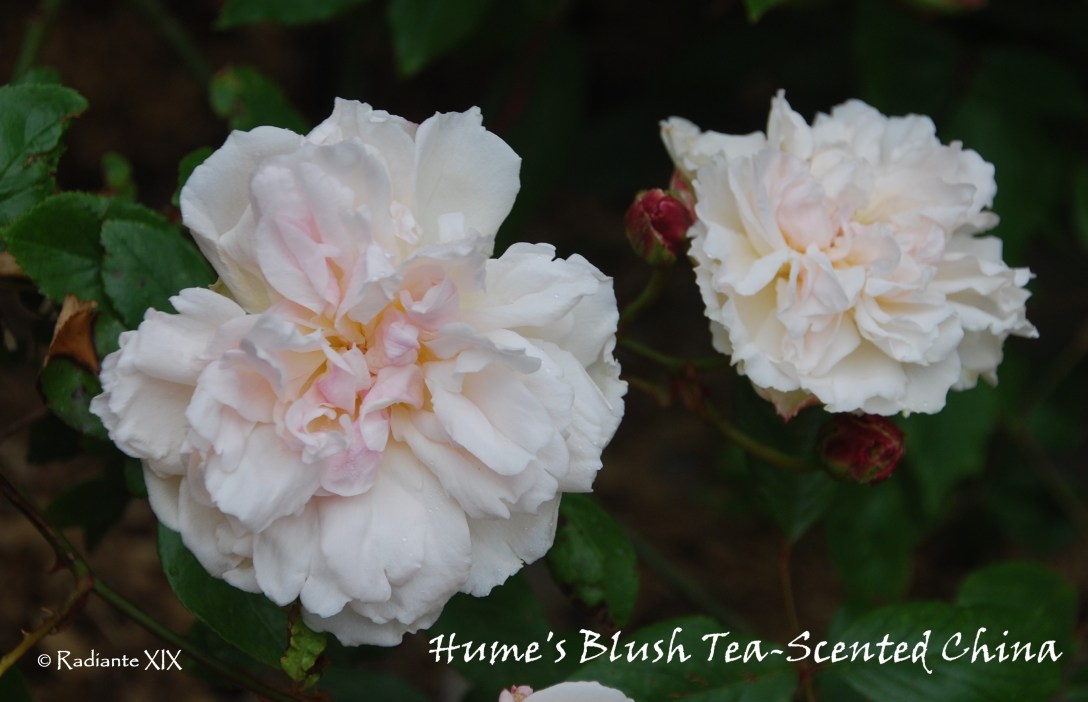
Hume’s Blush Tea-Scented China

There are four ‘stud’ roses; Slater’s Crimson China, Old Blush, Park’s Yellow Tea- Scented China, and Hume’s Blush Tea-Scented China. It was likely that many more were imported from China in the early nineteenth century. European plant collectors fell in love with their fragile fabulously fragranced blooms which appeared repeatedly throughout the year. These roses played a vital role in the development of our modern roses.

Today’s rose is ‘Hume’s Blush Tea-Scented China’, not a name that trips easily from my typing fingers so she is known in my garden as ‘HBTSC.’ Also known as ‘Spice,’ a name she acquired on the island of Bermuda where she can be found growing wild. to complicate the story she is also known as ‘Rosa odorata var. odorata’. Just a small caveat here though. The rose, or roses sold today as ‘HBTSC’ may not be the original introduction. There is disagreement over her identity, to put it mildly.

Introduced by Sir Abraham Hume, 2nd Baronet, of Wormleybury, Hertfordshire in 1809. Sir Abraham’s family was heavily involved in the building of ships principally for the East India Company. Sir Abraham had many interests, collecting paintings, diamonds, and plants. ‘HBTSC’ was one of the plants collected by the East India Company’s inspector for Tea in Canton John Reeves for Sir Abraham and brought back to Britain.  Indeed, John Reeves sent back azaleas, camellias, chrysanthemums as well as roses to Britain on the East India Company’s ships. We are in his debt for the many plants that now grow in our gardens.

This rose is reputed to be one of the roses allowed through the Naval blockade of the Napoleonic wars to travel to the garden of Empress Josephine at Malmaison in 1811. (I am in the middle of the exasperating post Brexit business of importing roses from France to the UK. I wonder if Josephine had any tips I can use to smooth their passage?)

‘HBTSC’ does indeed blush. Her buds are a strong pink, increasingly streaked white as they open to a large pale pink bloom. In strong sunlight, the blooms quickly blanch to white whilst retaining a ‘blush’ at the petal bases. A strong perfume that improves with direct sunlight and heat. This is a rose that doesn’t sleep in Zone 8. She has copious continuous blooms in the summer. Slows a little in the winter but always a bloom or five somewhere in the winter.

Rather sprawling in growth habit and not too large around a metre high but often much wider. Mine is against a warm sheltered wall where she lolls gracefully.  Foliage is typically a little sparse, with attractive red tinted new growth. Some thorns and prickles. Very disease resistant, no black spot or downy mildew. Hardy USDA zone 7b and warmer. Widely available.

I think ‘Hume’s Blush Tea-Scented China’ is a rose that should be more widely grown. Not just for her importance as a progenitor of the modern rose, she is completely undemanding and very easy to grow. Needs very little pruning, Chinas don’t like it. Ideal for those with a busy lifestyle. Grow her as she will give you a bloom almost every day of the year. What more can you ask of a rose?

This post first appeared in my Facebook blog on 22nd January 2022