The format of posts for this blog is usually a rose, together with a description and cultivation notes, plus the back story of the name. Today I confess to not having the rose at all as it seems to have drifted to extinction, and not left a photograph behind to charm everyone. It is the story of the namesake that I wish to tell you.
Three weeks ago, we had the elegant ‘Mrs Oakley Fisher’ named for one of the first three women elected to the board of the National Rose Society. Today it is the turn of Dora, the wife of Hayward Radcliffe Darlington, the president of the National Rose Society.
Dora’s rose ‘Mrs H.R. Darlington’ was introduced in 1919 by Samuel McGredy II. A Hybrid Tea described as having cream yellow blooms, being free flowering, and very vigorous. In Australia, the colour was more towards a clean white. She sounds stunning, with large petalled well shaped blooms that could reach nine inches (23 cm) across. I suspect some exaggeration there, but she was noted for large perfect blooms. Recommended for both garden and exhibition use. Her faults were a tendency to ball, burn in the sun, and not transplant too easily. One could say the same of a lot of white and pale coloured roses. Reading through the literature available ‘Mrs H.R. Darlington’ appears to have been more popular in Australia. She was regarded purely as an exhibition rose in the UK.
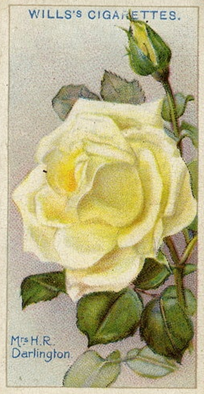
The picture is one from the W.D. & H. O. Wills cigarette cards No 41- 1926 which indicates the popularity of ‘Mrs H.R. Darlington’. The reverse of the card reads: ‘(No 41) MRS H.R. DARLINGTON (Hybrid Tea) A perfect white rose. The flowers are large, well formed, sweetly scented, and of considerable substance. It is a free grower, with dark green leathery foliage, and is very beautiful in the autumn, and suitable for almost any situation. Should be pruned to within three or four “eyes” during March. Introduced in 1920 and awarded the Gold Medal of the National Rose Society.’
Should you have wished to grow this rose in 1922 Daniel Bros. Ltd of Norwich sold her for 2s 6d – half a crown – (around £7 today). In the same year, Frank Cant & Co. sold her for 5s.
Browsing old rose catalogues is a lot of fun if slightly time wasting. Most catalogues include hundreds and hundreds of roses in contrast to the rather limited selection we are offered today. One sees a lot of old favourites still grown today but a vast number have gone to the great compost heap in the sky. I wonder if ‘Mrs H.R. Darlington’ is still grown in Australia? Perhaps someone can comment on this? I see there is some discussion concerning an identification mix up with another rose ‘’Mrs. C. Lamplough’.
~~~~~~~~~~~~~~~~~~~~~~~~~~
And of Dora herself? Born Dora Hill in 1863 in Wolstanton, Staffordshire into a wealthy family. Her father John Sherriff Hill came from a Scottish merchant family trading in coal. Following a trip to Australia for health reasons he became involved in Australian trading and shipping. Dora was educated at West Heath school in Surrey.
After the death of Dora’s mother, John Sheriff Hill remarried, and the family moved to St Albans. They lived in Hawkswick a large house built for the brewing family Fearnley Whittingstall. There Dora lived the life typical of a well to do Victorian daughter supporting charitable functions such as an amateur concert to raise funds for the renovation of the church tower. I found she won £2 in a Morning Post competition in 1868, no details of this other than the title ‘Psalms’. Perhaps guessing from which Psalm, a particular line came from? This was an age where a good religious education formed a large part of education.
In January 1890 Dora married the barrister Hayward Radcliffe Darlington. It sounded like a magical wedding as the outdoor Chinese lanterns were hung in frosted trees and shrubs at the groom’s family home Bourton Hall. Typically, the entire wedding present list appeared in the press, with presents ranging from diamond jewellery to a hand embroidered tray cloth. From browsing this I can see the newlyweds had a surfeit of silver salt cellars. I can imagine elderly spinster ladies shaking open the paper and commenting on who gave what, perhaps some of the gifts might have been considered a little mean. After the wedding, the honeymoon was taken in a chilly Torquay.
Hayward Radcliffe Darlington had a great interest in horticulture. An expert on narcissus and roses, he went on to become president of the National Rose Society. He wrote extensively, both books and articles, his 1911 book ‘Roses’ is available online. Dora followed this literary trend with articles such as ‘Colour Grouping in the Rose Garden’ and ‘Roses and Rain’ both of which appeared in the NRS Annual.
Unlike Florence Oakley Fisher Dora does not seem to have been a competitor in rose and horticultural shows. Press mentions include unrelated interests; Dora was the honorary secretary to the Potters Bar Navy League. Her father had been a shipowner so perhaps this isn’t to be unexpected. The most amusing press mention was from October 1901 when both Hayward and Dora were fined 1s with 9s costs for reading their horses on a footpath. A trifle awkward for a barrister I would imagine.
Dora’s rose has faded into obscurity, but I think as one of the first three first female members of the NRS council Dora should be remembered today. Perhaps a rose breeder has a candidate rose for ‘Dora Darlington’?
Comments welcome as always. If you can add to Dora’s story that would be great. Also, comment if you know of ‘Mrs H.R. Darlington’ still growing somewhere, or perhaps you remember this rose from the past?
First published on my Facebook blog Rose of the Day on 12th March 2022

 Rose of the Day