
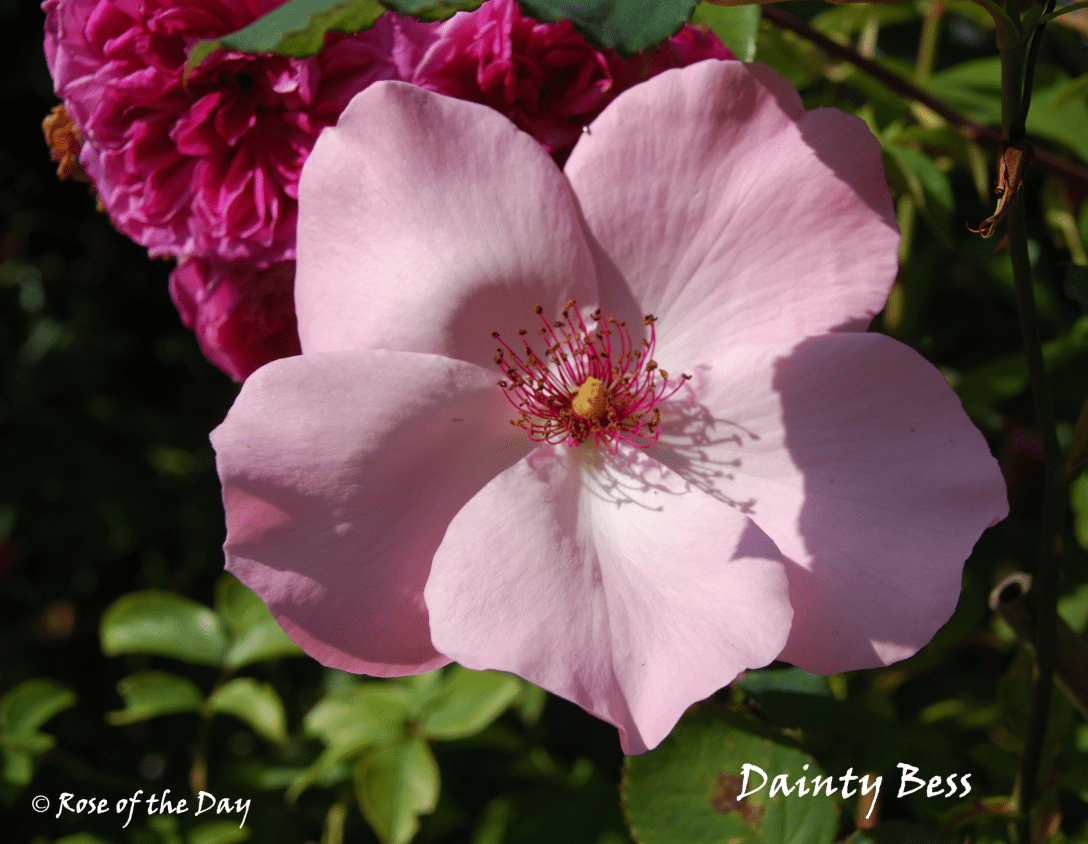
A look at a rose and her creator. Today we have ‘Dainty Bess’ and the Kent based rose breeder W.E.B. Archer & Daughter. Not so much seems to be known about William Archer and his daughter Muriel so I indulged in a bit of research, and uncovered a few long hidden facts. These rather forgotten rose breeders deserve attention.
Early Hybrid Tea roses have often drifted off to the big compost heap in the sky. Those that remain in commercial cultivation have qualities that make them worthy roses for any garden. I have a fondness for single roses and this rose is one of the better known – ‘Dainty Bess.’
Elegant, pointed carmine pink buds unfold into a large single bloom. Fluted and ruffled petals of pale pink with slightly darker backs. The crowning glory of this rose, probably the reason for her continuing popularity is her crown of unlevel reddish yellow filaments tipped with golden stamens surrounding a bright yellow stigma. Each bloom has a slightly different crown, which adds to her charm. Long stems carry these attractive blooms in clusters up above the foliage. Repeat blooms exceptionally well, she is almost continuously in bloom throughout the summer. Great fragrance as well, sweetly light.
A small rose, she is only just over 1m high. There is a climbing variety as well introduced in 1935, growing to around 3m but does not bloom quite as continuously as this bush variety. ‘Dainty Bess’ would be great in a large container, a pair on either side of your front door would be very special. Some reports of black spot late in the summer, but she is so lovely you can forgive these minor faults. USDA zone 4b-9b. Widely available.
~~~~~~~~~~~~~~
W.E.B. – William Edward Basil Archer led me on a merry dance through the archives. Baptised William Edward Archer he added Basil later and at one point used Basil as his first name. Name changes always hinder research!
William was born in Horton, Bradford, Yorkshire in 1861. His father, also William, is listed as a cabinet maker in 1851, Later, according to the census of 1861, he was an upholsterer employing six boys. William Edward followed his father’s trade as he is described as a furniture designer in the 1901 census when he is living with his wife Bessie and daughter Muriel Gertrude in Finchley, Middlesex. I found him again in 1911 eventually under the name Basil Archer in Coulsdon, still listed as a furniture designer and living with Bessie, Muriel, and his sister Francis. William appears to have been a successful designer of furniture, this area of Surrey is affluent now, and it was the same in 1911. It would be good to find his employer but no luck yet.
Between 1915 and 1918 William and the family moved to The Gables, Monks Horton in Kent. Sadly in 1920, his wife Bessie dies. I guess that by this time William has retired from furniture design, and begins to dabble in rose breeding.
In June 1924 for the first time, William takes one of his roses to the National Rose Society summer show. A rose he has produced from crossing the hybrid tea ‘Ophelia’ with the red hybrid tea ‘Kitchener of Khartoum.’ This new rose proved to be an instant success in winning a gold medal, the first awarded to an amateur rose grower in ten years. The Westminster Gazette reports that an expert valued the rose at several hundred pounds. This rose was ‘Dainty Bess’ named for William’s wife.
William’s amateur rose breeding soon turned into a business – W.E.B. Archer and Daughter. Muriel undertook the secretarial duties for this business, I do not know to what extent she was involved with the actual hybridising. In 1927 they took the Daily Mail cup together with 250 guineas (equivalent to around £15,500 today) for the best new scented seedling rose. A red Hybrid Tea, again William used ‘Kitchener of Khartoum’ as the pollen parent, which went on to be named ‘The Daily Mail Scented Rose.’
William and Muriel produced twenty eight roses between 1924 and 1940. The elegant ‘Dainty Bess’ and her refined daughter ‘Ellen Willmott’, together with ‘The Daily Mail Scented Rose’ and the climbing sport of this rose, and ‘Bonnie Jean’ remain in commercial cultivation. All of William and Muriel’s roses were introduced to Australia by Hazlewood Brothers. There may be some of the other varieties remaining there in cultivation, or at least growing in someone’s garden. Alas, all too many good roses fall out of fashion and fade to extinction.
It seems that the demands of growing food rather than flowers in WWII closed the business, although William was by this time 80 years old. He died in 1950 followed by Muriel, who had never married, two years later. In the short space of sixteen years, they produced roses of timeless beauty. One is left to consider what William could have done if he had been born into a nursery business rather than the furniture trade. I wonder if his furniture was as good as his roses?
This article first appeared on my Facebook blog on 19th February 2022.

 Rose of the Day