
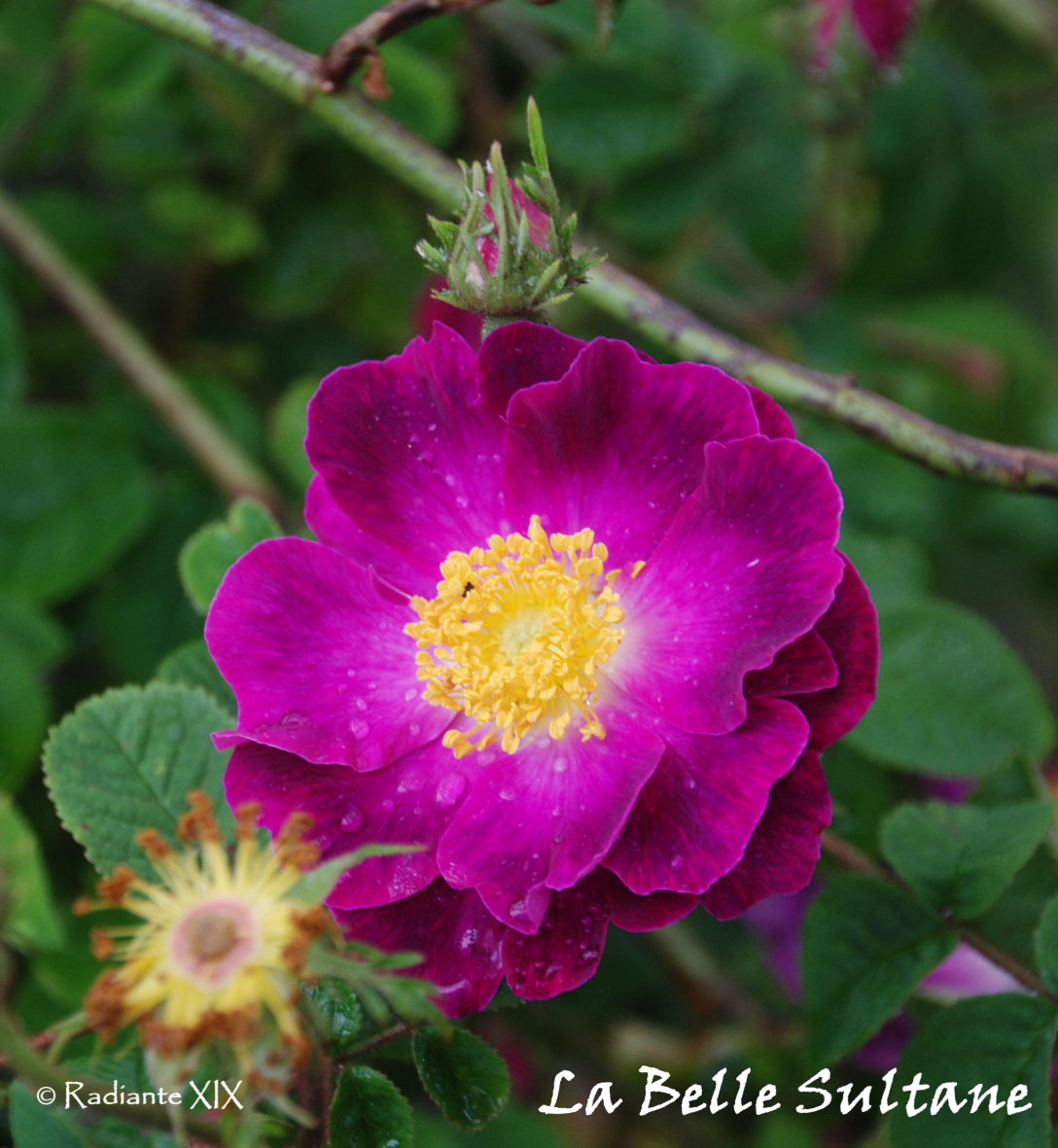
I am sure everyone wants to grow a rose that not only looks stunning but provides sustenance for pollinating insects. Today’s rose does both beautifully, the Gallica rose – ‘La Belle Sultane.’
This is a rose that stops you in your tracks. The colour, those dark purple, violet, crimson, and maroon tones highlighted by the white petal base and crowned with vivid golden yellow stamens. A velvet like texture, silk velvet of course, to the petals. I am fond of Tuscany Superb, but I think ‘La Belle Sultane’ has the edge. Fat little buds with feathery sepals open to this semi double beautiful queen rose, an apt name if ever there was one. Strong perfume as well, typical of the Gallica family. She blooms just once in June with a flood of blooms.
Tall arching stems, around 1.5 m and about the same in width. Can be larger in warm climates. Stems covered in red bristles but still prickly. A crop of round red hips will appear in the autumn. Exceptional disease resistance, falling into the 0-5% category in the 1998 Montreal Botanic Garden survey on rose disease. Easy to grow and tolerant of poor cultivation. Hardy USDA zones 4b-8b. Scoring an 8.4 in the American Rose Society 2022 handbook, – ‘A very good to excellent rose, one recommended without hesitation.’
Believed to originate from the Netherlands in the 1700s but was introduced by Dupont around 1811. She does have several names – ‘Gallica Meheca,’ ‘Aigle Rouge,’ and ‘Violacea.’ Some debate whether ‘Violacea’ is a different rose. However, you are likely to find her as ‘La Belle Sultane’ rather than her alternatives. Widely available.
Bees and other insects dependent on pollen will flock to this rose, likewise your friends when they visit you on those long hot June days.
First published 12th January 2022 on my Facebook blog Rose of the Day

 Rose of the Day